Guides
The Complete Custom Bag Ordering Process for New Zealand Businesses: From Concept to Delivery
Master the 7-stage custom bag ordering process for NZ businesses. From initial consultation to delivery—avoid costly mistakes with our expert procurement guide covering materials, artwork, samples, and compliance.
Published · By KiwiBag Works Team
Expert Quick Answer
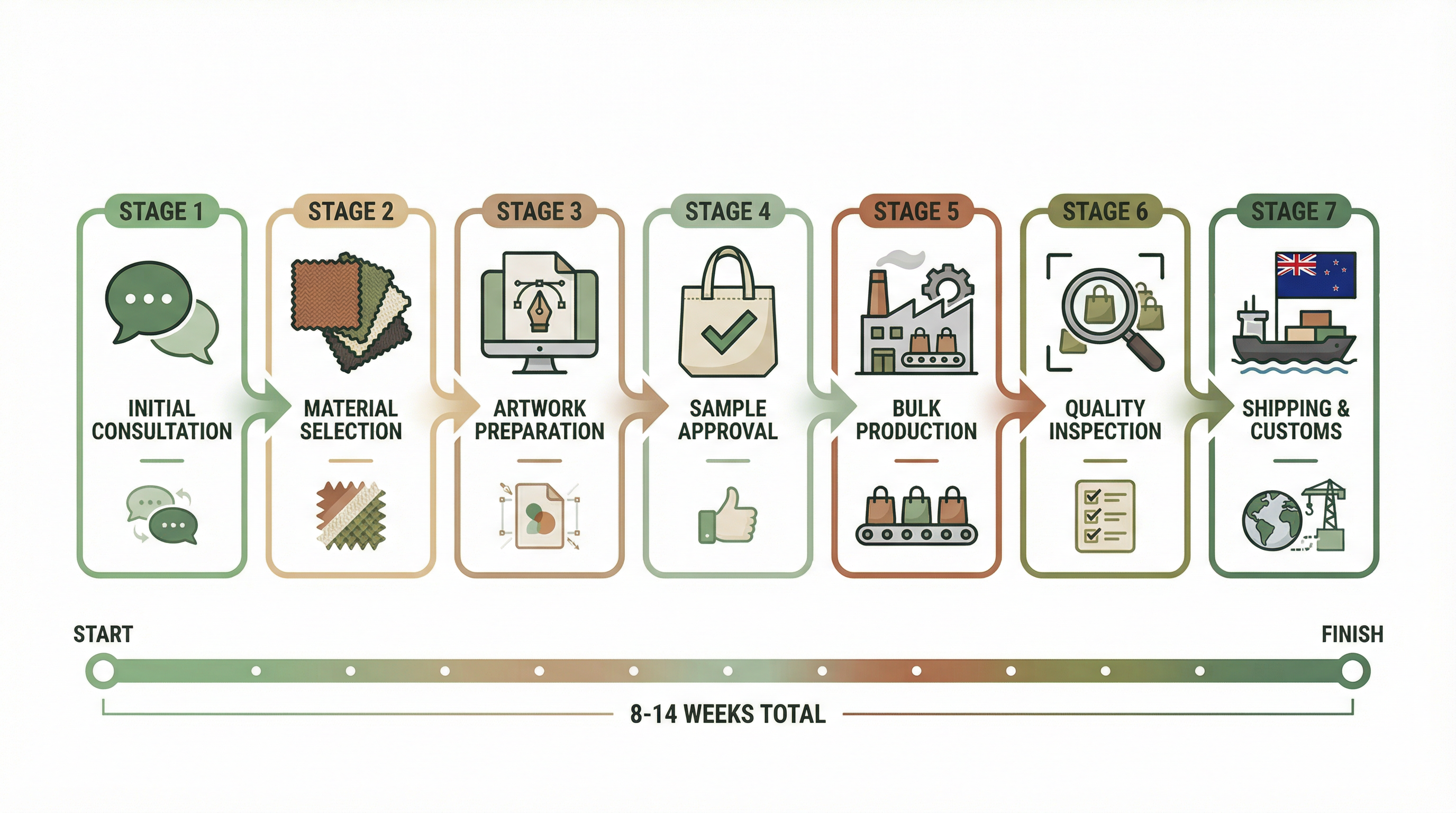
The custom bag ordering process for New Zealand businesses typically involves seven key stages: initial consultation and requirements definition, material and style selection, artwork preparation and approval, sample production and sign-off, bulk production, quality inspection, and shipping with customs clearance. For most orders, this process takes 8-14 weeks from initial enquiry to delivery in New Zealand. The critical success factors are providing print-ready artwork files, understanding minimum order quantities (typically 100-500 units depending on complexity), and building realistic timelines that account for sample revisions, production schedules, and international shipping. New Zealand businesses must also factor in GST on imported goods and potential MPI biosecurity inspections for natural fibre products like jute and cotton.
Why Understanding the Custom Bag Process Matters for New Zealand Businesses
For New Zealand businesses investing in custom branded bags, the ordering process represents far more than a simple transaction. It is a strategic decision that affects three critical business dimensions: budget allocation, brand representation, and regulatory compliance.
From a budget perspective, the custom bag procurement process contains numerous variables that can significantly impact final costs. We have seen businesses underestimate their total investment by 20-40% because they failed to account for sample fees, artwork preparation costs, freight charges, and GST on imported goods. Understanding each stage of the process allows procurement teams to build accurate budgets and avoid the uncomfortable conversation with finance when invoices exceed initial estimates. For a detailed breakdown of where costs accumulate, our analysis of hidden costs in custom bag procurement provides essential context.
Brand representation depends entirely on process execution. A poorly managed customisation project can result in colour mismatches, logo distortions, or material quality that undermines rather than enhances brand perception. In our experience helping New Zealand businesses source custom bags, the difference between a successful project and a disappointing one almost always traces back to decisions made during the early stages of the ordering process—particularly around artwork specifications and sample approval.
Compliance considerations are particularly relevant for New Zealand businesses. The Ministry for Primary Industries maintains strict biosecurity requirements for imported goods, and natural fibre products like jute, cotton, and canvas bags can trigger inspection and treatment requirements. Understanding these requirements before placing orders prevents costly delays and unexpected fumigation charges at the border.
The Seven-Stage Custom Bag Ordering Process for NZ Businesses
The journey from initial concept to branded bags in your warehouse follows a structured sequence. Each stage builds upon the previous one, and shortcuts at any point typically create problems downstream.
Stage 1: Initial Consultation and Requirements Definition
The process begins with clarifying exactly what you need. This sounds obvious, but in practice, this is where many projects start to go wrong. Vague briefs lead to misaligned expectations, and misaligned expectations lead to costly revisions.
During this stage, you should define the bag type (tote, drawstring, cooler, backpack), intended use case (retail, events, corporate gifting), target quantity, budget parameters, and delivery timeline. For New Zealand businesses, it is worth noting that our geographic isolation means shipping times are longer than for businesses in Asia, Europe, or North America. A realistic timeline expectation is essential from the outset—our comprehensive guide to custom bag production timelines explains what affects delivery dates.
Stage 2: Material and Style Selection
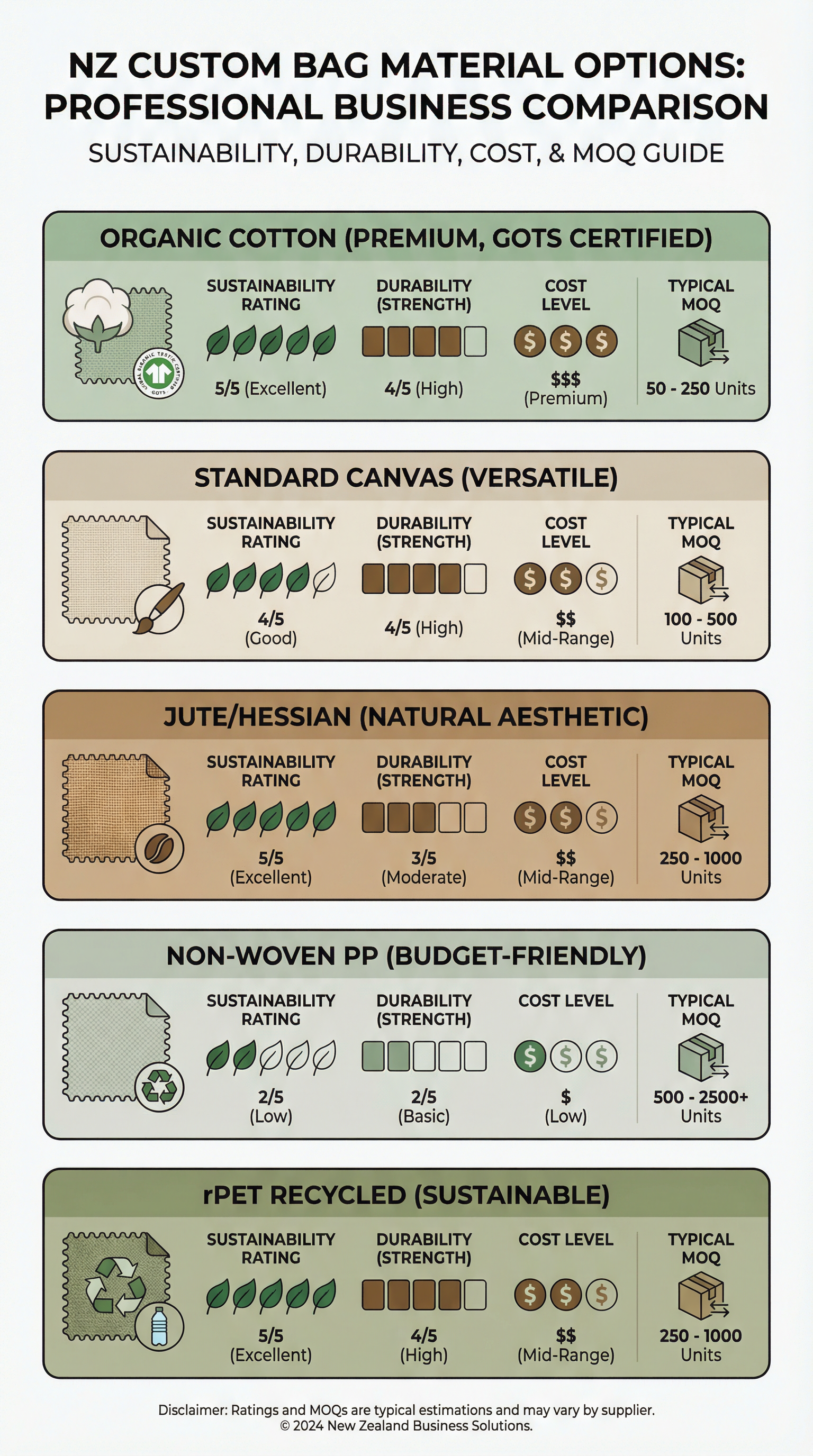
Material selection determines durability, appearance, environmental credentials, and cost. The most common options for New Zealand businesses include organic cotton (premium positioning, GOTS certification available), standard cotton canvas (versatile, cost-effective), jute and hessian (natural aesthetic, excellent for retail), non-woven polypropylene (budget-friendly, lightweight), and rPET recycled polyester (sustainability story, durable).
Each material has different printing compatibility, minimum order requirements, and lead time implications. For detailed guidance on material trade-offs, see our comparison of cotton, canvas, jute, rPET and non-woven bags.
Stage 3: Artwork Preparation and Approval
Artwork quality is the single most controllable factor in determining final product quality. We consistently observe that projects with professional, print-ready artwork proceed smoothly, while projects with inadequate artwork files experience delays, additional costs, and disappointing results.
Print-ready artwork requirements include: vector format files (AI, EPS, or PDF with outlined fonts), Pantone colour references for accurate colour matching, minimum 300 DPI resolution for any raster elements, clear indication of print position and dimensions, and separate files for multi-colour or multi-location printing.
For businesses without in-house design capability, most suppliers offer artwork assistance, but this typically adds 3-7 days to the timeline and may incur additional fees. Our guide on preparing artwork files for custom bag printing covers best practices for logo placement and colour selection.
Stage 4: Sample Production and Approval
The sample stage is your opportunity to verify that the final product will meet expectations before committing to bulk production. This stage typically takes 7-14 days and involves producing one or more physical samples that demonstrate material quality, construction, print quality, and overall appearance.
Sample approval is a critical checkpoint. Once you approve a sample and authorise bulk production, changes become extremely costly or impossible. We advise clients to evaluate samples carefully, involve all relevant stakeholders in the approval decision, and document any concerns before signing off. For insights into how sample delays affect overall timelines, see our analysis of sample approval timing impacts.
For complex projects or first-time orders with a new supplier, requesting a pre-production sample (before bulk) and a production sample (from the actual production run) provides additional quality assurance.
Stage 5: Bulk Production
Production timelines vary based on order quantity, bag complexity, print method, and factory capacity. Typical production windows range from 2-4 weeks for standard orders to 6-8 weeks for complex or high-volume orders.
During production, communication with your supplier is essential. Reputable suppliers provide production updates and may share in-process photographs. Any concerns should be raised immediately—addressing issues during production is far easier than resolving them after completion.
Stage 6: Quality Inspection
Quality control occurs at multiple points: incoming material inspection, in-process checks during production, and final inspection before shipping. For New Zealand businesses importing from overseas manufacturers, the final inspection is particularly important because returning defective goods is impractical and expensive.
Options for quality assurance include supplier self-inspection (standard), third-party inspection services (recommended for large orders or new suppliers), and video inspection calls (increasingly common, cost-effective verification). Our article on quality control inspection timelines explains how this stage affects delivery schedules.
Stage 7: Shipping and Customs Clearance
The final stage involves transporting finished goods from the factory to your New Zealand location. This typically involves sea freight (3-5 weeks from China, the most common manufacturing origin) or air freight (5-10 days, significantly more expensive).
New Zealand customs clearance adds additional time and requires accurate documentation. For natural fibre products, MPI biosecurity inspection may be required, which can add 1-14 days depending on inspection outcomes. Understanding these variables is essential for realistic delivery planning—our detailed analysis of customs clearance timing provides comprehensive guidance.
Critical Decision Factors That Determine Project Success
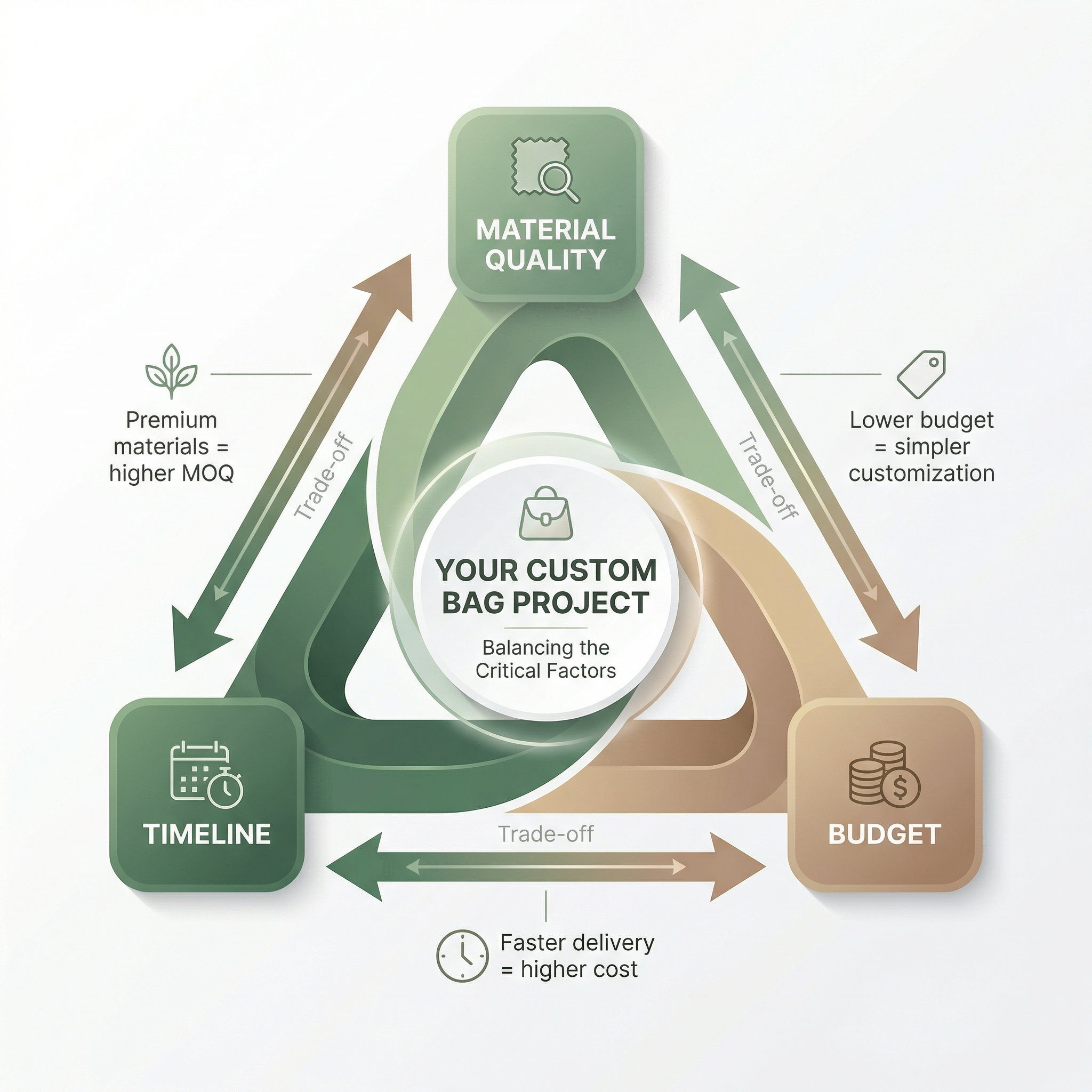
Three interconnected variables determine the outcome of any custom bag project: material selection, customisation complexity, and timeline requirements. Understanding the trade-offs between these factors enables better decision-making.
Material vs. Cost Trade-offs: Premium materials like organic cotton and genuine leather command higher prices but deliver superior brand perception and durability. Budget materials like non-woven polypropylene cost less but may not align with sustainability messaging or premium brand positioning. The right choice depends on your specific use case and audience expectations.
Customisation Complexity vs. Timeline: Simple single-colour prints on standard bag styles can be produced quickly and cost-effectively. Complex multi-colour prints, custom bag constructions, or speciality finishes (embroidery, debossing, metal hardware) require longer production times and higher minimum quantities. If your timeline is constrained, simplifying the design may be necessary. Our guide to print method timing helps evaluate production options.
Quality vs. Minimum Order Quantity: Higher-quality production typically requires higher minimum order quantities because premium materials and processes are not economically viable at small volumes. Businesses requiring small quantities may need to accept standard materials or stock bag options with simpler customisation. For businesses navigating these trade-offs, our guide to minimum order quantities provides essential context.
Tailored Strategies for Different Business Scales
The optimal approach to custom bag procurement varies significantly based on business size, order volume, and organisational requirements.
For Startups and Small Businesses (Under 500 Units)
Small-volume orders face inherent challenges in custom manufacturing. Most overseas factories have minimum order quantities of 500-1,000 units, which may exceed small business requirements.
Practical strategies include: seeking suppliers with lower MOQ options (some offer 100-300 unit minimums with adjusted pricing), considering stock bags with simple customisation (screen printing or heat transfer) rather than fully custom production, consolidating orders across multiple events or campaigns to reach economical quantities, and accepting longer lead times in exchange for lower minimum quantities.
For Medium Enterprises (500-5,000 Units)
Medium-volume orders typically access the full range of customisation options and achieve competitive per-unit pricing. At this scale, the focus shifts to optimising quality and managing the process efficiently.
Key considerations include: investing in proper sample approval processes, building relationships with reliable suppliers for repeat orders, considering inventory strategies (ordering larger quantities less frequently), and implementing quality control protocols appropriate to order value.
For Large Corporations and Multinationals (5,000+ Units)
Large-volume procurement introduces additional complexity around compliance, consistency, and coordination.
Enterprise requirements typically include: supplier audits and compliance verification (ethical manufacturing, environmental standards), consistent quality across multiple production runs, coordination with global brand guidelines and regional variations, integration with corporate procurement systems and approval workflows, and documentation for sustainability reporting and CSR communications.
At enterprise scale, the procurement process often involves dedicated supplier relationships, annual framework agreements, and formal quality management protocols.
New Zealand Market Considerations and Compliance Requirements
New Zealand's unique position creates specific considerations that businesses must address when ordering custom bags.
GST and Import Duties: Goods imported into New Zealand are subject to GST (currently 15%) calculated on the CIF value (cost, insurance, and freight). Most finished textile products, including bags, also attract import duties ranging from 0-10% depending on material composition and country of origin. These costs must be factored into budget calculations—a common oversight that creates unwelcome surprises when customs invoices arrive.
Biosecurity Requirements: The Ministry for Primary Industries enforces strict biosecurity controls on imported goods. Natural fibre products (cotton, jute, canvas, hemp) may require inspection and, if contamination is found, treatment or fumigation. While most commercial shipments clear without issue, the possibility of inspection delays should be built into delivery timelines.
Business Culture Considerations: New Zealand business culture values directness, reliability, and relationship-building. When working with overseas suppliers, clear communication of expectations, realistic timeline discussions, and consistent follow-up produce better outcomes than aggressive negotiation or unrealistic demands. Suppliers who understand the New Zealand market and have experience serving New Zealand clients typically provide smoother experiences.
Sustainability Expectations: New Zealand consumers and businesses increasingly expect sustainable practices. Custom bag orders should consider material sustainability (organic, recycled, or responsibly sourced), manufacturing ethics (fair labour practices, safe working conditions), and end-of-life considerations (recyclability, durability, reusability). These factors may influence supplier selection and material choices. Our article on choosing a bag type for corporate gifting provides additional context.
Common Questions About Custom Bag Ordering
How long does the entire custom bag process take?
From initial enquiry to delivery in New Zealand, most custom bag projects take 8-14 weeks. This includes consultation and quoting (1-2 weeks), sample production and approval (2-3 weeks), bulk production (3-5 weeks), and shipping plus customs clearance (2-4 weeks). Complex projects or orders placed during peak seasons may require longer timelines.
What is the typical minimum order quantity?
Minimum order quantities vary by product type and customisation level. Simple printed tote bags may have MOQs as low as 100-300 units. Complex custom designs, speciality materials, or premium finishes typically require 500-1,000 unit minimums. Stock bags with basic customisation often have the lowest MOQ requirements.
Can I get a sample before committing to a bulk order?
Yes, and you should. Reputable suppliers provide pre-production samples for approval before bulk manufacturing begins. Sample fees typically range from $50-200 NZD depending on complexity, and this investment provides essential quality verification before committing to larger expenditure.
What file formats are required for artwork?
Vector formats (AI, EPS, PDF with outlined fonts) are preferred for print production. These formats scale without quality loss and enable accurate colour separation. If vector files are unavailable, high-resolution raster files (300+ DPI, PNG or TIFF format) may be acceptable for some print methods.
How do I ensure colour accuracy?
Specify Pantone colour references rather than relying on digital colour representations. Screen colours vary between devices and do not accurately represent printed output. Pantone references provide a universal standard that manufacturers can match precisely.
What happens if there are quality issues with my order?
Quality issues should be documented immediately upon receipt with photographs and detailed descriptions. Reputable suppliers have quality guarantee policies and will work to resolve legitimate concerns. However, prevention through proper sample approval and quality inspection is far preferable to post-delivery dispute resolution.
Conclusion and Next Steps
The custom bag ordering process, while involving multiple stages and decisions, becomes manageable when approached systematically. Success depends on clear requirements definition, professional artwork preparation, thorough sample approval, and realistic timeline expectations.
For New Zealand businesses ready to begin their custom bag project, the most valuable first step is a detailed consultation that clarifies requirements, establishes budget parameters, and identifies the optimal approach for your specific situation. Whether you need 100 promotional totes for a local event or 10,000 branded bags for a national campaign, understanding the process ensures you achieve results that enhance rather than undermine your brand.
Our team specialises in guiding New Zealand businesses through the custom bag procurement process, from initial concept through to delivery. We invite you to explore our product range and contact us to discuss your specific requirements.
Related Reading: Deep Dives into Customization Decisions
For procurement teams seeking deeper understanding of specific customization variables, these focused analyses explore common decision points:
Artwork File Format Impact
How file format determines print quality before production begins.
Sample Approval Stakeholders
Why single-person approval creates costly blind spots.
Pantone Colour References
How objective colour standards prevent costly reprints.
Quantity Change Hidden Costs
Why late quantity changes erase expected savings.
Print Position Tolerance
Why written tolerance specs prevent quality disputes.
Inner Packaging Specification
How packaging determines final presentation quality.
Lead Time Commitment Timing
Why quotation timing determines actual delivery dates.
Material Certification Documentation
Why certification documents determine market access.
Shipping Terms & Total Cost
Why FOB vs DDP determines true landed cost.
Payment Milestone & Quality Leverage
Why payment structure determines buyer leverage during production.
Handle Attachment & Warranty Exposure
Why handle attachment method determines warranty claims more than fabric weight.
Closure Mechanism & Reuse Rate
Why closure mechanism specification determines bag reuse rate more than branding quality.
Gusset & Base Construction
Why gusset and base construction determines load failure before fabric weight does.
Thread Colour & Brand Consistency
Why unspecified thread colour creates brand consistency failures that no contract can address.
Dimension Tolerance & Usability
Why bags without written tolerance specs arrive unusable for their intended purpose.
Lining Material & Perceived Quality
Why unspecified lining material shapes quality perception more than outer fabric does.
Print Method & Delivery Timing
Why print method selection changes the production timeline.
Artwork Files & Print Quality
Why artwork file format determines the final print result.