Guides
How Long Does It Take to Produce Custom Bags in New Zealand? A Complete Production Timeline Guide
Discover realistic production timelines for custom bags in NZ. Expert breakdown of 2-14 week lead times, from local printing to offshore manufacturing.
Published · By David Ross
Expert Quick Answer
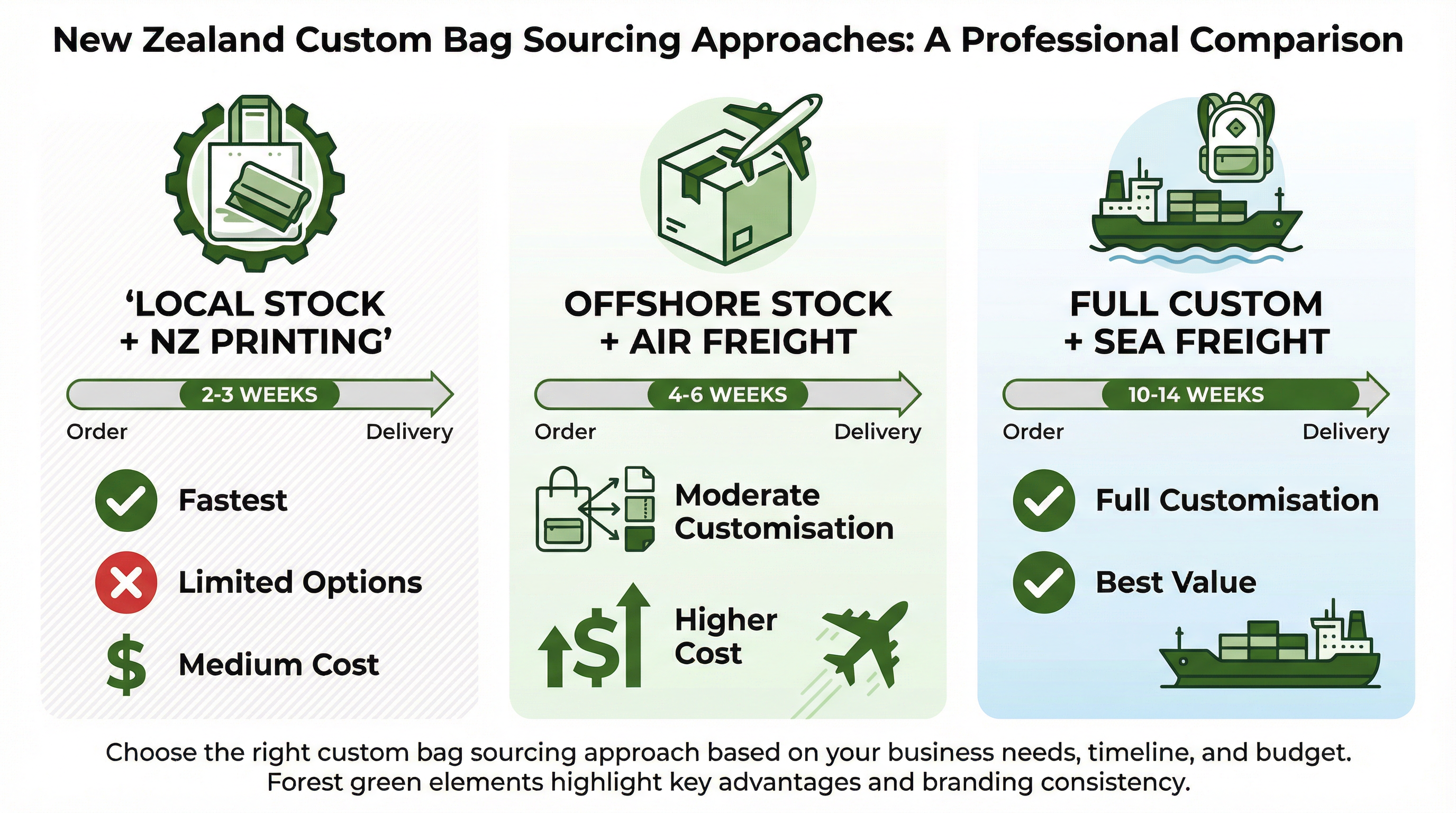
For New Zealand businesses, custom bag production typically takes 2 to 14 weeks, depending on your sourcing approach. Local stock bags with on-shore printing deliver in 2-3 weeks. Offshore custom manufacturing with sea freight requires 10-14 weeks. The critical variables are material type, customisation complexity, and shipping method. The most common mistake NZ buyers make is underestimating the total timeline by 3-4 weeks—forgetting to account for artwork approval cycles, sample iterations, and New Zealand's biosecurity inspection requirements for natural fibre products.
Why Production Lead Time Is a Critical Decision for New Zealand Businesses
Understanding production timelines is not simply a logistics exercise—it directly impacts three fundamental business outcomes that procurement teams must balance carefully.
From a budget control perspective, lead time determines your shipping options. A 14-week timeline allows economical sea freight from Asia at approximately $0.15-0.30 per bag. Compress that to 6 weeks, and you're forced into air freight at $1.50-3.00 per bag—potentially doubling your total landed cost. We have seen marketing teams approve "rush orders" without realising the freight premium alone exceeded their entire printing budget. (For detailed cost analysis, see our guide on the hidden costs of custom bag procurement.)
Brand consistency depends on adequate lead time. When timelines compress, quality compromises follow. Suppliers may substitute materials, skip sample approval stages, or reduce quality control inspection. A corporate client once received 2,000 tote bags with their logo printed 15% smaller than approved because the factory rushed production to meet an unrealistic deadline. The bags were technically "delivered on time" but unusable for their brand standards.
Risk management requires timeline buffers. New Zealand's geographic isolation means supply chain disruptions have amplified consequences. Auckland port congestion, biosecurity holds, and seasonal shipping delays can each add 1-2 weeks to delivery. Procurement teams who build these realities into their planning avoid the expensive emergency measures that come with last-minute scrambling.
The Practical Production Process: What Actually Happens During Those Weeks
Many buyers receive a "6-8 week" quote without understanding what activities occur within that window. Breaking down the production stages reveals where time is consumed—and where delays commonly occur.
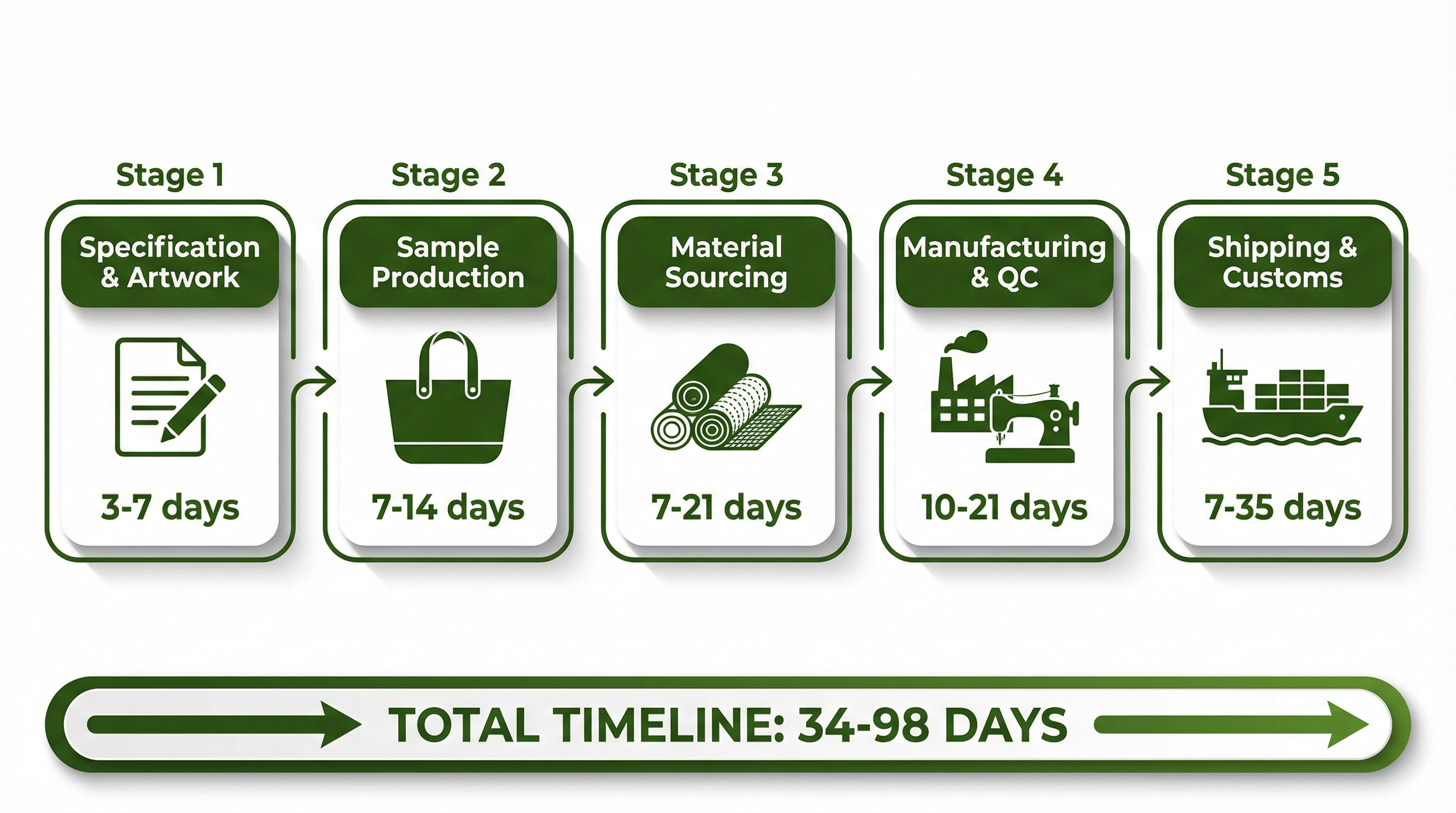
Stage 1: Specification Confirmation and Artwork Approval (3-7 Days)
Before any production begins, suppliers require finalised specifications and print-ready artwork. This stage involves confirming bag dimensions, material weight, handle style, printing method, and colour specifications. In our experience, 40% of timeline delays originate in this stage—not from supplier slowness, but from buyer-side approval bottlenecks.
The practical challenge is that many organisations require multiple stakeholders to approve artwork. Marketing wants to adjust the logo placement. Procurement needs to confirm the material specification. Legal wants to review the sustainability claims on the tag. Each review cycle adds 2-3 days.
NZ-specific consideration: If your bags include Māori design elements or te reo text, ensure you have appropriate cultural consultation completed before this stage. Discovering IP concerns after production begins creates costly delays.
Stage 2: Sample Production and Approval (7-14 Days)
For orders above 500 units or with significant customisation, most suppliers produce a pre-production sample. This physical sample reveals details that digital mockups cannot convey—the actual fabric hand-feel, print colour accuracy, stitching quality, and handle attachment strength.
Sample shipping from offshore manufacturers typically takes 5-7 days via air courier to New Zealand. Add 2-3 days for your team to physically inspect and provide feedback. If revisions are needed, the cycle repeats.
Critical insight: Some buyers skip samples to save time. This is false economy. We have witnessed orders where the "approved" digital mockup resulted in bags with handles attached at the wrong angle—a detail invisible in flat artwork but obvious in physical form. The 10-day sample investment prevented a 2,000-unit disaster.
Stage 3: Material Sourcing and Preparation (7-21 Days)
Even after approval, production cannot begin until materials are ready. Standard materials like 140gsm cotton canvas or basic non-woven polypropylene are typically stocked by established factories. However, specific requirements extend this stage significantly.
Organic cotton with GOTS certification requires batch traceability, often adding 7-10 days for material allocation. Custom Pantone colours require fabric dyeing, adding 10-14 days. Recycled PET (rPET) materials have limited supplier availability, potentially adding 14-21 days during high-demand periods.
The hidden variable: Material preparation is where "quoted lead time" often becomes fiction. A supplier may quote "4 weeks production" assuming materials are available—then discover their fabric supplier is backordered. Experienced procurement teams always ask: "Is this timeline based on confirmed material availability, or assumed availability?"
Stage 4: Manufacturing and Quality Control (10-21 Days)
Actual production time depends on order quantity, bag complexity, and factory capacity. A straightforward cotton tote with single-colour screen print might require 10-12 days for 1,000 units. A structured cooler bag with multiple compartments, zippers, and full-colour digital printing could require 18-21 days for the same quantity.
Quality control adds 2-3 days minimum. Reputable suppliers conduct inline inspection during production and final inspection before packing. For orders destined for New Zealand, suppliers familiar with our market also check for biosecurity compliance—ensuring natural fibre products are free from contamination that could trigger MPI holds.
Stage 5: Shipping and Customs Clearance (7-35 Days)
This stage shows the most dramatic variation—and is where NZ buyers most frequently miscalculate.
Sea freight from China to Auckland: 18-25 days sailing time, plus 3-5 days port handling and customs clearance. Total: 21-30 days under normal conditions. During peak season (September-December), add 5-10 days for port congestion.
Air freight from China to Auckland: 3-5 days transit, plus 2-3 days clearance. Total: 5-8 days. Cost premium: 5-10x sea freight rates.
Biosecurity inspection: Natural fibre products (cotton, jute, hessian) may be selected for MPI inspection. This adds 2-5 days and inspection fees of $80-200. Products with visible contamination (seeds, plant material, insects) face fumigation requirements or rejection.
Key Factors That Determine Your Specific Timeline
Not all custom bag orders follow the same timeline. Understanding which factors apply to your situation helps you plan accurately.
Material Selection and Timeline Impact
| Material Type | Typical Additional Time | Key Consideration |
|---|---|---|
| Standard Cotton Canvas | Baseline | Widely stocked, fastest option |
| Organic Cotton (GOTS) | +7-14 days | Certification requires batch allocation |
| Jute/Hessian | +3-7 days | Biosecurity inspection likely |
| Recycled PET (rPET) | +10-14 days | Limited supplier availability |
| Non-Woven PP | Baseline | Fastest for large volumes |
| Custom Dyed Fabrics | +10-14 days | Dyeing process required |
The trade-off explained: Organic and recycled materials align with sustainability goals but require longer lead times. If your event has a fixed date, you may need to choose between material preference and timeline certainty. (For material comparison details, see our guide on organic cotton for corporate branding.)
Customisation Complexity and Timeline
The relationship between customisation and lead time is not linear—certain features create disproportionate delays.
Screen printing adds minimal time for 1-2 colours but requires screen production ($50-150 per colour). Each additional colour adds setup time. Four-colour printing typically adds 2-3 days versus single-colour.
Digital transfer printing enables full-colour, photographic-quality prints without per-colour setup costs. However, the transfer application process is slower, adding 3-5 days for orders above 500 units.
Embroidery requires logo digitisation ($80-200 one-time cost) and significantly slower production speed. Expect embroidered orders to take 5-7 days longer than equivalent screen-printed orders. (For printing method timing, see our guide on screen printing versus digital transfer.)
Custom bag construction—non-standard dimensions, additional pockets, special closures—typically requires 500+ unit minimums and adds 7-14 days because factories must create cutting patterns and potentially source specific hardware.
Strategic Recommendations by Business Size
For Startups and Small Businesses (Under 500 Units)
Your primary constraint is accessing reasonable lead times without the volume leverage that larger buyers command. Several strategies help navigate this reality.
Leverage local stock programs. New Zealand suppliers maintain inventories of unbranded bags in popular styles. Adding your logo via local screen printing delivers in 2-3 weeks with minimums as low as 50-100 units. You sacrifice some customisation options but gain timeline certainty and the ability to reorder quickly.
Plan around standard specifications. The more your requirements align with common configurations (standard dimensions, popular colours, simple printing), the faster suppliers can fulfil. Custom requests that require offshore manufacturing push timelines to 10-14 weeks regardless of quantity.
Build relationships with responsive suppliers. For ongoing promotional needs, establishing a supplier relationship allows faster turnaround on repeat orders. Your specifications are already on file, sample approval is streamlined, and suppliers prioritise known customers during capacity constraints.
For Medium Enterprises (500-5,000 Units)
At this volume, you have meaningful negotiating leverage but must balance cost optimisation against timeline requirements.
Consider split sourcing strategies. Order 70% of your requirement via economical sea freight with 12-14 week lead time. Order 30% via air freight with 4-6 week lead time. This provides buffer stock while optimising overall cost.
Invest in sample approval rigour. At 2,000+ units, a production error is expensive. The 10-14 day sample approval investment is worthwhile insurance. Request multiple samples if your order includes variations (different colours, sizes, or print positions).
Negotiate realistic timelines, not optimistic ones. Suppliers competing for your business may quote aggressive timelines. A supplier who honestly quotes 10 weeks and delivers in 9 is more valuable than one who quotes 6 weeks and delivers in 11.
For Large Enterprises and Corporates (5,000+ Units)
Your volume justifies fully custom manufacturing, but your brand standards and compliance requirements add complexity.
Build annual planning into procurement cycles. Large orders benefit most from sea freight economics, but require 14-16 week total lead times. Align your promotional calendar with realistic production windows rather than forcing timelines to fit arbitrary deadlines.
Establish quality protocols with suppliers. At scale, inline quality inspection and pre-shipment third-party audits are worthwhile investments. These add 3-5 days but prevent the catastrophic scenario of receiving thousands of non-compliant bags.
Consider supplier diversification. Relying on a single offshore supplier creates concentration risk. Qualifying a secondary supplier—even at slightly higher cost—provides contingency when primary suppliers face capacity constraints or disruptions.
New Zealand Market Considerations: What Makes Our Situation Unique
Several factors specific to the New Zealand market affect custom bag timelines in ways that generic international guides overlook.
Biosecurity and MPI Requirements
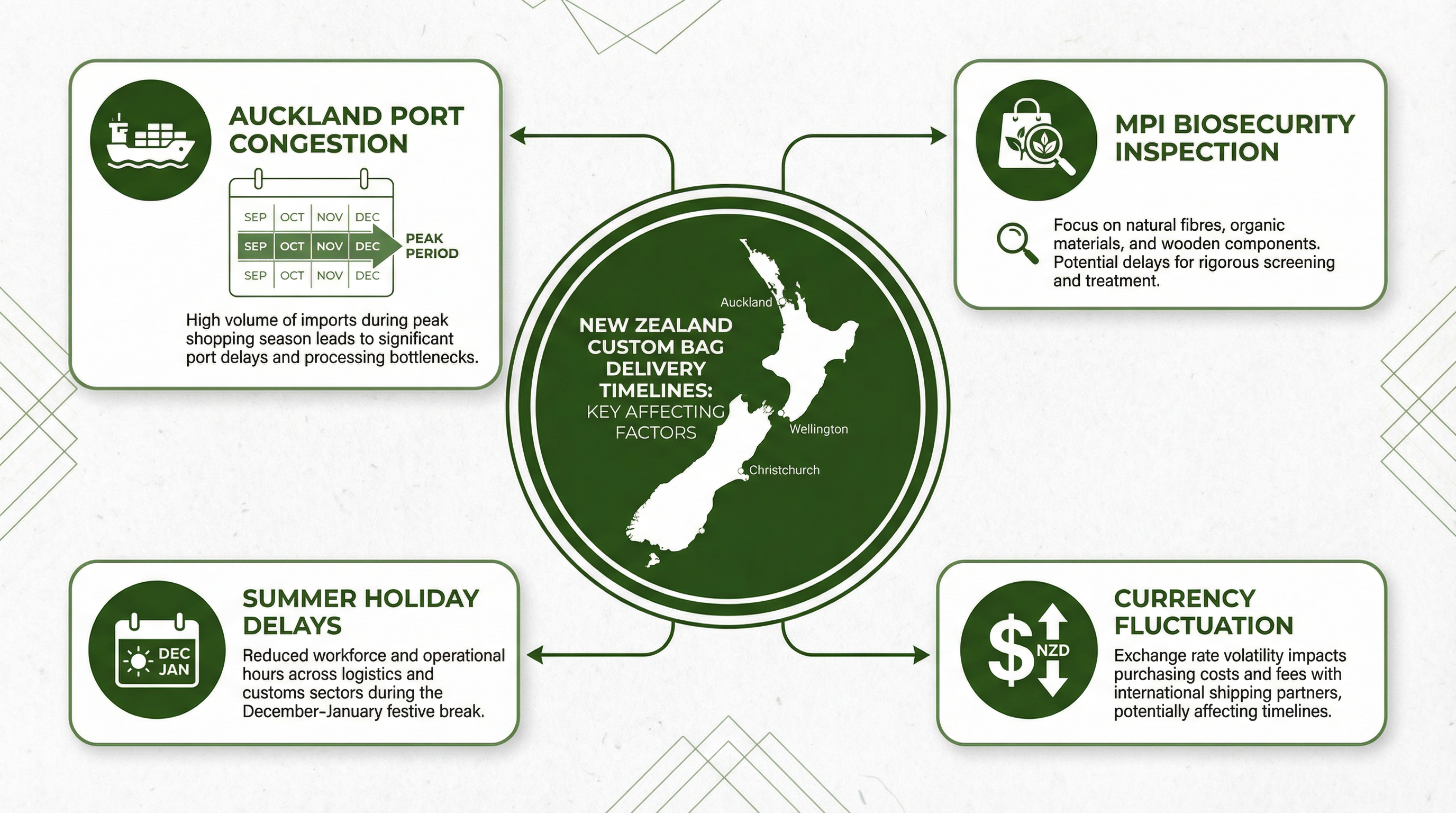
New Zealand's strict biosecurity regime applies to natural fibre products. Cotton, jute, and hessian bags may be selected for Ministry for Primary Industries (MPI) inspection upon arrival. Products must be free from contamination—seeds, plant material, soil, insects—or face fumigation treatment or rejection.
Practical implication: Work with suppliers experienced in NZ exports who understand our biosecurity standards. Request pre-shipment inspection photos showing clean, contaminant-free products. Budget 2-5 additional days for potential MPI processing.
Seasonal Shipping Patterns
New Zealand's peak import season (September-December) coincides with pre-Christmas retail preparation and summer event season. Auckland port experiences significant congestion during this period, with vessel delays of 5-10 days common.
Planning guidance: For December events, begin procurement in August. For Q1 corporate gifting, begin in October. The NZ summer holiday period (late December-mid January) also creates domestic logistics delays as warehouses and freight companies operate reduced schedules.
Currency and Pricing Volatility
Offshore manufacturing is typically quoted in USD or CNY. NZD exchange rate movements can significantly impact landed costs between quote acceptance and payment. A 5% currency movement on a $20,000 order represents $1,000 variance.
Risk mitigation: For orders with extended lead times, discuss currency hedging options with your supplier or finance team. Some suppliers offer NZD-fixed pricing for a small premium, providing budget certainty.
Common Questions About Custom Bag Production Timelines
What is the fastest possible turnaround for custom bags in New Zealand?
The fastest option is local stock bags with on-shore printing, delivering in 2-3 weeks with minimums of 50-100 units. If you need bags within 2 weeks, you're limited to whatever stock is immediately available from NZ suppliers—customisation options will be restricted to simple single-colour printing.
Can I get custom bags faster by paying more?
Yes, but with diminishing returns. Air freight can reduce shipping time from 25 days to 5 days, but at 5-10x the cost. Rush production fees (typically 15-30% premium) can compress manufacturing time by 20-30%. However, you cannot accelerate material sourcing for specialty fabrics or skip quality control without accepting significant risk.
How do minimum order quantities affect lead time?
Higher MOQs generally enable better production scheduling and material pricing, but don't necessarily shorten lead time. A 5,000-unit order takes longer to manufacture than a 500-unit order. The relationship is: higher MOQ = better unit economics, not faster delivery. (For detailed MOQ guidance, see our comprehensive guide on minimum order quantities for custom bags.)
What happens if my supplier misses the quoted lead time?
This depends on your contract terms. Professional suppliers include delivery windows rather than fixed dates, with provisions for force majeure events. Before ordering, clarify: What happens if delivery is delayed? Are there penalties? What communication will you receive if timelines slip? Reputable suppliers proactively communicate delays rather than going silent.
Should I order extra bags to account for defects?
Yes. Industry standard is 5-10% overage allowance for screen printing and 3-5% for digital printing. Some suppliers automatically include this buffer; others produce exact quantities. Clarify this before ordering. For critical events with zero tolerance for shortfall, order 10-15% above your confirmed requirement.
How far in advance should I start planning custom bag procurement?
For fully custom offshore manufacturing: 16-20 weeks before your need date. For local stock with custom printing: 4-6 weeks. For urgent needs from available stock: 2-3 weeks. The earlier you begin, the more options you have and the lower your costs will be.
Planning Your Next Custom Bag Order
Understanding production timelines transforms custom bag procurement from a reactive scramble into a strategic advantage. The businesses that consistently receive quality products on time and within budget are those that plan realistically, communicate clearly with suppliers, and build appropriate buffers into their timelines.
The key insight from 15 years of B2B procurement experience: The quoted lead time is rarely the actual lead time. Add 2-3 weeks for the approval cycles, shipping variables, and unexpected delays that inevitably occur. A "10-week" project that you plan as a 13-week project arrives comfortably. A "10-week" project that you plan as a 10-week project creates stress, rush fees, and compromised quality.
For New Zealand businesses ready to begin their custom bag journey with realistic timelines and transparent communication, our team provides detailed production schedules tailored to your specific requirements, materials, and delivery needs.
Related Reading: Deep Dives into Lead Time Factors
For procurement teams seeking deeper understanding of specific timeline variables, these focused analyses explore common decision points:
Sample Approval Delays
How revision cycles compound timeline impact beyond the actual revision time.
Material Procurement Impact
Why fabric sourcing often determines delivery more than production speed.
Rush Order True Costs
The hidden expenses beyond air freight premiums.
Print Method Timeline Lock
How printing selection commits your schedule early.
Factory Holiday Impact
Why shutdowns add weeks instead of days to timelines.
QC Inspection Time
Days you cannot recover in the quality control phase.
Container Booking Windows
How shipping schedules override production completion.
Customs Clearance Variables
The unpredictable days no one can guarantee.
LCL Consolidation Delays
Hidden waiting periods quotes never mention.