Procurement Strategy
Why Artwork Revision Cycles Cost More Than the Design Time for Custom Drawstring Bags
The three weeks spent refining your logo placement on a custom drawstring bag may have already triggered a cascade of cost increases that never appear on the revision invoice.
Published · By Sarah Chen
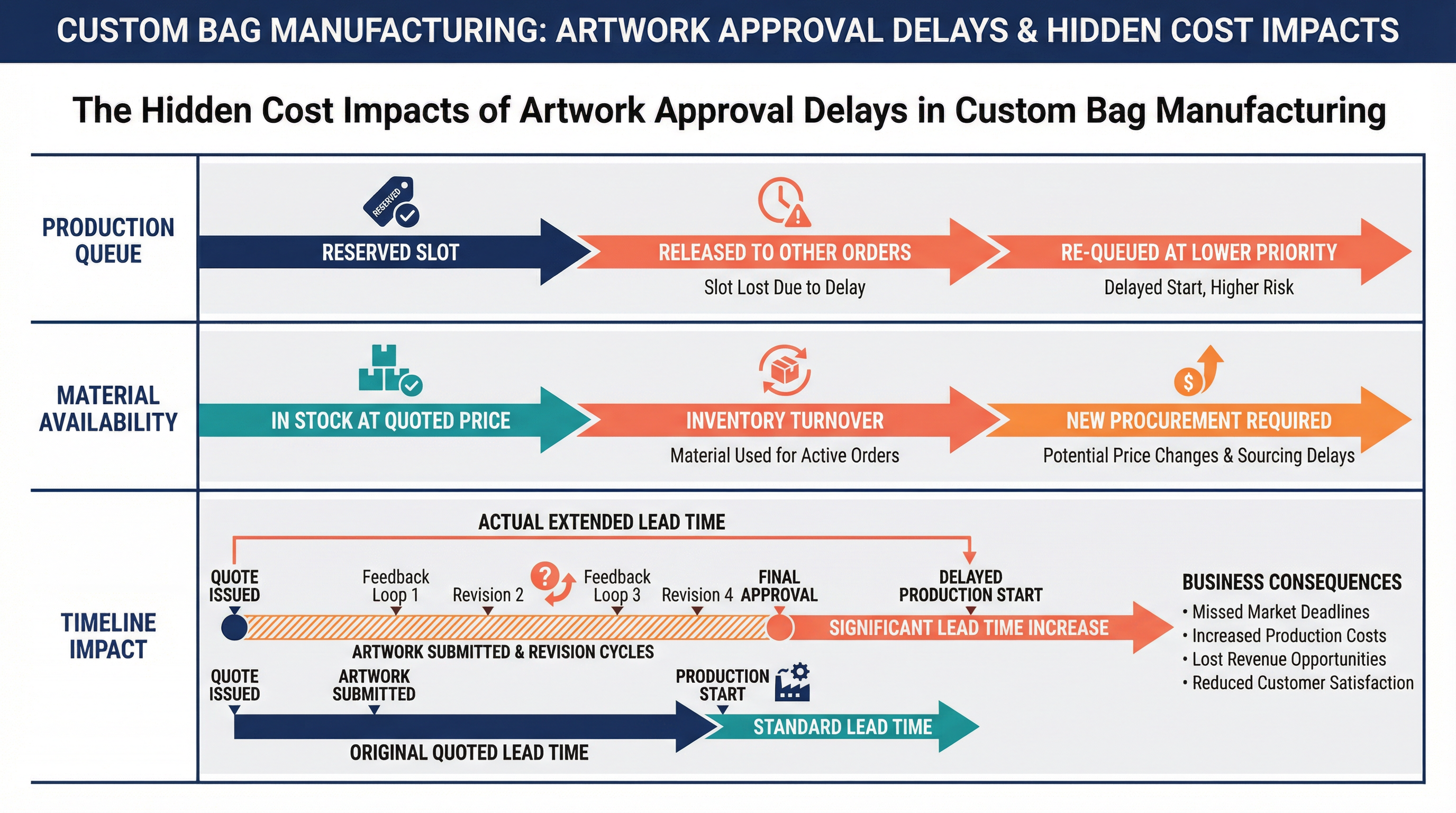
The three weeks spent refining your logo placement on a custom drawstring bag may have already triggered a cascade of cost increases that never appear on the revision invoice. This is one of the most consistently underestimated cost drivers in promotional bag procurement, and it stems from a fundamental misunderstanding of how production scheduling interacts with quoted pricing.
When a supplier provides a quote for 500 custom drawstring bags at a specific unit price, that quote contains an implicit assumption about when production will occur. The price reflects not just material costs and labour rates, but also the supplier's current production capacity, their existing material inventory, and their assessment of where your order fits within their manufacturing queue. None of these factors are static. They shift continuously as other orders enter the system, as material prices fluctuate, and as production slots fill or become available.
The artwork approval process exists within this dynamic environment, but procurement teams often treat it as a separate, consequence-free phase. The assumption is that once the design is finalised, production simply begins from wherever it was paused. In practice, the production slot that was tentatively allocated when the quote was issued may no longer exist by the time artwork approval concludes. The supplier has moved on to other orders, and your project re-enters the queue at whatever position is currently available.
This queue repositioning has direct cost implications that rarely surface in explicit line items. A supplier who quoted a four-week lead time based on an available production slot in early January may now be looking at a six-week timeline because that slot was given to another client whose artwork was approved faster. The original quote assumed certain efficiencies—perhaps the production line was already configured for similar bag specifications, or the required fabric was in stock from a recent order. Those efficiencies may have evaporated during the approval delay.
The material dimension compounds this problem. Fabric suppliers and hardware vendors operate on their own inventory cycles. A quote for custom drawstring bags in a specific cotton canvas weight assumes that the supplier either has that material in stock or can source it within the quoted timeline. Extended artwork approval periods can push the actual production start date past the material supplier's inventory turnover. The fabric that was available at the quoted price may have sold to another buyer, requiring a new procurement cycle at potentially different pricing.
What makes this particularly difficult to manage is that suppliers rarely communicate these shifting economics in real time. The original quote remains technically valid—the supplier will honour the unit price if you proceed. But the context around that quote has changed. The lead time extends. The production priority shifts. The material sourcing becomes more complex. These changes manifest as delays and complications rather than explicit price increases, which makes them harder to quantify and easier to dismiss as normal production variability.
The practical impact becomes most visible when procurement teams attempt to compress timelines after extended approval cycles. Having spent three weeks on artwork revisions, the internal deadline for receiving the finished bags remains unchanged. The request goes back to the supplier: can we still meet the original delivery date? The answer is often yes, but with conditions. Rush fees apply. Air freight replaces sea shipping. Weekend production shifts are scheduled. These costs appear as separate line items, disconnected from the artwork approval process that created the need for them.
For organisations managing custom promotional bag programmes, the connection to understanding minimum order quantities becomes essential context. MOQ pricing reflects an optimised production scenario—adequate lead time, standard material availability, normal production scheduling. Each week of artwork approval delay moves the actual production further from that optimised scenario, even when the quoted MOQ and unit price remain nominally unchanged.
The procurement teams who navigate this successfully tend to treat artwork approval as a production-critical milestone rather than an internal design exercise. They establish hard deadlines for approval completion, communicate those deadlines to all stakeholders involved in the review process, and build buffer time into their project timelines specifically to absorb approval delays without impacting production scheduling. They also maintain ongoing communication with suppliers during the approval phase, providing updates on expected completion dates so that production slots can be managed proactively rather than reactively.
The underlying principle is that quoted pricing represents a snapshot of production economics at a specific moment. The longer the gap between quote acceptance and production start, the more likely those economics have shifted. Artwork approval delays are the most common cause of that gap, and their cost impact extends far beyond the visible hours spent on design revisions.