Insights
Why Your Artwork File Format Determines Custom Tote Bag Print Quality Before Production Even Begins
The file format decision happens weeks before printing, yet it locks in quality outcomes that cannot be corrected during production. Factory perspective on the technical constraint most procurement teams overlook.
Published · By KiwiBag Works Team
There is a particular moment in every custom tote bag project where the final print quality becomes essentially predetermined—and it happens long before any ink touches fabric. This moment occurs when the artwork file is submitted, and the format of that file creates constraints that no amount of production skill can overcome.
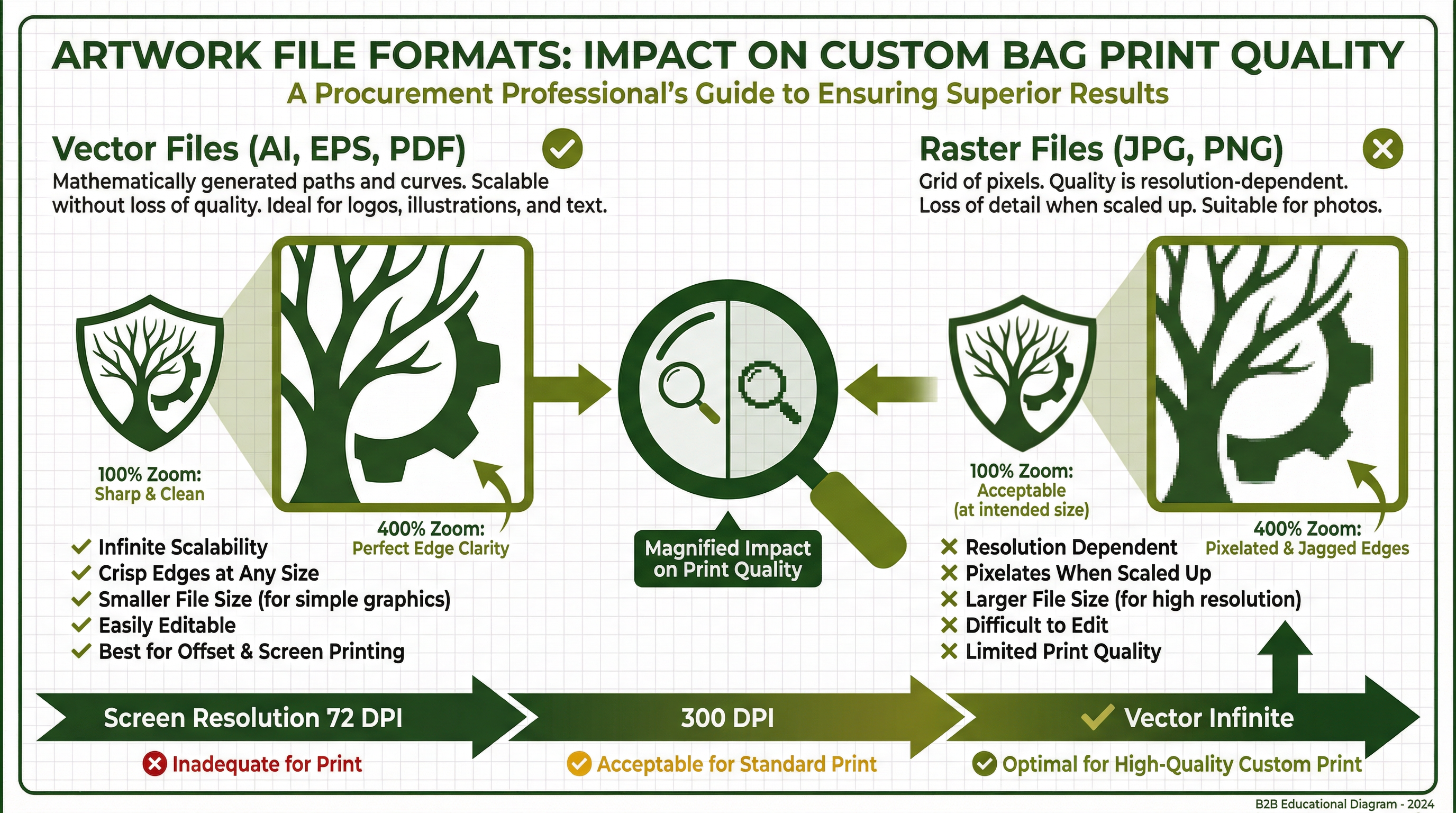
From the production floor perspective, we see this pattern repeatedly: a procurement team invests significant effort in selecting the right bag style, negotiating favourable pricing, and coordinating delivery logistics—only to receive finished products with logos that appear slightly fuzzy, edges that lack crispness, or colours that seem somehow muted. The instinct is to question the printing quality or the factory's capabilities. In practice, the outcome was determined weeks earlier, the moment a 72 DPI JPEG was accepted as the production artwork.
The technical distinction between vector and raster files is straightforward to explain but its practical implications are widely underestimated. Vector files—typically AI, EPS, or properly constructed PDF formats—define graphics through mathematical relationships. A curve is described as a mathematical formula, which means it can be scaled to any size while maintaining perfect edge definition. Whether printed at 50mm or 500mm, the edges remain mathematically precise. Raster files—JPEG, PNG, or TIFF formats—define graphics as grids of coloured pixels. At their native resolution, they appear sharp. Scale them up, and the pixel grid becomes visible as jagged edges and blurred details.
The critical issue is that screen resolution and print resolution operate on fundamentally different scales. A logo that appears perfectly crisp on a computer monitor at 72 DPI will produce noticeably soft edges when printed at production scale. Print processes typically require 300 DPI minimum, and screen printing—the most common method for custom cotton and canvas bags—benefits from even higher resolution or, ideally, true vector artwork. When a raster file at screen resolution is submitted, the production team faces an impossible choice: print at the inadequate resolution and accept quality degradation, or attempt to artificially upscale the file, which introduces its own artefacts and quality issues.
What makes this particularly problematic is the timing. Artwork submission typically occurs early in the ordering process, often before samples are produced. By the time a physical sample reveals the quality limitation, the project timeline rarely allows for artwork recreation. The procurement team is then forced to accept compromised quality or delay the entire project—neither option being satisfactory.
The situation becomes more complex when dealing with legacy artwork. Many businesses have logos that were created years ago, sometimes by designers who are no longer available, stored in formats that made sense for web use but were never intended for large-format printing. When the marketing team provides "the logo file" to procurement, it may be a JPEG that has been resized, compressed, and saved multiple times over the years—each iteration degrading quality further. The file looks acceptable in an email attachment or PowerPoint presentation, but it cannot support professional print production.
From a production management standpoint, we can identify the problem immediately upon receiving artwork. The file properties reveal resolution, format, and whether text has been properly converted to outlines. However, raising concerns at this stage creates an awkward dynamic. The procurement team has already invested time in the project, may have communicated timelines to internal stakeholders, and often lacks the technical background to fully appreciate why the artwork is problematic. The path of least resistance is to proceed and hope the quality issues are not severe enough to cause rejection.
The practical solution requires intervention much earlier in the process. Before any pricing discussions or timeline commitments, artwork suitability should be verified. This means requesting the original vector source files—not exports, not conversions, but the actual working files from which the logo was created. If these files do not exist, the honest assessment is that professional-quality custom bag printing will require artwork recreation. This is an additional cost and timeline consideration, but it is far preferable to discovering the limitation after samples are produced or, worse, after bulk production is complete.
For procurement professionals managing custom bag projects, the file format question deserves the same attention as material selection or minimum order quantities. A technically adequate artwork file is not a nice-to-have; it is a prerequisite for achieving the print quality that justifies the investment in custom branded merchandise. The conversation with your design team or brand manager should happen before supplier engagement, not after production has begun.
The factories that produce consistently excellent results are not necessarily using superior equipment or more skilled operators. They are working with clients who provide production-ready artwork from the outset. The quality gap between acceptable and excellent custom bag printing often traces back to this single, early-stage decision about file format—a decision that many procurement teams do not realise they are making until the consequences become visible in the finished product.