Procurement Strategy
Why Ordering Below MOQ Often Means Longer Wait Times
The assumption that paying a premium for smaller quantities leads to faster delivery fundamentally misunderstands how production scheduling operates on the factory floor.
Published · By Michael Chen
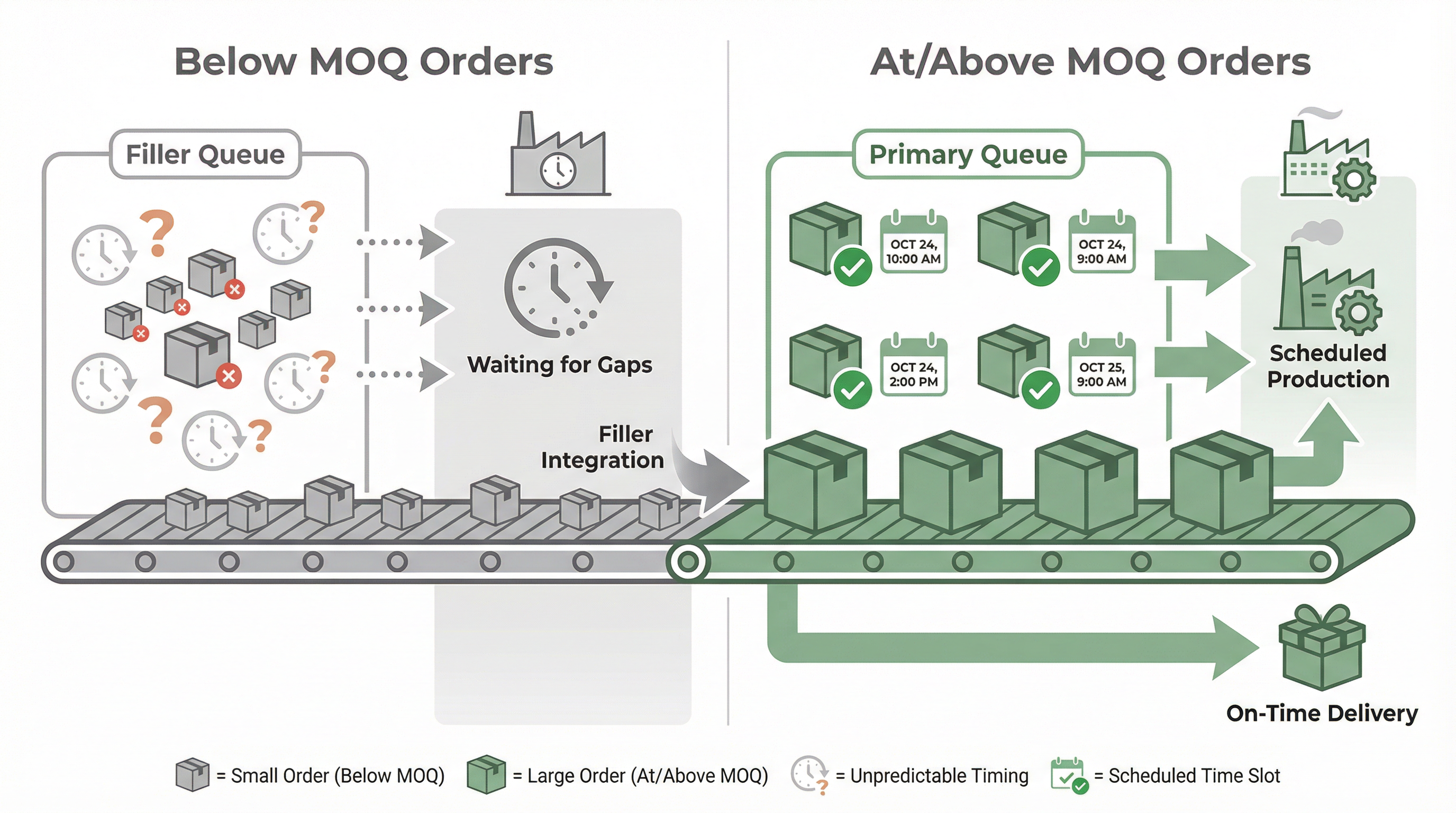
The assumption seems logical enough: if you are willing to pay a premium per unit to order below the stated minimum, the supplier should be able to accommodate you quickly. After all, it is a smaller quantity. Less to produce, less to ship, faster turnaround. This reasoning makes intuitive sense from a buyer's perspective, but it fundamentally misunderstands how production scheduling operates on the factory floor.
When a manufacturing facility receives an order that meets or exceeds its minimum order quantity, that order enters what is effectively the primary production queue. It gets assigned a production slot, materials are procured specifically for it, and the timeline communicated to the buyer reflects a genuine commitment. The factory has determined that this order size justifies dedicating equipment, labour, and quality control resources in a predictable sequence. The lead time quoted is not arbitrary—it is based on when that dedicated slot becomes available.
Orders that fall below the MOQ threshold, even when accepted with a per-unit surcharge, occupy a fundamentally different position in the scheduling hierarchy. These orders typically do not receive their own production slot. Instead, they are categorised as what production managers often call filler work or consolidation batches. The factory will produce them when there is a gap between larger orders, when a production line would otherwise sit idle, or when enough similar small orders accumulate to justify a combined run. The practical consequence is that the lead time for these orders becomes unpredictable in ways that the quoted estimate rarely captures.
This scheduling reality creates a paradox that catches many procurement teams off guard. A buyer ordering 150 units when the MOQ is 300 might assume they are reducing their risk by committing to less inventory. They pay the premium, receive a lead time estimate, and plan their internal timeline accordingly. What they often discover is that the delivery date slips—not because of production problems, but because their order kept getting bumped in favour of larger jobs that the factory prioritised. The premium they paid covered the inefficiency of a short run; it did not purchase priority in the production queue.
The mechanics behind this are straightforward once you understand how factories allocate their most constrained resource: uninterrupted production time. Changing over a line from one product specification to another—different fabric, different print setup, different stitching pattern—involves downtime that produces nothing. A factory running a 2,000-unit order absorbs that changeover cost across many units. A 150-unit order absorbs the same fixed cost across far fewer, which is why the per-unit price increases. But the changeover time itself does not shrink. From the factory's perspective, scheduling two 150-unit orders back-to-back means two changeovers, while a single 300-unit order means one. The mathematics of production efficiency favour consolidation, and scheduling decisions reflect that.
For buyers navigating this dynamic, the practical implication is that ordering at or slightly above MOQ often results in more reliable delivery than ordering below it with a premium. The additional units may feel like excess inventory, but they purchase something more valuable than the goods themselves: a position in the primary production queue with a lead time that the factory has genuine incentive to honour. When delivery predictability matters—for a product launch, a seasonal campaign, or an event with a fixed date—this distinction can be the difference between a successful execution and an expensive scramble for alternatives.
None of this suggests that below-MOQ orders are never appropriate. For initial sampling, market testing, or situations where inventory risk genuinely outweighs timeline risk, accepting the scheduling uncertainty may be the right trade-off. The misjudgment occurs when buyers assume that paying more per unit translates into faster or more reliable service. In the logic of production scheduling, it rarely does. Understanding how these thresholds actually function—and why they exist in the first place—allows for more realistic planning and fewer unpleasant surprises when the delivery date approaches.