Insights
Why the Closure Mechanism on Your Custom Corporate Gift Bag Determines Whether Recipients Experience a Gift or a Handover
Most corporate gift bag specifications omit closure entirely, defaulting to open-top bags that eliminate the temporal boundary between receiving and discovering. This article examines why closure is the specification element that activates every other interior design decision.
Published · By KiwiBag Works Team
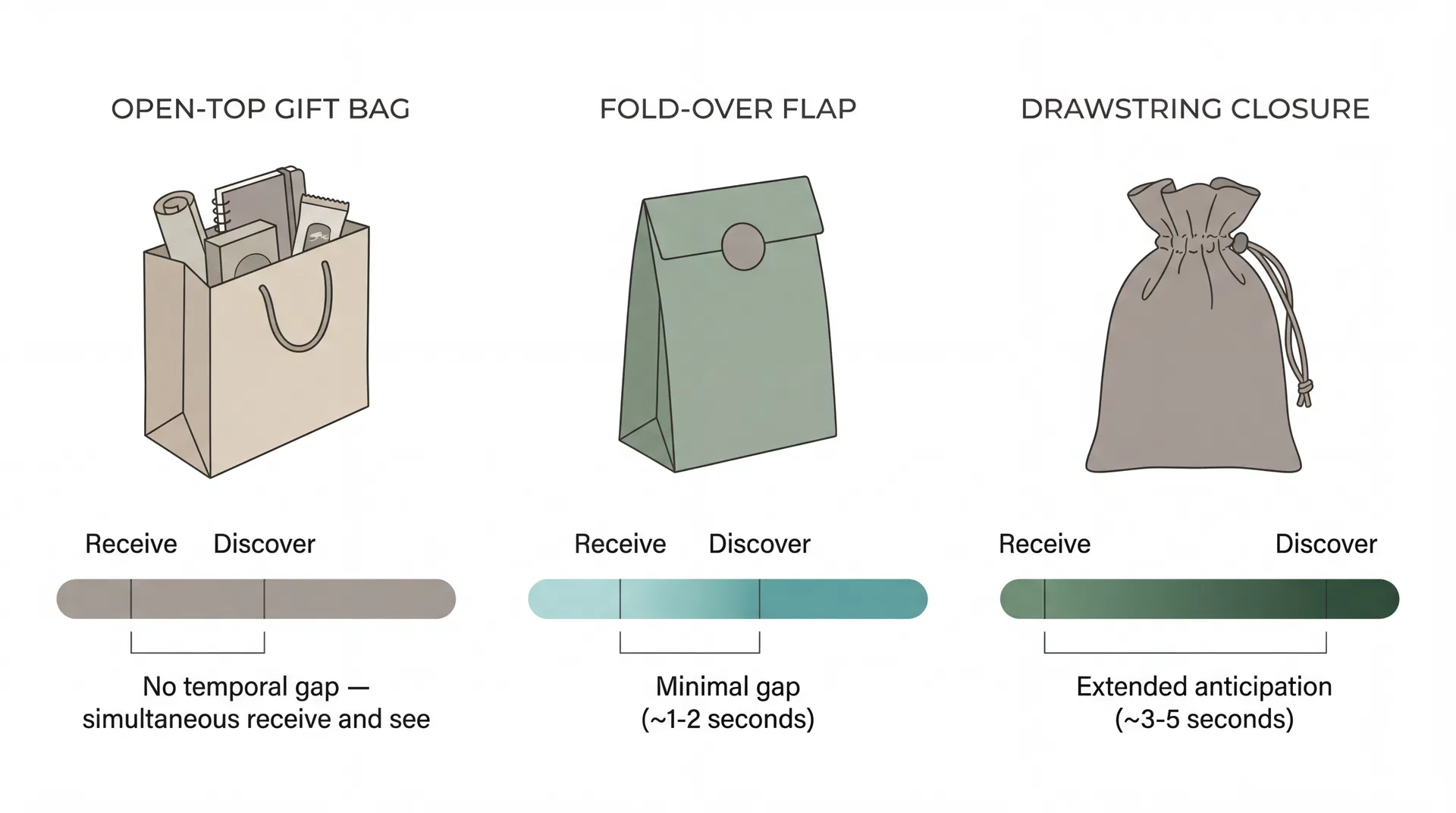
The majority of custom corporate gift bags produced for the New Zealand market arrive at their destination with an open top. This is not a design decision. It is the absence of a design decision, and the distinction matters because the open top eliminates the single most important moment in the gifting sequence: the transition from receiving to discovering. When a recipient is handed a bag with no closure, their eyes move to the bag’s interior before their hands do. The contents are visible from above. There is no concealment, no barrier, no moment at which the recipient must perform an action to reveal what is inside. The gift experience collapses from a two-phase sequence—receive, then discover—into a simultaneous event where receiving and seeing happen at the same instant. That collapsed sequence is perceptually identical to being handed a shopping bag containing a purchase. The bag functions as a carrier, not as a gift vessel, and the recipient’s emotional response calibrates accordingly.
The reason this default persists is that procurement specifications categorise bag closure under logistics rather than presentation. When closure appears in a specification brief at all, it appears in the section addressing transport and handling: “How will the bags be transported to the event venue?” or “Will the bags need to be stacked during storage?” The closure is framed as a solution to a physical problem—preventing items from shifting or falling out during transit—rather than as a design element that controls the recipient’s experience. This framing means that if the procurement team determines the bags will be hand-delivered at a seated event (where transport risk is minimal), the closure specification is omitted entirely. The bags arrive open-topped because the logistics rationale for closure did not apply, and no presentation rationale was ever considered.
The perceptual mechanics of why closure matters so disproportionately to the gift experience are rooted in how the brain processes anticipation. Research into gift-wrapping psychology has established that the act of unwrapping—the physical process of removing a barrier between the recipient and the gift—is not merely a functional step but a cognitive event that shapes how the gift itself is evaluated. The barrier creates a temporal gap between the moment of receiving and the moment of seeing, and that gap is where anticipation forms. Anticipation primes the recipient’s emotional state toward positive evaluation. Without the barrier, there is no gap, no anticipation, and the recipient’s evaluation of the gift defaults to a neutral, transactional assessment. In the context of corporate gifting, where the relationship between giver and recipient is typically professional rather than intimate, this anticipation effect is amplified rather than diminished. Professional relationships lack the emotional baseline that personal relationships provide, so the gift’s presentation carries a heavier burden in establishing the emotional register of the exchange.
In practice, this is often where corporate gift bag decisions begin to undermine their own purpose without any visible failure in the specification. A procurement team specifies premium organic cotton canvas, a restrained debossed logo, coordinated tissue paper lining, and a rigid base insert—every element calibrated for executive-level gifting. The bag is produced exactly as specified. But because the specification did not include a closure mechanism, the bag arrives as an open-topped vessel. The tissue paper, which was specified to create a layered interior experience, is visible from above before the recipient touches it. The debossed logo, positioned at the lower corner to avoid a promotional appearance, is irrelevant because the recipient’s attention is drawn downward into the open bag rather than across its exterior surface. The rigid base insert, designed to maintain structural presentation, serves no perceptual purpose because the recipient can see the contents are already neatly arranged. Every interior finishing element loses its experiential function when the bag has no closure, because those elements were designed to be discovered sequentially—and an open top makes them simultaneously visible.
The closure options available for custom corporate gift bags occupy a spectrum from minimal to ceremonial, and each position on that spectrum creates a different temporal boundary between receiving and discovering. At the minimal end, a simple fold-over flap—where the bag’s top edge is folded inward once and held with a small adhesive seal or a branded sticker—creates a light barrier that requires the recipient to break the seal and unfold the flap before seeing the contents. The cost is negligible: NZD 0.05 to NZD 0.15 per unit for the sticker or seal, with no structural modification to the bag. The fold-over does not create a dramatic reveal, but it establishes the essential temporal boundary. The recipient must do something before they can see the gift. That “something” is the minimum viable ceremony that separates a gift bag from a carrier bag.
Moving along the spectrum, a drawstring closure—where a cord or ribbon is threaded through eyelets or a channel at the bag’s top edge—creates a more deliberate barrier. The recipient must loosen the drawstring, widen the opening, and then look inside or reach in. This sequence takes three to five seconds, which is enough time for anticipation to form. The drawstring also gathers the bag’s opening into a narrower aperture, which means the contents are not fully visible even when the recipient first looks in—they see a partial view that resolves into a full view as they open the bag further. This graduated reveal is perceptually powerful because it mimics the unwrapping sequence of traditional gift presentation. The cost of a drawstring closure on a custom cotton or canvas bag is NZD 0.30 to NZD 0.80 per unit, depending on the cord material and whether the eyelets are metal-reinforced or fabric-bound.
At the ceremonial end of the spectrum, a magnetic snap closure concealed within the bag’s top hem creates a closure that is invisible from the exterior but produces a tactile and auditory signal when opened. The recipient feels the magnetic resistance, hears the soft release, and then parts the bag’s opening to reveal the interior. This three-sensory sequence—touch, sound, sight—is the closure equivalent of luxury packaging, and it communicates a level of design intentionality that recipients register even if they cannot articulate it. The cost is NZD 1.50 to NZD 3.00 per unit for a concealed magnetic closure, which includes the magnet hardware, the reinforced hem construction, and the additional sewing steps. For a 200-unit executive gift order, the total addition is NZD 300 to NZD 600—a meaningful but not prohibitive investment when measured against the relational purpose the bags are intended to serve.
The interaction between closure type and the other specification elements that previous articles in this series have addressed is worth understanding because closure acts as a gatekeeper for every other interior design decision. The interior tissue paper that was specified to create a layered discovery experience only functions as intended if the recipient encounters it through an opening sequence rather than seeing it from above. The colour coordination between exterior and interior only creates a “reveal moment” if there is an actual reveal—a point at which the interior becomes visible for the first time. The base padding that maintains structural presentation only matters if the recipient’s first view of the interior is from the side (looking in through a closure they have just opened) rather than from above (looking down into an open bag). Closure is not one specification element among many. It is the specification element that activates all the others.
The factory production perspective on closure reveals a timing dependency that procurement teams rarely anticipate. Unlike interior finishing elements such as tissue paper or ribbon ties, which can sometimes be added as post-production insertions, structural closures must be integrated into the bag’s construction during the sewing phase. A drawstring channel requires the bag’s top hem to be sewn as a tube rather than a flat fold. Magnetic snap hardware requires reinforcement patches to be sewn into the hem before the magnets are inserted. A fold-over flap requires additional fabric allowance in the cutting pattern. If the procurement brief does not specify a closure type at the initial specification stage, the bag’s construction will proceed with a standard open-top hem, and adding a closure after production has begun requires either reworking completed bags (which is labour-intensive and risks quality inconsistencies) or restarting the production run with a modified pattern (which adds lead time and cost). The procurement team that specifies closure in the initial brief gets it integrated seamlessly. The team that requests it after sample approval pays a premium that typically exceeds the closure’s original cost by a factor of two to three.
For teams working through how different corporate gift formats serve different business relationship objectives, the closure specification deserves to be understood not as a functional feature but as the mechanism that determines whether the bag delivers a gift experience or a handover experience. The distinction is temporal: a gift experience has duration—the seconds between receiving and discovering—while a handover experience is instantaneous. That duration is where the emotional imprint forms, and the emotional imprint is what converts a corporate gesture from a transaction into a relationship-building moment. A procurement brief that includes “drawstring closure, 5mm cotton cord, natural colour, threaded through six brass eyelets at 50mm from top edge” adds one line to the specification and approximately NZD 0.60 per unit to the production cost. That one line determines whether the recipient’s experience of the bag has a beginning and a middle, or whether it is a single, flat moment that registers and dissipates in the same instant.
The pattern that emerges across corporate gift bag programmes where closure is specified versus where it is omitted is consistent enough to be predictive. Bags with closures are retained by recipients at measurably higher rates, not because the closure itself adds functional value to the bag’s afterlife as a reusable tote, but because the closure created a gift experience that the recipient associates with the bag. The bag becomes a souvenir of a moment rather than a container that once held an item. This associative memory is what drives the recipient to keep the bag in rotation—using it for lunches, books, or market shopping—rather than folding it into a drawer. The closure’s contribution to the bag’s long-term brand value is therefore indirect but substantial: it does not make the bag more useful, but it makes the bag more meaningful, and meaningful objects are the ones that people keep.