Insights
Why the Size of Your Custom Corporate Gift Bag Relative to Its Contents Determines Presentation Impact More Than the Bag's Own Quality
Procurement teams approach corporate gift bag sizing as a containment problem—the bag must be large enough to hold the items. But the proportional relationship between bag volume and gift contents is a presentation variable, not a logistics variable, and treating it as the latter produces gift bags that technically function but visually undermine the gifts inside them.
Published · By KiwiBag Works Team
Procurement teams ordering custom bags for corporate gifting programmes approach the sizing decision as a containment problem. The brief specifies the gift items—a branded notebook, a bottle of wine, a selection of artisan chocolates—and the bag is selected to accommodate those items with enough room to close the top. The logic is functional: the bag must be large enough to hold everything without tearing, and small enough to avoid unnecessary material cost. This containment logic works for shipping cartons and retail carrier bags, where the bag's purpose ends the moment the contents are removed. It does not work for corporate gift bags, where the bag's purpose is to frame the contents as a deliberate, considered gesture. The relationship between the bag's internal volume and the gift items it contains is a presentation variable, not a logistics variable, and treating it as the latter produces gift bags that technically function but visually undermine the gifts inside them.
The misjudgment occurs because procurement specifications for corporate gift bags typically define size in absolute terms—height, width, and gusset depth—without reference to the items the bag will contain. A procurement team ordering custom cotton canvas tote bags for a client appreciation programme might specify a standard medium tote: 380mm wide, 420mm tall, 120mm gusset. This specification is selected from a catalogue of standard sizes, and it is confirmed adequate because the gift items physically fit inside. What the specification does not capture is how the items will sit inside the bag, how much empty space will surround them, and whether the bag's proportions will frame the contents as a curated collection or a random assortment dropped into an oversized container. A medium tote that is perfectly sized for a wine bottle, a notebook, and a box of chocolates arranged side by side becomes dramatically oversized when the gift is a single premium notebook and a pen set. The same bag, the same quality, the same branding—but the presentation effect is entirely different because the proportional relationship between container and contents has changed.
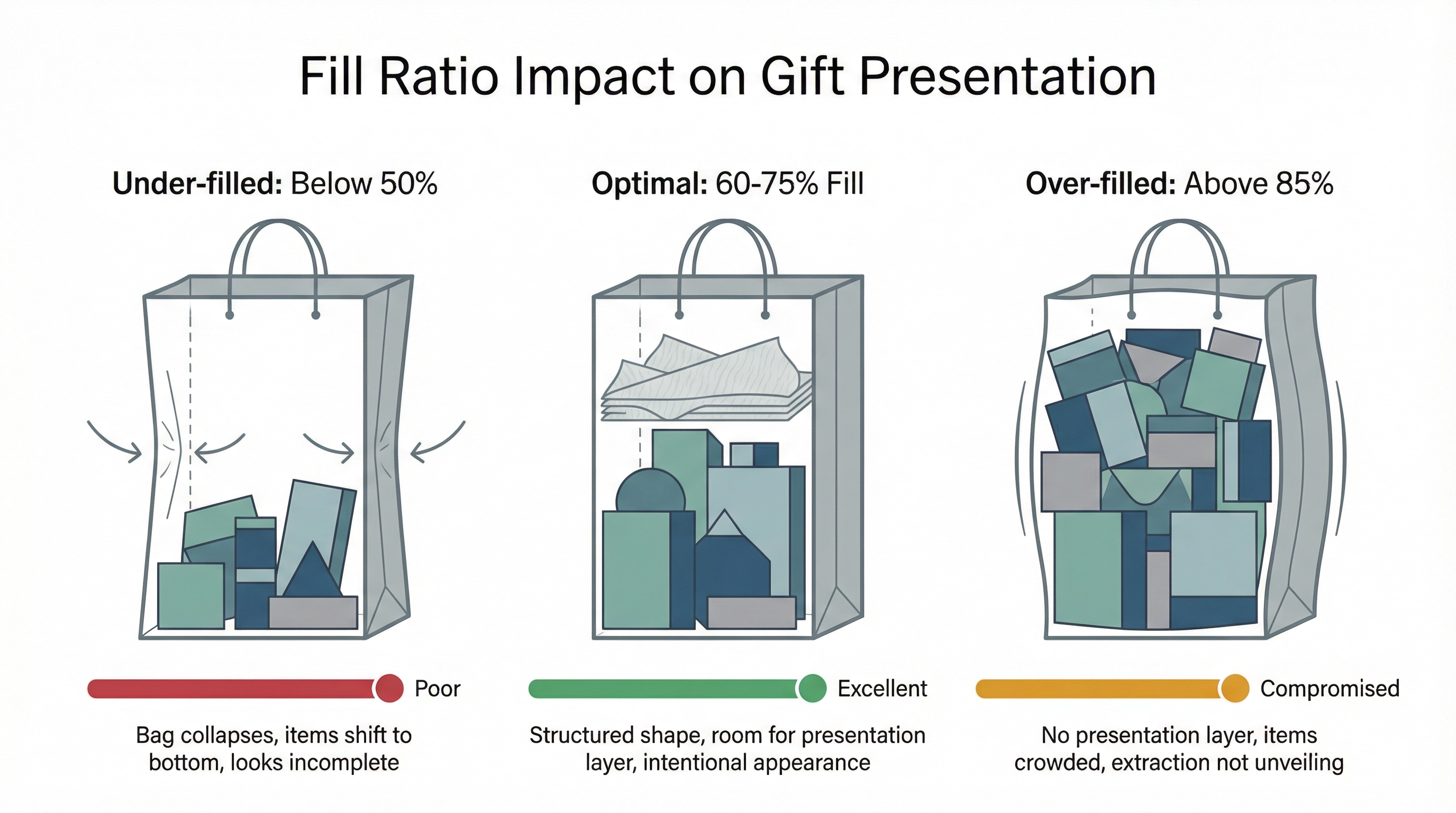
The fill ratio—the proportion of the bag's internal volume occupied by the gift items—is the variable that determines whether a corporate gift bag reads as intentional or incidental. When gift items occupy approximately sixty to seventy-five percent of the bag's usable volume, the presentation achieves a balance between fullness and breathing room. The items appear deliberately arranged, the tissue paper or presentation layer fills the remaining space without looking like padding, and the bag maintains its structural shape because the contents provide internal support. Below fifty percent fill, the bag collapses around the contents, the items shift and settle to the bottom, and the empty upper portion of the bag folds inward, creating the visual impression of a half-empty container. Above eighty-five percent fill, there is no room for a presentation layer, the items press against each other and against the bag walls, and the act of removing items becomes an extraction rather than an unveiling. Both extremes communicate the same message to the recipient: the bag was not selected for these specific items. It was selected from a catalogue and the items were placed inside afterward.
In practice, this is often where corporate gift type decisions start to be misjudged—not at the point of selecting the gift items, which typically receives careful attention, but at the point of selecting the container that will present them. The procurement team invests significant time choosing gifts that align with the recipient's industry, the company's brand values, and the occasion's significance. A premium New Zealand wine, a hand-bound leather journal, a locally crafted food item—each selection is deliberate. Then the bag selection happens as a separate line item, often managed by a different person or at a different stage of the procurement process. The bag is ordered in a standard size that accommodates the largest anticipated gift combination, and the same bag is used across all gift tiers. The result is that a carefully curated premium gift set arrives in a bag that makes it look like a hastily assembled conference pack.
The structural consequences of poor fill ratio extend beyond visual presentation. A custom canvas tote bag is designed to maintain its shape when the contents provide internal support. The gusset at the base creates a flat bottom that allows the bag to stand upright, and the side panels maintain their vertical line when the contents press gently against them from inside. When the bag is significantly larger than its contents, the base gusset has nothing to support it, the sides collapse inward, and the bag loses the structured silhouette that distinguishes it from a disposable carrier bag. The recipient receives what appears to be a limp fabric sack rather than a structured gift bag. The fabric quality, the print quality, the handle construction—all the specifications the procurement team carefully selected—are undermined by the bag's inability to hold its shape because the contents do not fill it adequately. A twelve-ounce cotton canvas bag that cost NZD 8.50 per unit looks indistinguishable from a six-ounce promotional bag when it is half-empty, because the structural advantage of heavier fabric only manifests when the bag is appropriately filled.
The multi-tier gifting programme is where this sizing error compounds most visibly. A company running an end-of-year appreciation programme might have three gift tiers: a premium tier for key clients containing a wine bottle, artisan food selection, and branded merchandise; a standard tier for regular clients containing a notebook and chocolate box; and a basic tier for broader contacts containing a single branded item. The instinct is to order one bag size across all three tiers for production efficiency and visual consistency. The bag is sized to accommodate the premium tier, which means it is appropriately filled for the top-tier gift but progressively emptier for the standard and basic tiers. The basic tier gift—a single branded item in a bag designed for three items—creates the most damaging presentation, because the recipient receives a large, high-quality bag that is conspicuously empty. The bag's quality actually amplifies the problem: a premium bag with minimal contents looks like a gift that was supposed to contain more but did not. The recipient's unconscious interpretation is not "they gave me a nice bag" but "something is missing from this gift."
The cost implications of ordering multiple bag sizes for a tiered programme are less significant than procurement teams typically assume. A factory producing custom bags for a corporate gifting order can accommodate two or three size variants within the same production run, provided the artwork and material specifications remain consistent. The setup cost for an additional size variant is typically a single die-cutting charge of NZD 60 to NZD 120, because the screen printing setup, material sourcing, and handle attachment process remain unchanged. On a programme ordering two hundred bags across three tiers—eighty premium, seventy standard, and fifty basic—the additional die-cutting charges add approximately NZD 0.90 to NZD 1.80 per bag across the total order. This is a fraction of the per-unit bag cost and an even smaller fraction of the total gift programme budget. The procurement team that orders a single bag size to save this marginal cost is optimising for production efficiency at the expense of presentation quality across two-thirds of the programme.
The gusset dimension is the most frequently miscalculated element in corporate gift bag sizing, because it is the dimension that determines the bag's depth and therefore its ability to accommodate three-dimensional objects. Standard catalogue sizes typically offer gusset depths of 80mm, 100mm, or 120mm, and procurement teams select based on the widest item in the gift set. A wine bottle with an 80mm diameter technically fits in a 100mm gusset, but the bottle presses against both sides of the bag, eliminating any space for tissue paper wrapping and creating visible bulging on the bag's exterior. A 140mm gusset accommodates the same bottle with room for a tissue paper wrap and a small complementary item alongside it, and the bag maintains a clean exterior profile. The difference between a gusset that technically fits and a gusset that presents well is typically 30 to 40mm—a dimension that adds less than NZD 0.30 to the per-unit material cost but fundamentally changes how the gift appears when the recipient looks inside.
The seasonal dimension of corporate gifting in New Zealand introduces additional sizing considerations that procurement teams based in office environments rarely encounter. End-of-year gifts distributed in November and December often include food items—artisan preserves, chocolate selections, local honey—that have irregular shapes and require upright positioning to prevent leaking or crushing. A bag sized purely on the combined footprint of these items may not account for the vertical clearance needed to prevent items from pressing against each other or against the bag's closure. Mid-year gifts, which tend toward smaller, more personal items like premium stationery or technology accessories, require smaller bags that frame these items as individually significant rather than lost in empty space. The procurement team that orders a single bag size for year-round gifting is applying a one-size-fits-all solution to a problem that varies by season, occasion, and gift composition.
The presentation layer—tissue paper, shredded fill, fabric wrapping, or a branded card placed on top of the items—is the element that transforms a bag of items into a gift presentation. This layer requires space inside the bag that is not occupied by the gift items themselves. When the fill ratio is too high, there is no room for the presentation layer, and the items sit exposed at the top of the bag, looking like groceries rather than gifts. When the fill ratio is too low, the presentation layer becomes excessive filler, and the recipient must dig through layers of tissue paper to find a small item at the bottom—an experience that feels more like unwrapping a shipping parcel than receiving a gift. The optimal sizing allows the presentation layer to sit naturally on top of the gift items, visible when the recipient looks into the bag, creating a moment of anticipation before the items are revealed. This requires the bag to be approximately 50 to 80mm taller than the tallest item, with enough gusset depth for the items to sit without crowding. These are specific dimensional requirements that cannot be met by selecting a standard catalogue size and hoping the proportions work.
For procurement teams evaluating which types of corporate gifts work best across different business needs, the bag sizing decision deserves the same specificity as the gift selection itself. The bag is not a container that holds the gift. The bag is the frame that presents the gift, and a frame that is too large makes the artwork look small, while a frame that is too tight makes the artwork look cramped. Neither serves the artwork well, and neither serves the corporate relationship the gift is intended to strengthen.
The pattern that produces consistently strong presentation outcomes is not complex, but it requires the procurement team to reverse their sizing logic. Instead of selecting a standard bag size and confirming the gifts fit inside, the process should start with the gift items arranged as they will appear in the bag, measure the combined dimensions including the presentation layer, and then specify a bag size that provides the appropriate proportional relationship. For a premium client gift containing a wine bottle, a notebook, and a food item arranged side by side, this might mean a bag that is 400mm wide, 350mm tall, and 160mm deep—dimensions that do not correspond to any standard catalogue size but that produce a presentation where the items fill the bag with intention rather than accident. The custom sizing adds a die-cutting charge to the order, but it ensures that every bag in the programme communicates what the procurement team intended: that this gift was assembled with the specific recipient in mind, not pulled from a shelf and dropped into whatever bag was available.