Procurement Strategy
Why Custom Pantone Colours Create a Hidden MOQ Inside Your Eco Bag Order
The colour specification on your brand guidelines may trigger a separate minimum order requirement that exists entirely outside your bag supplier's quoted MOQ.
Published · By Sarah Chen
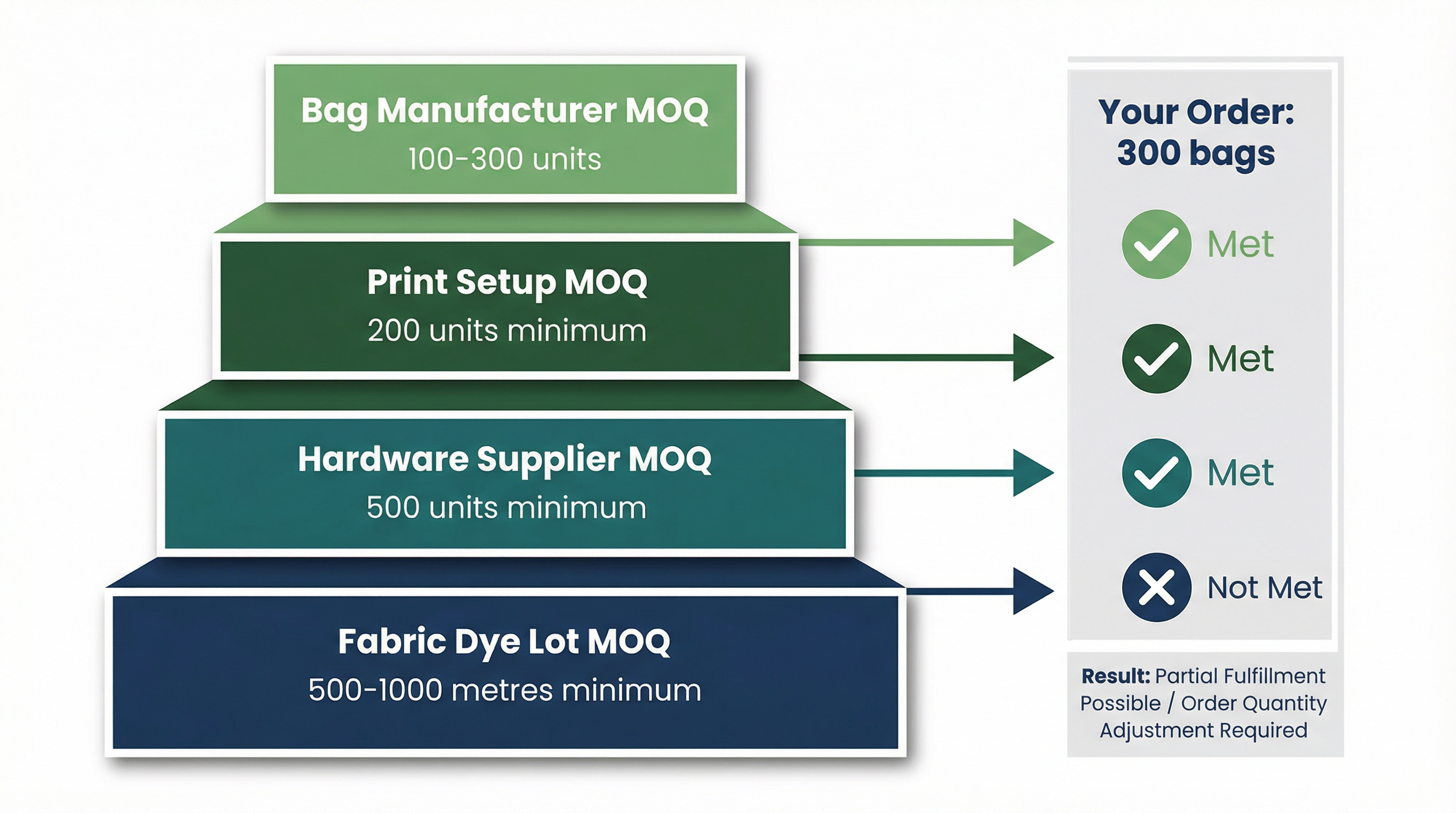
The colour specification on your brand guidelines may trigger a separate minimum order requirement that exists entirely outside your bag supplier's quoted MOQ. This is one of the most consistently misunderstood aspects of custom promotional bag procurement, and it creates friction between marketing teams who expect precise brand compliance and procurement teams who are working within fixed budgets.
When a buyer requests a custom cotton tote bag in a specific Pantone shade—say, Pantone 2728 C to match their corporate blue—the assumption is that the bag manufacturer will simply source fabric in that colour and proceed with production. In practice, fabric suppliers operate on their own minimum order structures that have nothing to do with the bag factory's MOQ. A fabric mill's minimum dye lot for custom colours typically starts at 300 to 500 metres, and for certain weave types or organic certifications, that threshold can climb to 1,000 metres or more. A standard tote bag consumes roughly 0.4 to 0.6 metres of fabric depending on size and construction. The arithmetic reveals the problem: a 500-metre dye lot produces enough fabric for approximately 800 to 1,200 bags, regardless of whether the bag manufacturer's stated MOQ is 100 or 300 units.
This creates what might be called a nested MOQ structure—a minimum within a minimum that only becomes visible when custom colours enter the specification. Buyers who have successfully ordered 200 bags in a stock colour are often surprised to learn that the same quantity in a custom Pantone shade either cannot be produced at all, or carries a substantial per-unit premium to cover the unused fabric from the minimum dye lot.
The quality implications extend beyond simple cost arithmetic. Fabric dye lots are not perfectly reproducible. A batch of cotton canvas dyed to Pantone 7545 C in January will not be an exact match to a batch dyed to the same specification in June, even from the same mill using the same dye formulation. The variables include water mineral content, ambient humidity during drying, and subtle variations in the greige fabric base. For a single production run, this is irrelevant—all bags come from the same dye lot. For buyers who plan to reorder the same bag design over multiple years, the colour drift between batches becomes a brand consistency issue that no amount of Pantone specification can fully prevent.
The practical response to this reality varies by order volume. Buyers ordering quantities that comfortably exceed the fabric dye lot minimum—typically 1,000 bags or more—can specify custom Pantone colours with confidence that the economics and quality control will work in their favour. Buyers ordering in the 200 to 500 unit range face a decision: accept a stock colour that approximates the brand specification, pay a premium for custom dyeing that will be amortised across fewer units, or increase the order quantity to reach the fabric MOQ threshold.
What complicates this decision is that stock colour availability varies significantly by fabric type. A conventional cotton canvas might be available in 30 or 40 stock shades, making it relatively easy to find a close match. An organic cotton canvas with GOTS certification might be available in only 8 to 12 stock colours, because the certified dyeing facilities are fewer and the demand for each colour variant is lower. Recycled polyester fabrics present similar constraints—the recycling process affects dye uptake, and suppliers maintain limited stock colour ranges to manage inventory complexity.
The metamerism problem adds another layer of difficulty that rarely appears in supplier discussions but surfaces immediately when the finished bags arrive. Metamerism refers to the phenomenon where two colours appear identical under one lighting condition but noticeably different under another. A fabric sample approved in a showroom under warm incandescent lighting may look distinctly off-brand when displayed at a trade show under cool fluorescent tubes. This is not a manufacturing defect or a supplier failure—it is a physical property of how dyes interact with light. The only reliable mitigation is to evaluate colour samples under the actual lighting conditions where the bags will be used, which requires more planning than most procurement timelines accommodate.
For organisations navigating these constraints, the connection to understanding minimum order quantities becomes essential context. The bag manufacturer's quoted MOQ represents only one layer of the production economics. The fabric supplier's dye lot minimum, the print shop's screen setup threshold, and the hardware supplier's minimum run for custom-coloured zippers or buckles each introduce their own quantity floors. A seemingly simple request for a custom eco bag in brand colours can activate three or four nested MOQs simultaneously, each with its own cost implications.
The procurement teams who navigate this successfully tend to approach colour specification as a variable rather than a fixed requirement. They identify which elements of the bag must match the brand exactly—often the printed logo—and which elements can accept a close approximation in a stock colour. A navy canvas bag with a precisely Pantone-matched screen-printed logo often delivers better brand consistency than a custom-dyed bag where the fabric colour drifts slightly between production batches. This selective precision concentrates the colour-matching investment where it has the most visual impact while avoiding the nested MOQ complications that custom fabric dyeing introduces.
The underlying principle is that colour precision and order flexibility exist in tension. Buyers who require exact Pantone matching across all bag components are implicitly committing to larger order quantities, whether they recognise that commitment at the specification stage or discover it when the quotes arrive. Understanding this trade-off early in the project allows for more realistic budgeting and prevents the frustrating late-stage negotiations that occur when a colour requirement turns out to be economically incompatible with the planned order volume.