Compliance
Why Customs Clearance Adds Unpredictable Days to Your Custom Jute Bag Timeline That No One Can Guarantee
Customs clearance timelines for custom jute bags range from one day to two weeks depending on variables outside anyone's direct control. Compliance perspective on the clearance uncertainty that procurement teams consistently underestimate.
Published · By Rachel Morrison
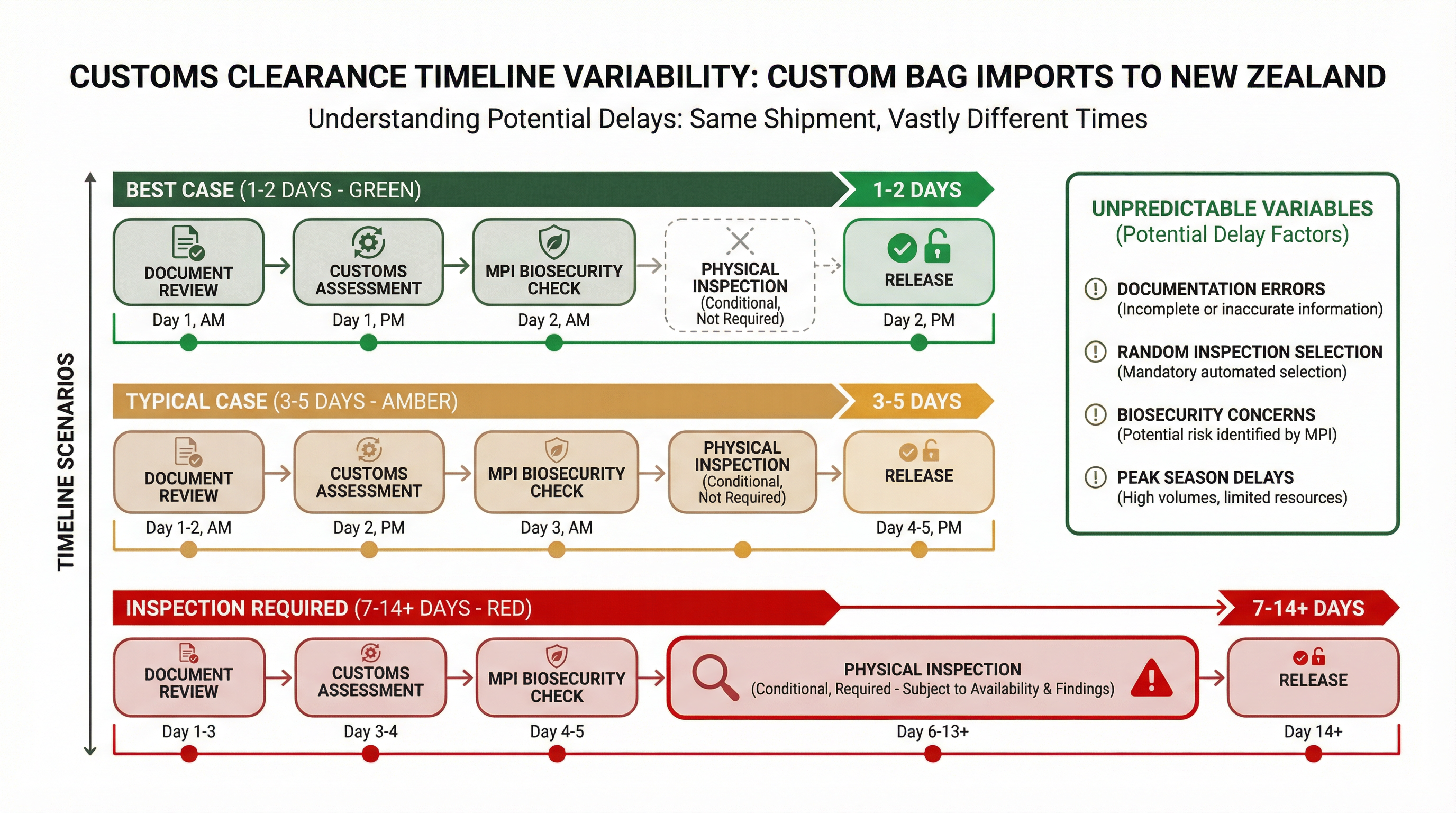
There is a particular form of timeline optimism that appears in nearly every custom jute bag procurement plan I review. The optimism manifests as a single number in the delivery calculation—typically two or three days—allocated for customs clearance. This number represents an average that obscures a range spanning from twenty-four hours to two weeks or more, and the difference between these outcomes is largely outside anyone's ability to predict or control at the time the order is placed.
The clearance process for imported goods entering New Zealand involves multiple agencies with different mandates, different inspection criteria, and different capacity constraints. Customs assesses duty obligations and trade compliance. The Ministry for Primary Industries evaluates biosecurity risk. Each agency operates independently, and a shipment must satisfy both before release. The timeline for this dual assessment depends on factors that cannot be known until the cargo actually arrives and enters the clearance queue.
In practice, this is often where production timeline decisions start to be misjudged. The documentation review phase appears straightforward but contains numerous failure points. Commercial invoices must match packing lists. Product descriptions must align with tariff classifications. Country of origin declarations must be consistent across all documents. A single discrepancy—a weight variance, a missing HS code, an inconsistent unit count—can trigger a documentation hold that adds two to five days while the importer provides clarification or amended paperwork.
The biosecurity dimension introduces uncertainty that procurement teams rarely anticipate. Natural fibre products like jute bags receive heightened scrutiny because plant-based materials can harbour seeds, insects, or soil contamination. MPI's risk assessment system flags certain product categories, shipping origins, and supplier histories for mandatory inspection. A shipment that cleared in forty-eight hours on the previous order may be selected for physical inspection on the next, adding a week to the timeline with no warning and no recourse.
Physical inspection, when required, involves its own scheduling dependencies. MPI inspectors must be available. The cargo must be accessible at an approved examination facility. If contamination is found—even minor soil residue on packaging—the shipment may require treatment, fumigation, or re-export. These remediation processes operate on their own timelines, measured in days rather than hours, and the costs fall entirely on the importer regardless of whether the contamination originated with the supplier, the shipping line, or the port handling.
The random selection element deserves particular attention because it defeats any attempt to predict clearance timing based on past experience. A percentage of all shipments are selected for inspection regardless of risk profile, supplier history, or documentation quality. This random audit function exists precisely to prevent importers from gaming the system, but it means that even a flawless shipment from a trusted supplier can be delayed by a week through pure statistical chance.
Peak periods compound these baseline uncertainties. The weeks before Christmas, the post-Chinese New Year surge, and the pre-winter promotional season all create backlogs at both Customs and MPI. Processing times that average three days during quiet periods can extend to seven or eight days when inspection queues are full and staff are stretched across higher volumes. These seasonal patterns are predictable in general terms but impossible to forecast precisely for any individual shipment.
The practical consequence for custom jute bag orders is that the final delivery date cannot be guaranteed with the precision that event deadlines or campaign launches require. A shipment that arrives at Auckland port on Monday might clear by Wednesday or might clear the following Monday, and the buyer will not know which outcome to expect until the clearance process is already underway. Building a three-day buffer into the timeline provides reasonable confidence for most shipments but offers no protection against the inspection scenarios that can consume two weeks.
Buyers who have examined the complete picture of how long custom bag production actually takes understand that customs clearance represents the final variable in a chain of dependencies, and unlike production or shipping, it cannot be expedited through additional payment or supplier pressure. The clearance timeline is what it is, determined by agency workloads, inspection selections, and documentation accuracy that only becomes testable when the cargo arrives.
The documentation accuracy dimension is the only element within the buyer's direct influence, and it deserves more attention than most procurement processes provide. Working with experienced customs brokers who specialise in textile imports, ensuring supplier documentation meets New Zealand requirements before shipment, and maintaining consistent product descriptions across orders all reduce the probability of documentation holds. These measures cannot eliminate clearance uncertainty, but they remove the self-inflicted delays that transform a three-day clearance into a ten-day ordeal.
For custom jute bag orders with firm delivery requirements, the practical approach involves building clearance buffers that account for inspection scenarios rather than averages. A one-week buffer after expected port arrival provides reasonable protection against typical delays. A two-week buffer provides protection against inspection holds. The choice between these buffers depends on the consequence of missing the deadline—a corporate event with fixed dates requires more conservative planning than inventory replenishment with flexible timing.
The uncomfortable reality is that no supplier, freight forwarder, or customs broker can guarantee clearance timing for any individual shipment. They can provide estimates based on typical processing times. They can flag risk factors that increase inspection probability. They can ensure documentation is complete and accurate before submission. What they cannot do is predict whether MPI will select your particular container for physical examination, or whether the inspector will find a seed fragment that triggers fumigation requirements. This irreducible uncertainty is built into the import process, and procurement timelines that ignore it are built on assumptions that will eventually fail.