Insights
Why the Fabric Weight of Your Custom Corporate Gift Bag Communicates a Value Judgment Before the Recipient Even Opens It
Procurement teams selecting custom bags for corporate gifting programmes evaluate material options through a lens that prioritises visual appearance and unit cost. What this evaluation process consistently overlooks is that fabric weight is the first quality signal the recipient processes, and it is processed through touch before the recipient has consciously registered the bag's visual design.
Published · By KiwiBag Works Team
Procurement teams selecting custom bags for corporate gifting programmes evaluate material options through a lens that prioritises visual appearance and unit cost. The fabric swatch arrives, the team confirms the colour matches the brand palette, the surface texture looks appropriate, and the price falls within budget. The order proceeds. What this evaluation process consistently overlooks is that fabric weight—measured in ounces per square yard or grams per square metre—is the first quality signal the recipient processes, and it is processed through touch before the recipient has consciously registered the bag's visual design. A 6-ounce cotton tote and a 12-ounce cotton canvas tote may look similar in a product photograph. They do not feel similar in the hand. The heavier bag communicates substance, intentionality, and investment. The lighter bag communicates exactly what it is: a cost-optimised container. In corporate gifting, where the bag's purpose is to frame the gift as a considered gesture rather than a logistical delivery, that tactile first impression shapes the entire experience that follows.
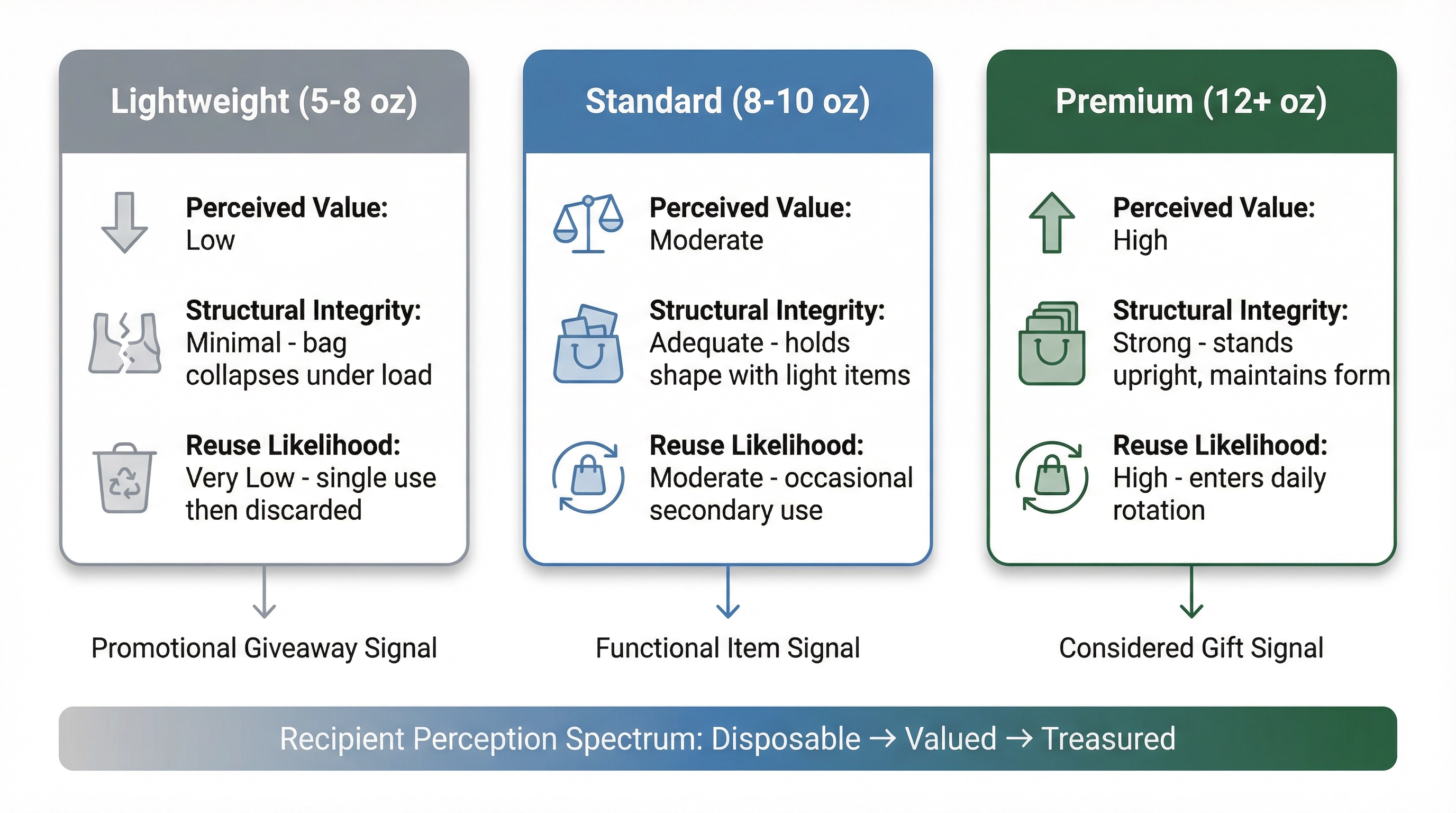
The misjudgment occurs because procurement specifications for corporate gift bags typically describe material in categorical terms rather than quantitative ones. The brief might specify "cotton canvas" or "organic cotton" or "jute" without defining the weight, weave density, or structural grade. These categorical descriptions feel precise—they name a specific material type—but they leave the most consequential quality variable entirely unspecified. A factory receiving an order for "cotton canvas tote bags" has a range of canvas weights available, from lightweight 5-ounce sheeting suitable for disposable event bags to heavyweight 16-ounce duck canvas used for industrial tool bags. Without a weight specification, the factory will quote and produce using whichever weight optimises their margin within the buyer's stated budget. For most promotional bag factories, that default sits between 6 and 8 ounces—adequate for carrying lightweight items, but lacking the structural rigidity and tactile density that distinguish a premium gift bag from a promotional giveaway.
The relationship between fabric weight and perceived value operates through a mechanism that is difficult to override with visual design alone. When a recipient lifts a corporate gift bag from a table or receives one from a presenter, the weight of the bag registers before any visual assessment begins. A bag that weighs noticeably more than expected triggers an unconscious quality inference: heavier objects are associated with higher value, greater durability, and more careful construction. This association is not rational—a heavier bag is not inherently more valuable—but it is remarkably consistent across consumer research and product perception studies. In the specific context of corporate gifting in New Zealand, where business culture favours substance over ostentation, a bag that feels substantial without looking excessive aligns precisely with the relationship signal most companies intend to send. The problem is that achieving this tactile impression requires specifying fabric weight at the procurement stage, and most procurement briefs do not include this parameter.
The weight specification gap creates particular problems when corporate gift bags are distributed across different business contexts within the same programme. A company might order custom canvas tote bags for three purposes: client appreciation gifts containing premium items, partner recognition packages for annual reviews, and employee welcome kits for new hires. The instinct is to order a single bag specification across all three applications, varying the contents but keeping the container consistent. This approach is efficient but misaligned, because the appropriate fabric weight for each context is different. A client appreciation bag carrying a bottle of wine, a branded notebook, and a selection of artisan food items needs a 12-ounce or heavier canvas to support the weight without deforming and to communicate premium positioning through its structure. An employee welcome kit containing a lanyard, a company handbook, and a water bottle can function adequately in an 8-ounce canvas. Ordering the lighter weight across all applications saves perhaps NZD 0.60 to NZD 1.20 per unit, but it means the client appreciation bag—the highest-stakes application in the programme—arrives feeling like a promotional item rather than a premium gift.
The compliance dimension of material selection adds another layer that procurement teams in New Zealand increasingly need to navigate but rarely address at the specification stage. When a corporate gift bag is distributed to clients in the food and beverage industry, the material may need to meet food contact safety standards if the bag will be reused for carrying food items—a common secondary use for quality tote bags. Oeko-Tex Standard 100 certification confirms that the fabric has been tested for harmful substances and is safe for skin contact and incidental food contact, but this certification is not standard on promotional-grade cotton canvas. A government agency receiving corporate gifts may have internal procurement policies that require demonstrable sustainability credentials, meaning a bag described as "eco-friendly" without GOTS certification or verified organic content could create an awkward situation where the recipient's compliance team questions the gift's provenance. These are not theoretical risks—they are the kind of quiet, relationship-eroding complications that surface weeks after distribution when the recipient's internal processes catch up with the gift.
The weave density of the fabric interacts with weight in ways that affect both the bag's structural performance and its suitability for different branding methods. A tightly woven 10-ounce canvas provides a smooth, stable surface for screen printing, producing crisp logo reproduction with sharp edges and consistent ink coverage. A loosely woven 10-ounce canvas—same weight, different construction—creates a textured surface where ink settles unevenly into the weave pattern, producing a logo that looks slightly rough or vintage. For brands with detailed logos, fine typography, or precise colour requirements, the weave density determines whether the printed result looks professional or approximate. Procurement teams that specify fabric weight without specifying weave density may receive bags that weigh correctly but print poorly, and the factory is not at fault because the specification was met as written. The branding that was supposed to elevate the corporate gift instead undermines it, and the root cause traces back to a material specification that was incomplete rather than incorrect.
The seasonal context of corporate gifting in New Zealand introduces material considerations that procurement teams based in office environments rarely experience firsthand. End-of-year corporate gifts distributed in November and December coincide with the beginning of the New Zealand summer. A heavyweight jute bag that feels appropriately substantial in an air-conditioned boardroom may feel coarse and uncomfortable to carry in thirty-degree heat. A cotton canvas bag in the same weight range offers a smoother hand feel that works across seasons. Conversely, mid-year corporate gifts distributed during the New Zealand winter may accompany outdoor events or client entertainment where moisture resistance matters—and untreated cotton canvas absorbs water readily, potentially damaging the contents. These environmental factors are not exotic edge cases. They are the normal conditions under which recipients will first interact with the bag, and they determine whether the material choice feels considered or careless.
The afterlife of a corporate gift bag—what happens to it after the gift is removed—is where material selection has its most lasting impact on brand perception, and it is the dimension most completely absent from procurement specifications. A well-made bag in an appropriate weight becomes a daily-use item: a grocery bag, a gym bag, a work tote, a weekend market companion. Each reuse extends the brand impression in a natural, non-promotional context. A poorly specified bag—too light to hold its shape, too rough to carry comfortably, too flimsy to trust with heavy items—gets relegated to a cupboard or donated within weeks. The difference between these two outcomes is not the bag's visual design or the quality of the logo print. It is the fabric weight and construction quality, which determine whether the bag is functional enough to earn a place in the recipient's daily routine. A 12-ounce canvas tote with reinforced handles and a flat base will carry groceries for years. A 6-ounce cotton bag with unfinished seams will stretch, sag, and tear within months. The brand on the first bag accumulates thousands of impressions over its lifetime. The brand on the second bag accumulates none, because the bag was never used after the gifting occasion.
The cost differential between material grades is consistently smaller than procurement teams estimate, which is part of why the specification gap persists. Upgrading from an 8-ounce standard cotton canvas to a 12-ounce premium cotton canvas adds approximately NZD 0.80 to NZD 1.50 per unit for a standard tote bag, depending on the order volume and the supplier's material sourcing. Adding Oeko-Tex certification to the material specification adds no per-unit cost if the factory already sources certified fabric—which most established manufacturers do—and adds NZD 0.15 to NZD 0.30 per unit if a certified alternative needs to be sourced specifically for the order. On a 500-unit corporate gift bag order with a unit price of NZD 8 to NZD 12, the total cost of upgrading from a generic specification to a properly weighted, certified material is less than five percent of the order value. That five percent determines whether the bag feels like a premium gift or a promotional handout, whether it meets the recipient's industry compliance expectations, and whether it enters daily use or immediate storage.
For procurement teams evaluating which types of corporate gifts work best across different business contexts, the material specification of the bag deserves the same deliberate attention as the gift selection itself. The bag is not neutral packaging. It is the first physical interaction the recipient has with the gesture, and the fabric weight is the first data point in that interaction. A specification that reads "cotton canvas, 12oz, tight weave, Oeko-Tex certified" takes ten seconds longer to write than one that reads "cotton canvas" and costs marginally more to produce. The difference in recipient experience is not marginal. It is the difference between a bag that communicates "we thought about this" and one that communicates "we ordered these."
The pattern that consistently produces the best outcomes in corporate gifting programmes is not the most expensive material or the heaviest fabric. It is the material specification that matches the weight and certification to the specific business context, recipient industry, and intended use case. A 10-ounce organic cotton canvas with GOTS certification is the right choice for a sustainability-focused client in the food or government sector. A 12-ounce premium cotton duck canvas with a waxed finish is the right choice for an executive gift intended to convey durability and understated quality. A 14-ounce heavyweight canvas with leather trim details is the right choice for a high-value client retention gift where the bag itself is part of the gift's perceived value. Each of these specifications serves a different relationship purpose, and each communicates a different value judgment to the recipient. The procurement team that specifies "cotton canvas" for all three contexts has made a single material decision that produces three different levels of misalignment. The specification was not wrong. It was simply not specific enough to carry the relationship weight that corporate gifting demands.