Supply Chain
Why Factory Holiday Shutdowns Add Six Weeks to Your Custom Drawstring Bag Timeline Instead of One
Factory holidays impact custom bag production far beyond official closure dates. Expert insight on why one-week shutdowns create six-week timeline gaps.
Published · By David Ross
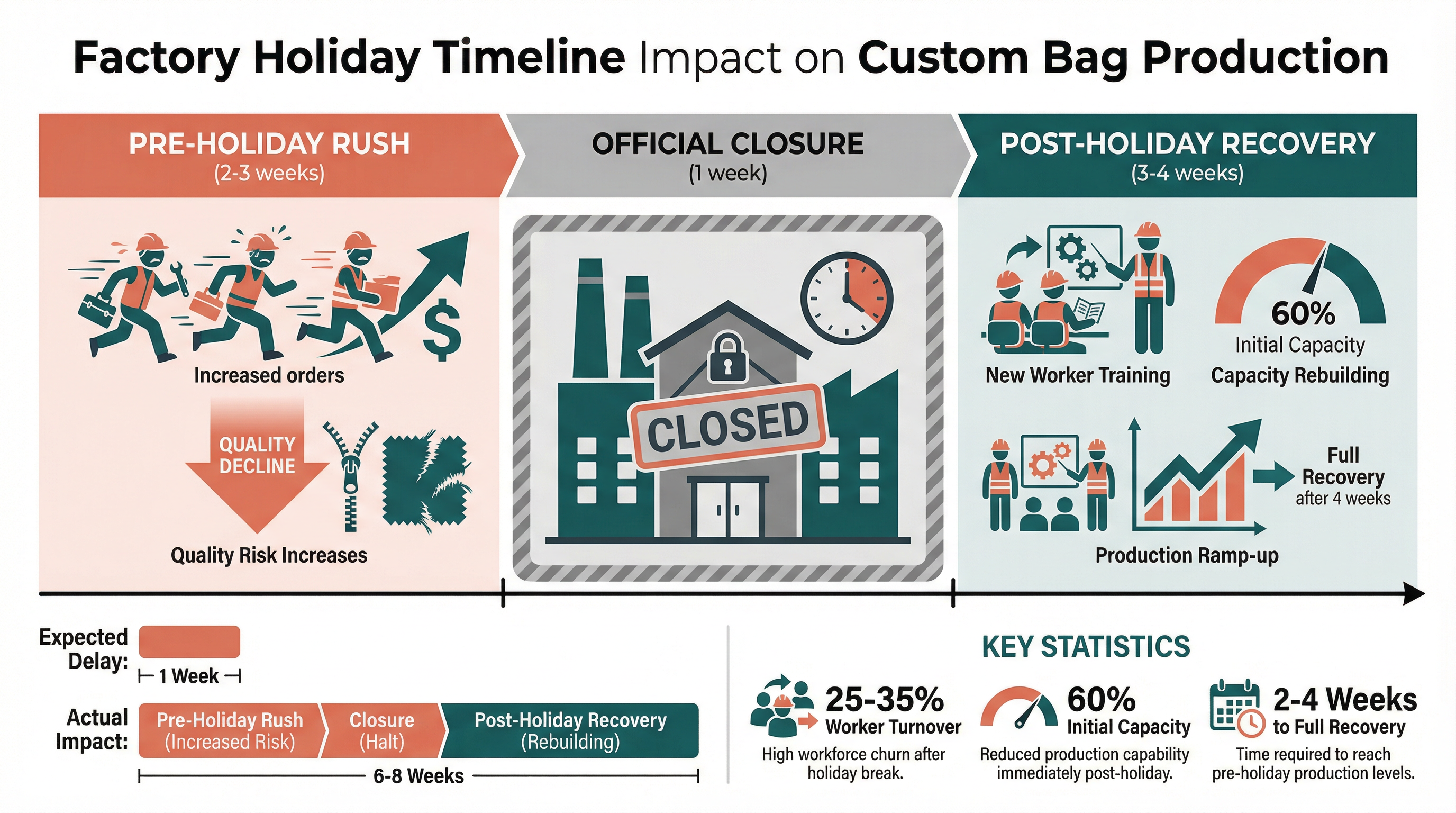
There is a particular pattern in custom drawstring bag procurement that repeats itself every year, yet continues to catch experienced buyers off guard. It occurs when someone calculates their order timeline around a factory's official holiday dates, assumes a one-week closure means a one-week delay, and then discovers that the actual production gap spans six weeks or more.
The miscalculation is understandable. Official holiday calendars show specific dates. Factory contacts confirm those dates when asked. The arithmetic seems straightforward—if production normally takes four weeks and the factory closes for one week, the total should be five weeks. This logic fails because it treats factory holidays as simple pauses in an otherwise continuous process, rather than as disruptions that affect production capacity before, during, and after the official closure period.
In practice, this is often where production timeline decisions start to be misjudged. The official closure represents only the middle portion of a three-phase disruption. The pre-holiday phase begins two to three weeks before the official dates, as factories rush to complete existing orders and workers begin leaving early. The post-holiday phase extends three to four weeks after reopening, as factories rehire, retrain, and gradually restore production capacity. A one-week official holiday thus creates a six to eight week window of compromised production capability.
The pre-holiday rush phase deserves particular attention because it affects quality as much as timing. Factories under pressure to clear orders before closure often extend working hours, reduce inspection thoroughness, and accept shortcuts that would normally be rejected. For custom drawstring bags with specific print quality requirements or precise colour matching, this period represents elevated defect risk. Orders completed during this window may technically meet the deadline but arrive with quality issues that would not have occurred during normal production periods.
The post-holiday recovery phase presents a different challenge that many procurement teams fail to anticipate. Worker turnover during major holidays can reach 25 to 35 percent at some facilities. This is not absenteeism—these workers have permanently left, either returning to their home regions, switching to different factories, or leaving manufacturing entirely. The factory must hire replacements, train them on equipment and quality standards, and gradually rebuild production line efficiency. A production line that previously produced 500 custom bags per day may operate at 60 percent capacity for the first two weeks after reopening, then 80 percent for another two weeks, before returning to normal output.
This capacity recovery curve has direct implications for order scheduling. An order placed to begin production immediately after a holiday reopening will not receive the same production speed or quality attention as an order placed during normal periods. The factory is simultaneously training new workers, resolving equipment issues that accumulated during the shutdown, and managing a backlog of orders from other buyers who made the same timing assumption.
The quality dimension of post-holiday production is frequently underestimated. New workers on a drawstring bag production line may not yet understand the difference between acceptable and unacceptable cord tension, handle attachment strength, or print registration. Experienced quality control staff may also have departed, leaving supervisors stretched thin across multiple lines. The first production runs after a major holiday often show higher defect rates than the same factory produces during stable periods. Buyers who require consistent quality for branded merchandise or corporate gifts should factor this reality into their timeline planning.
For New Zealand buyers sourcing custom bags from Asian manufacturers, the Chinese New Year period creates the most significant annual disruption. The official holiday spans approximately one week, but the practical impact on production timelines extends from late January through mid-March. Orders intended for delivery in March or April—common timing for autumn corporate events and promotional campaigns—must account for this extended disruption window.
The shipping dimension compounds the factory-side delays. Port facilities and freight forwarders also operate with reduced capacity around major holidays. Vessels scheduled to depart in the weeks before closure often experience overbooking as multiple factories rush to ship completed orders. The weeks immediately after reopening see similar congestion as accumulated inventory moves simultaneously toward ports. For sea freight from China to New Zealand, this can add one to two weeks beyond normal transit times during the peak disruption period.
Buyers who have studied the complete picture of how long custom bag production actually takes understand that factory holidays require timeline adjustments measured in weeks, not days. The practical approach involves either completing orders well before the pre-holiday rush begins, or planning for delivery dates that fall after the post-holiday recovery period ends. The middle ground—orders that intersect with any portion of the disruption window—carries both timeline risk and quality risk that experienced procurement teams learn to avoid.
The financial implications extend beyond delayed delivery. Rush shipping to compensate for holiday-related delays can cost five to ten times normal freight rates. Quality issues discovered after delivery require replacement orders or customer compensation. Missed promotional deadlines may result in cancelled campaigns or reduced marketing effectiveness. These costs are avoidable with proper timeline planning, but only if the planning accounts for the full six to eight week disruption window rather than the one-week official holiday.