Insights
Why the Handle on Your Custom Corporate Gift Bag Signals Occasion Formality Before the Recipient Registers the Bag Itself
Procurement specifications for corporate gift bag handles address load capacity but never formality signal. From the production floor, the pattern is clear: handle type is the first tactile contact the recipient has with the gift, and it establishes an unconscious expectation about occasion formality before the bag's visual design is even processed.
Published · By KiwiBag Works Team
There is a moment in every corporate gifting interaction that procurement teams never witness and therefore never design for. It is the moment the recipient reaches for the bag. Their hand closes around the handle before their eyes have processed the bag’s colour, branding, or material. That tactile first contact—the texture, the width, the tension of the handle against the palm—establishes an immediate, unconscious expectation about what kind of occasion this gift belongs to. A thin, twisted paper handle communicates something fundamentally different from a padded cotton rope handle, and both communicate something different from a grosgrain ribbon handle. The procurement specification for handles, however, almost never addresses this signal. It addresses load capacity.
The standard factory quotation for a custom corporate gift bag lists handle options as a material and cost line item. Twisted paper handles at one price point. Polypropylene rope at another. Cotton rope slightly higher. Ribbon handles at the premium tier. The quotation format presents these options as a cost-performance trade-off: how much weight can the handle support relative to its price per unit. A procurement team selecting handles for a corporate gift bag containing a wine bottle and a box of artisan chocolates—approximately 1.8 kilograms combined—will evaluate whether the handle can support that weight without failure. Twisted paper handles are rated for roughly 2 kilograms. Polypropylene rope handles for 4 kilograms. Cotton rope for 5 kilograms. All three options exceed the load requirement, so the decision defaults to cost, and the twisted paper handle wins because it is the least expensive option that meets the functional specification. The bag ships with handles that are structurally adequate and perceptually wrong for the occasion.
The perceptual error is invisible in the procurement process because the handle’s formality signal is not a category that appears on any specification sheet. But it is a category that every recipient processes instantly and involuntarily. Twisted paper handles, regardless of their structural integrity, carry the visual and tactile signature of a retail shopping bag. They are the handles on the bag you receive at a bookshop or a takeaway restaurant. When a recipient encounters twisted paper handles on a corporate gift bag, the unconscious classification is “retail transaction” rather than “professional gesture.” The bag may contain a thoughtfully curated gift worth several hundred dollars, but the handle has already framed the interaction as commercial rather than relational. The recipient’s expectations adjust downward before they have looked inside.
Cotton rope handles occupy a different position on the formality spectrum. The weight of the rope, the softness of the fibres against the palm, and the visible knot or grommet attachment on the bag’s exterior all communicate a level of material investment that exceeds functional necessity. Nobody uses cotton rope because it is the cheapest way to attach a handle to a bag. The material choice itself signals that someone considered the recipient’s tactile experience—and that consideration registers as respect. In New Zealand’s business culture, where relationships are built on understated gestures rather than ostentatious displays, cotton rope handles strike a balance between premium feel and cultural appropriateness. They communicate formality without excess, which is precisely the register that client appreciation and partner recognition gifts need to hit.
Ribbon handles—grosgrain or satin—occupy the highest formality position and introduce a different set of procurement risks. Grosgrain ribbon, with its distinctive ribbed texture, signals luxury retail and occasion-specific gifting. Satin ribbon, smooth and reflective, signals wedding-tier formality. Both are appropriate for executive gifts, board-level relationship gestures, and high-value client presentations. Both are inappropriate for team appreciation bags, conference welcome packs, or any context where the recipient will carry the bag in public for more than a few minutes, because ribbon handles are not designed for sustained carrying comfort and their formality level creates social awkwardness in casual settings. A recipient carrying a satin-ribbon-handled gift bag through an office corridor feels conspicuous in a way that a recipient carrying a cotton-rope-handled bag does not. The ribbon signals “special occasion” so strongly that it draws attention to the act of receiving a gift, which in egalitarian workplace cultures can create discomfort rather than appreciation.
The handle attachment method is the second dimension of this decision that procurement specifications routinely overlook. The same cotton rope handle communicates different quality levels depending on whether it is glued to the interior of the bag, threaded through a punched hole and knotted on the inside, or threaded through a metal grommet and knotted on the exterior. Glued attachment is the fastest and cheapest production method, but it creates a visible adhesive line on the bag’s interior and limits the handle’s load capacity to the strength of the glue bond rather than the strength of the rope itself. Punched-and-knotted attachment is stronger and cleaner, but the punched hole can tear under load if the bag material is lightweight. Grommet attachment—where a metal eyelet reinforces the hole through which the rope passes—is the most durable method and the one that communicates the highest production quality, because the grommet is visible on the bag’s exterior as a deliberate design element rather than a hidden structural necessity. The cost difference between glued and grommet attachment is typically NZD 0.30 to NZD 0.60 per bag, a figure that is negligible in the context of a corporate gift programme but that changes the recipient’s perception of the bag’s construction quality.
From the production floor, the handle specification has implications that extend well beyond the handle itself. Handle type determines the bag’s construction sequence, because different handles require different attachment processes at different stages of assembly. Twisted paper handles are typically glued into the bag during the final folding stage—a fast, automated process that adds minimal production time. Cotton rope handles threaded through grommets require the grommets to be set before the bag is folded, which means the grommet-setting step must be inserted into the middle of the production sequence rather than appended at the end. Ribbon handles require precise length cutting and heat-sealing of the ribbon ends to prevent fraying, followed by careful alignment during attachment to ensure both handles hang at identical lengths. Each handle type creates a different production rhythm, and switching handle types between orders requires reconfiguring the assembly line—a changeover that typically costs thirty to forty-five minutes of production time. This is why factories prefer to quote handle options as fixed choices rather than customisable variables: the production efficiency of standardisation is significant, and the factory’s incentive is to steer the client toward whichever handle type is already set up on the line.
The procurement team that accepts the factory’s default handle recommendation is optimising for the factory’s production efficiency rather than the recipient’s experience. This is not a criticism of the factory—their role is to produce bags efficiently and profitably, and recommending the handle type that minimises changeover time is rational from their perspective. But the procurement team’s role is to ensure the finished product serves its business purpose, and the business purpose of a corporate gift bag is not production efficiency. It is relationship communication. When the factory recommends twisted paper handles because they are already set up on the line, and the procurement team accepts because the handles meet the load specification, the resulting bag may be structurally sound and cost-effective while being perceptually misaligned with the gifting occasion.
Handle length is the third variable that affects both the bag’s visual proportion and the recipient’s carrying experience, and it is the variable most frequently left to factory default. Standard handle lengths are calibrated for retail shopping bags, where the bag hangs at hip level and the customer carries it while walking through a shopping centre. Corporate gift bags are carried differently—typically for a short distance, from the gifting moment to the recipient’s desk, car, or hotel room. The carrying distance is shorter, but the visual impression during that carry is more significant, because the recipient is often carrying the bag in front of colleagues, clients, or event attendees. A handle that is too long causes the bag to hang low and swing, creating a casual, shopping-bag silhouette. A handle that is too short forces the recipient to carry the bag with an awkward, arm-bent posture that looks uncomfortable. The optimal handle length for a corporate gift bag is typically 20 to 30mm shorter than the retail standard for the same bag size, creating a carry position that keeps the bag closer to the body and maintains the bag’s structured appearance during transport.
The interaction between handle type and bag material creates formality combinations that are either coherent or contradictory, and procurement teams that select handles and materials independently often produce contradictory combinations. A heavy twelve-ounce cotton canvas bag with twisted paper handles sends a mixed signal: the canvas says “premium and durable” while the handles say “disposable retail.” A lightweight six-ounce cotton bag with grosgrain ribbon handles sends the opposite mixed signal: the fabric says “basic and functional” while the handles say “luxury occasion.” Coherent combinations align the formality level of the handle with the formality level of the material: cotton rope on canvas, ribbon on structured card or heavy linen, polypropylene on mid-weight cotton or jute. These combinations feel intentional because the components reinforce rather than contradict each other, and that coherence is what the recipient perceives as “quality” even if they cannot articulate why one bag feels more considered than another.
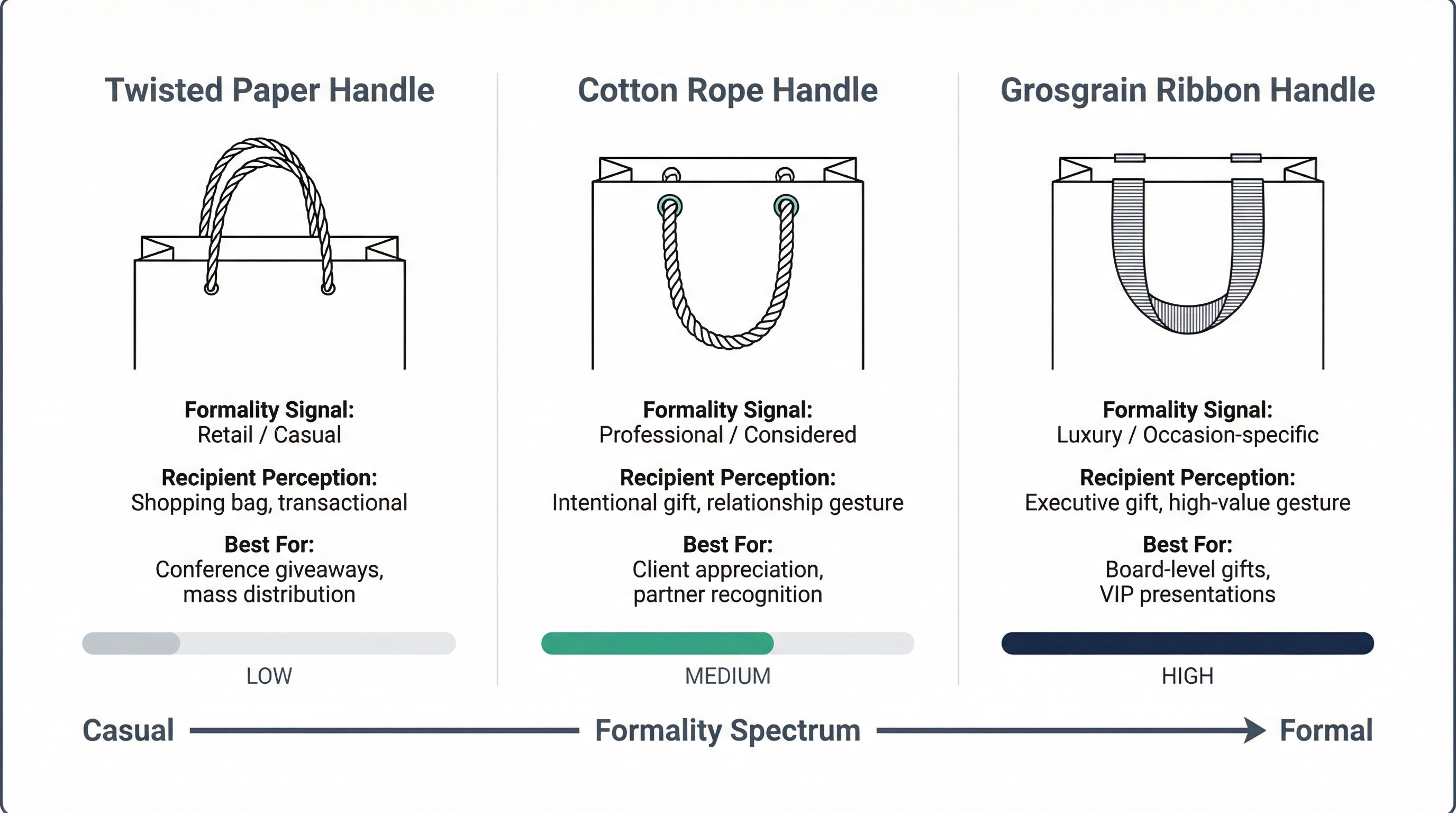
For teams working through the broader decision of matching corporate gift types to specific business contexts, the handle specification deserves to be treated as a formality calibration tool rather than a load-bearing component. The handle is not the part of the bag that carries the gift. The handle is the part of the bag that the recipient touches first, and that first touch establishes the perceptual framework for everything that follows—the bag’s appearance, the gift inside, and the relationship the gift is intended to represent. A procurement specification that addresses handle load capacity without addressing handle formality signal is solving the engineering problem while ignoring the communication problem. The engineering problem is trivial—almost any handle type can support the weight of a typical corporate gift. The communication problem is the one that determines whether the gift achieves its business objective.
The pattern from the production side is consistent across thousands of orders: when the handle type is coherent with the bag material, the gifting occasion, and the recipient relationship tier, the bags are reordered. When the handle type is selected on cost or load capacity alone, the bags fulfil the immediate order but do not generate repeat business, because the gifting programme produced bags that were functionally adequate and perceptually forgettable. The handle did not fail structurally. It failed communicatively. And that failure traces back to a procurement specification that treated the handle as hardware rather than as the first point of human contact with the gift.