Insights
Why Inner Packaging Specification for Custom Bags Determines Final Presentation More Than the Bag Itself
The custom promotional bag arrives at your warehouse looking nothing like the sample you approved. The bags are wrinkled, creased, and require individual steaming before distribution. The factory met every specification—except the one you never thought to include.
Published · By KiwiBag Works Team
There is a procurement detail that rarely appears in specification documents, yet consistently determines whether custom bags arrive ready for immediate distribution or require hours of remedial handling. Inner packaging—how each bag is protected during transit from factory to warehouse—sits in a specification blind spot where assumptions replace explicit requirements. The factory assumes the client understands that packaging costs extra and must be specified. The client assumes the factory will protect the product appropriately. Neither assumption is communicated, and the gap becomes visible only when cartons are opened and wrinkled bags emerge.
From a procurement perspective, the focus during custom bag ordering naturally centres on the bag itself—material weight, print quality, construction standards, colour accuracy. These are the visible elements that stakeholders will evaluate when the bags are distributed. Inner packaging, by contrast, is invisible in the finished product. It serves its purpose during transit and is immediately discarded upon arrival. This invisibility creates a cognitive gap where packaging specifications receive less attention than they deserve, despite having equal impact on the final outcome.
The default packaging approach for most factories, when no specification is provided, is bulk packing. Bags are folded, stacked, and placed directly into export cartons without individual protection. This approach minimises packaging material costs and maximises carton density, which reduces shipping costs per unit. For certain products—heavy-duty jute bags, structured conference satchels with rigid bases—bulk packing may be entirely appropriate. The products are robust enough to withstand compression and handling without visible damage.
However, for soft fabric bags—cotton totes, canvas shoppers, lightweight promotional bags—bulk packing creates problems that only become apparent at destination. Bags at the bottom of cartons bear the weight of bags above them for weeks during ocean transit. Fabric develops compression creases that do not release naturally. Printed areas pressed against adjacent bags may transfer ink or develop surface marks. The bags that emerge from bulk-packed cartons are technically undamaged—they meet all construction and print specifications—but they are not presentation-ready. They require steaming, pressing, or extended hanging time before they can be distributed without embarrassing the brand they carry.
The remediation cost is rarely calculated in advance because the problem is not anticipated. A procurement team receiving 2,000 wrinkled tote bags faces an immediate decision: distribute them as-is (risking brand perception), steam each bag individually (adding $0.50-1.00 per unit in labour), or delay distribution while bags naturally release creases (potentially missing event deadlines). None of these options were budgeted. The apparent savings from not specifying individual packaging—perhaps $0.15 per unit—are consumed many times over by remediation costs that were never anticipated.
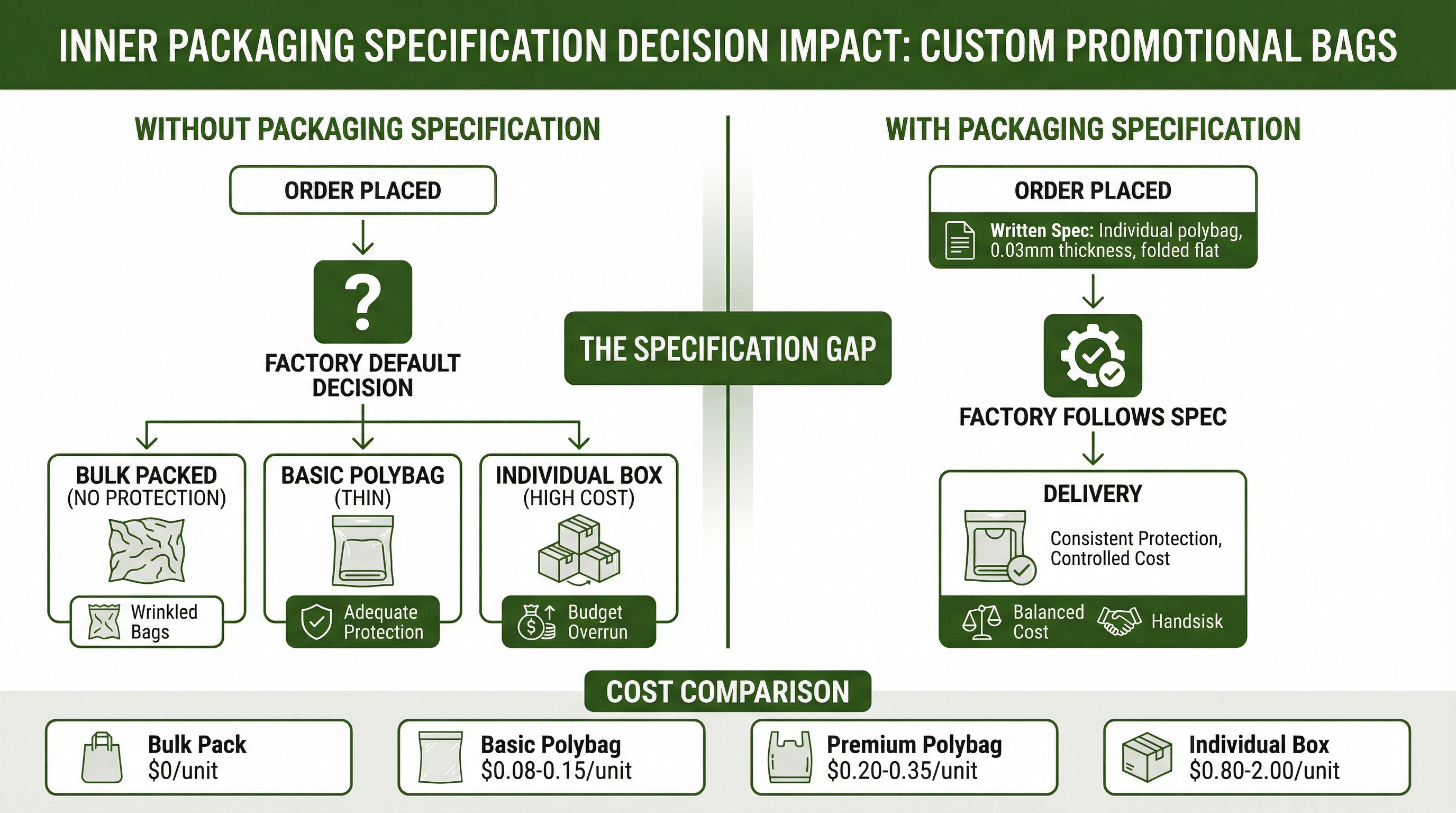
In practice, this is where the ordering process reveals a specification gap that experienced buyers learn to close. The question is not whether to specify inner packaging, but which packaging approach matches the product and its intended use. Individual polybag packaging—each bag sealed in a clear plastic sleeve—adds $0.08-0.15 per unit but ensures bags arrive crease-free and protected from moisture, dust, and handling marks. For premium corporate gifts or retail-ready merchandise, this cost is trivial compared to the presentation value it protects.
The specification complexity increases when considering polybag thickness. A 0.02mm polybag provides basic dust protection but offers minimal crease prevention. A 0.03mm polybag maintains bag shape during transit and provides meaningful protection. A 0.05mm polybag offers premium protection suitable for luxury items but adds cost that may not be justified for promotional giveaways. Without explicit thickness specification, the factory will default to whatever material is currently in stock—which may or may not match the protection level the product requires.
Folding method represents another specification element that is rarely documented but significantly affects arrival condition. A cotton tote bag can be folded flat (minimising carton space but creating fold creases), rolled (reducing creases but requiring more carton volume), or tissue-stuffed (maintaining shape but adding material cost and volume). Each approach has cost and presentation implications. When the specification simply states "individual polybag," the factory chooses the folding method based on production efficiency rather than presentation requirements. The bags arrive protected from dust but creased from folding—technically meeting the specification while failing the unstated expectation.
For New Zealand businesses ordering custom bags, the inner packaging conversation deserves explicit attention during the quotation stage. The specification should include: packaging type (bulk, individual polybag, tissue wrap, individual box), material thickness if applicable, folding method, and any special requirements for premium items. This level of detail may feel excessive for what seems like a minor element, but the detail prevents the scenario where bags arrive requiring remediation that was never budgeted.
The factories that consistently deliver presentation-ready products are not using superior packaging materials. They are working with clients who communicate packaging requirements explicitly, treating inner packaging as a specification element rather than an afterthought. The five minutes spent documenting packaging requirements during the quotation stage prevents the five hours spent steaming wrinkled bags before an event deadline. For procurement professionals managing custom bag projects, adding inner packaging to the standard specification checklist represents one of the highest-return investments in project documentation—a small addition that protects the presentation value of everything else the specification defines.