Insights
Why the Interior Finishing of Your Custom Corporate Gift Bag Determines Whether Recipients Experience Unwrapping or Retrieval
Procurement specifications for corporate gift bags address the exterior in detail but almost never specify the interior, leaving the most emotionally charged moment in the gifting sequence to default to a utilitarian shopping bag experience.
Published · By KiwiBag Works Team
There is a consistent pattern in how corporate gift bag specifications are structured, and it reveals a blind spot that affects the most critical moment in the gifting sequence. The specification typically addresses the bag’s exterior in considerable detail: material weight, colour reference, print method, logo position, handle type, dimensions. These are the elements visible when the bag is presented to the recipient, and procurement teams rightly invest attention in getting them right. What the specification almost never addresses is the bag’s interior—the surface, finishing, and presentation elements that the recipient encounters at the moment of opening. This omission means that the most emotionally charged moment in the corporate gifting experience—the moment the recipient reaches into the bag to discover its contents—defaults to whatever the factory’s standard interior construction happens to be. In most cases, that standard construction is an unfinished interior with visible seam allowances, raw fabric edges, and no presentation layer between the gift and the bag’s base. The exterior says “considered gift.” The interior says “retail carrier bag.” The recipient’s perception resolves this contradiction in favour of the interior experience, because the interior is what they encounter at the moment of highest emotional engagement.
The reason this specification gap persists is structural rather than negligent. Procurement briefs for custom bags are typically built from templates that evolved from retail and promotional bag ordering. Those templates were designed for bags whose primary function is carrying purchased items from a store to a destination—bags where the interior is irrelevant because the customer already knows what they bought and is simply transporting it. When these templates are adapted for corporate gift bags, the exterior specification fields transfer directly, but no interior specification fields exist because the original template never needed them. The procurement team fills in every field on the brief, believes the specification is complete, and submits it to the factory. The factory produces exactly what was specified. The result is a bag with a premium exterior and a utilitarian interior, and neither party recognises the gap because the brief appeared comprehensive.
The perceptual mechanism at work here is worth understanding because it explains why interior finishing has a disproportionate impact on how the gift is received. When a person is handed a gift bag, their visual system processes the exterior—the colour, the material texture, the logo—and forms an initial expectation about the quality and thoughtfulness of the gesture. This expectation is provisional. It is confirmed or contradicted by the tactile and visual experience of opening the bag. If the recipient parts the tissue paper, feels the rustle of coordinated wrapping, and discovers the gift nestled in a presentation layer, the initial expectation is confirmed and amplified. The gesture registers as deliberate, layered, and considered. If the recipient reaches into an open bag, touches bare fabric, and lifts the gift directly from the bag’s base, the initial expectation is contradicted. The exterior promised a gift experience; the interior delivered a retrieval experience. The brain resolves this mismatch by recategorising the object: it is not a gift bag but a branded bag that happens to contain a gift. The distinction matters because the first categorisation generates gratitude and relationship reinforcement, while the second generates a polite acknowledgment and nothing more.
In practice, this is often where corporate gift bag decisions start to diverge from their intended purpose in ways that procurement teams cannot diagnose from the specification alone. A company invests in 10-ounce organic cotton canvas, specifies a muted colour palette, selects a debossed logo at a restrained lower-corner position, and chooses cotton rope handles—every exterior element calibrated for executive gifting. The bag arrives from the factory looking exactly as specified. But when the recipient opens it, they encounter an unlined interior with overlocked seam edges, no tissue paper layer, and the gift sitting directly on the bag’s flat base. The experience of opening this bag is indistinguishable from reaching into a reusable shopping bag to retrieve groceries. Every investment in exterior quality is undermined by an interior that was never specified because the procurement brief did not include interior finishing as a specification category.
The interior finishing elements that transform a bag’s opening experience from retrieval to revelation are neither complex nor expensive, which is part of why the specification gap is so persistent—there is no cost barrier that would force procurement teams to notice it. The most impactful element is a tissue paper layer: two to three sheets of acid-free tissue in a colour that coordinates with the bag’s exterior, placed over the gift so that the recipient’s first interaction is with the tissue rather than the gift itself. This single addition changes the opening sequence from “reach in and lift out” to “part the tissue and discover,” which is the fundamental difference between retrieving an item and unwrapping a gift. The cost is approximately NZD 0.15 to NZD 0.30 per bag depending on tissue weight and whether it is custom-printed or plain. For a 300-unit corporate gift order, the total addition is between NZD 45 and NZD 90—less than the cost of a single replacement bag if the original specification fails to achieve its relational purpose.
Beyond tissue paper, the interior finishing options that procurement teams should evaluate include ribbon closure, interior colour coordination, and base padding. A ribbon tie—either a pre-attached ribbon that the recipient unties, or a separate ribbon that gathers the tissue paper at the bag’s opening—adds a deliberate “unwrapping” step that extends the anticipation phase of the gifting experience. The cost is NZD 0.20 to NZD 0.50 per unit for a satin or grosgrain ribbon in a coordinated colour. Interior colour coordination—where the bag’s interior surface is a different colour or finish from the exterior—creates a reveal moment when the bag is opened, signalling that the interior was designed with the same intention as the exterior. This is achieved either through a printed interior lining or by using a fabric with a contrasting interior face, adding NZD 0.40 to NZD 1.20 per unit depending on the method. Base padding—a rigid card insert or a padded base layer—prevents the gift from settling unevenly and ensures the presentation remains structured when the recipient looks into the bag. The cost is NZD 0.10 to NZD 0.25 per unit. None of these elements individually transforms the experience. Together, they create an interior environment that matches the exterior’s quality signal and sustains the gift classification through the opening sequence.
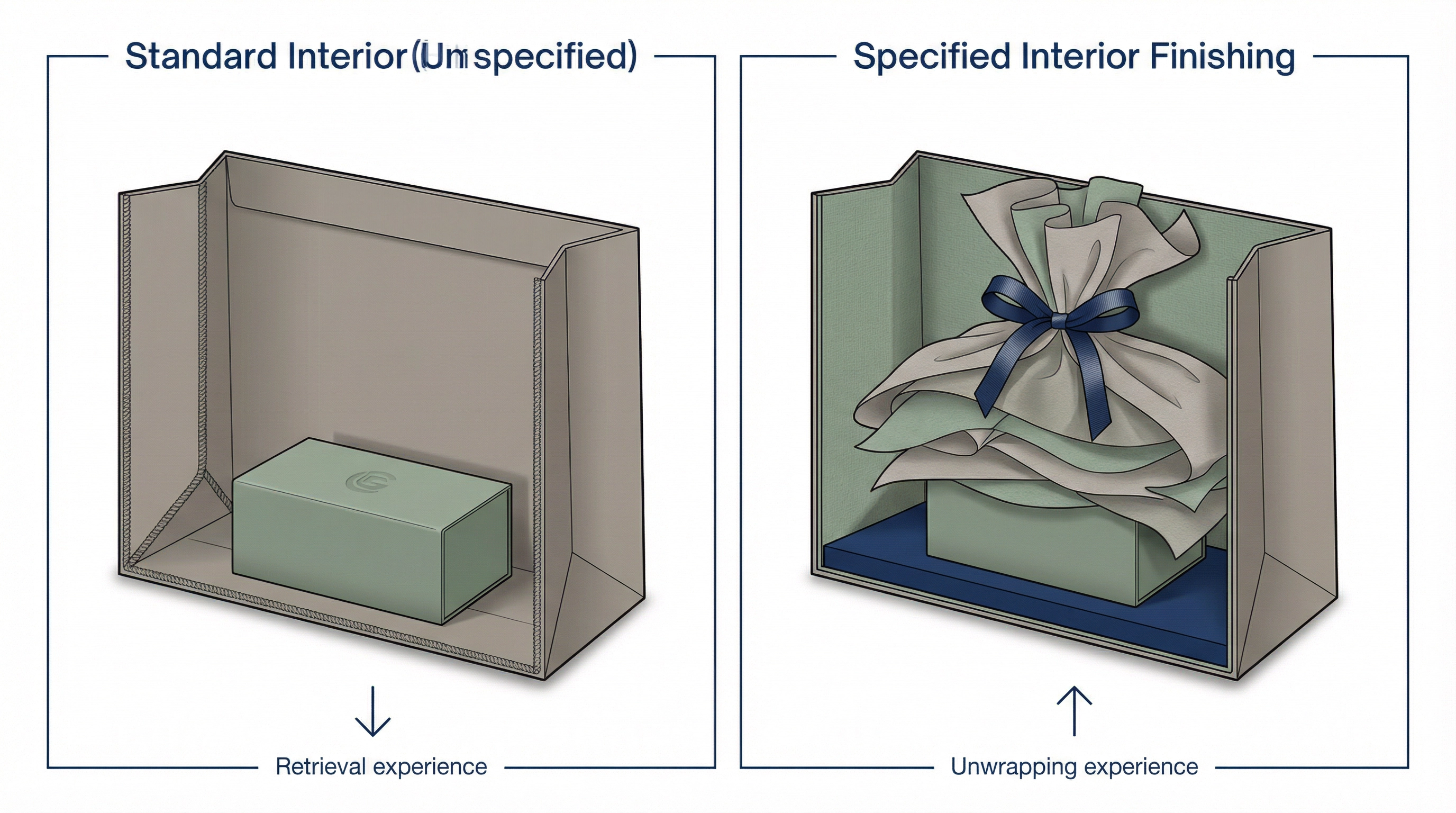
The New Zealand corporate gifting context adds a dimension to interior finishing that procurement teams sourcing from international suppliers frequently overlook. New Zealand business culture values authenticity and genuine consideration over performative generosity. A corporate gift bag that is beautifully constructed on the outside but utilitarian on the inside can be perceived as a gesture that prioritises appearance over substance—a reading that is particularly damaging in a business culture that values substance. Conversely, a bag with a thoughtfully finished interior communicates that the sender considered the recipient’s actual experience of receiving the gift, not just the visual impression at the moment of handover. This distinction resonates strongly in New Zealand’s relationship-driven business environment, where the quality of a gesture is evaluated by its depth rather than its surface. A custom eco bag with coordinated tissue paper and a simple ribbon closure communicates more genuine consideration than a more expensive bag with an unfinished interior, because the interior finishing demonstrates that someone thought about what the recipient would experience when they opened the bag—not just what they would see when they received it.
The factory production perspective on interior finishing reveals why the specification must be explicit rather than assumed. Factories that produce custom bags treat interior finishing as an add-on process rather than a standard inclusion, because the majority of their orders—retail bags, promotional bags, trade show bags—do not require interior presentation. The production line is set up to complete the bag’s construction (cutting, sewing, handle attachment, printing) and then move to quality inspection and packing. Adding interior finishing requires a separate station in the production flow: tissue paper insertion, ribbon attachment, base card placement. This station does not exist in the standard production line configuration, so it must be specifically requested and costed. If the procurement brief does not mention interior finishing, the factory will not add it, will not suggest it, and will not cost it—because from the factory’s perspective, the brief is the complete specification, and adding unrequested elements would be a production deviation. The specification gap is therefore self-reinforcing: procurement teams do not specify interior finishing because they do not know it is a variable, and factories do not suggest it because they only produce what is specified.
The timing of interior finishing specification within the ordering process matters more than procurement teams typically realise. Interior finishing elements need to be specified at the same stage as the bag’s structural design—during the initial brief, not as an afterthought during sample review. This is because certain interior finishing options affect the bag’s construction. A ribbon closure requires reinforced attachment points at the bag’s interior rim. A contrasting interior lining requires the fabric to be sourced and cut as part of the bag’s main production, not added later. A rigid base insert requires the bag’s base dimensions to accommodate the insert without bulging. If these elements are requested after the sample has been approved and production has begun, they either cannot be incorporated or require a production restart that adds cost and delays delivery. The procurement team that includes interior finishing in the initial specification gets it at marginal cost. The team that requests it mid-production pays a premium for what amounts to a production line reconfiguration.
For procurement teams evaluating how to match corporate gift formats to their intended business relationship objectives, the interior finishing specification deserves the same deliberate attention as the exterior material and print specification. The exterior determines how the bag looks when it is presented. The interior determines how the bag feels when it is opened. Presentation is a single moment—the handover. Opening is the experience that creates the emotional imprint, and the emotional imprint is what determines whether the gift achieves its relational purpose. A procurement brief that specifies “acid-free tissue paper, 17gsm, colour to coordinate with exterior; 15mm grosgrain ribbon closure in complementary tone; 1.5mm greyboard base insert” adds three lines to the specification document and approximately NZD 0.85 to NZD 1.50 per unit to the production cost. Those three lines determine whether the recipient’s experience of opening the bag is an act of unwrapping or an act of retrieval, and that distinction is the difference between a corporate gift that strengthens a relationship and a branded bag that merely contains one.
The pattern that consistently produces the strongest results in corporate gift bag programmes is not the most elaborate interior finishing but the most coherent one. A bag where the exterior material, colour, print position, and interior finishing all communicate the same message—“this was prepared specifically for you”—outperforms a bag with a more expensive exterior and a neglected interior. Coherence between exterior and interior is what creates the perception of intentionality, and intentionality is what distinguishes a gift from a transaction. The procurement specification that achieves this coherence is not longer or more complex than a standard specification. It simply includes the interior as a design surface rather than treating it as dead space. The bag has two experiences: the one the world sees and the one the recipient has. Most specifications only address the first. The second is the one that matters.