Procurement Strategy
Why a Suspiciously Low MOQ Should Raise Questions
When a supplier quotes a minimum order quantity significantly lower than industry norms, experienced buyers know to treat it as a yellow flag rather than a green light.
Published · By David Ross
When a supplier quotes a minimum order quantity significantly lower than industry norms, the instinct for most procurement officers is to celebrate. A lower commitment means less capital tied up in inventory, reduced risk if the product underperforms, and an easier approval process with finance. But in the world of custom bag manufacturing, an unusually low MOQ often signals something else entirely—and experienced buyers have learned to treat it as a yellow flag rather than a green light.
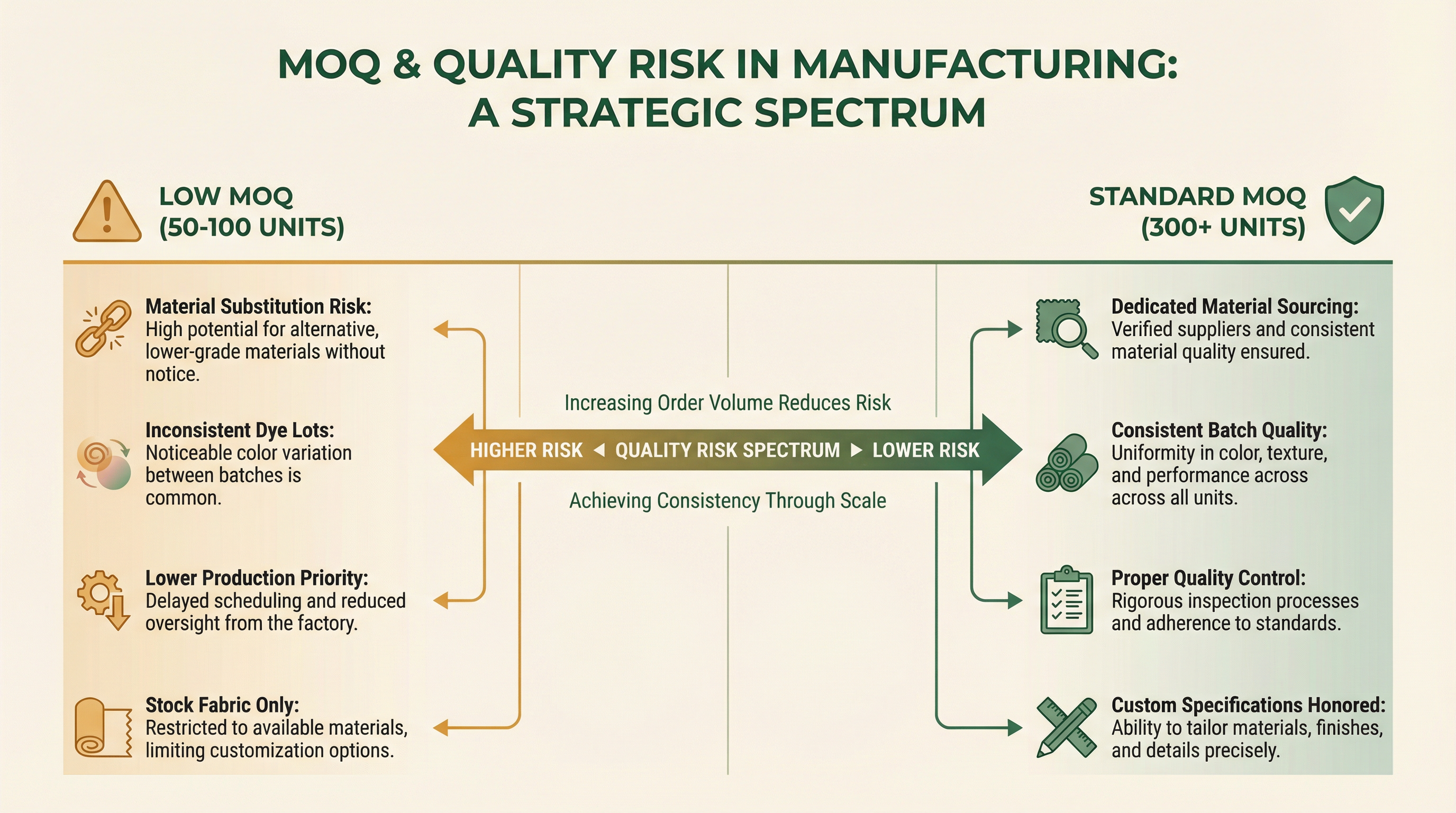
The logic behind this caution comes down to understanding how textile supply chains actually function. A bag manufacturer does not simply pull fabric from a shelf and start cutting. The cotton or jute or recycled polyester they use comes from upstream suppliers who themselves have minimum purchase requirements. A fabric mill producing custom-dyed material typically requires orders measured in hundreds or thousands of metres, not the few dozen needed for a small batch of bags. When a manufacturer claims they can produce 50 custom tote bags with your specific Pantone colour, the question worth asking is: where is that fabric coming from?
The answer, more often than not, involves compromise. The manufacturer may be using leftover stock from a previous client's order, which means the shade might be close to your specification but not exact. They might be substituting a lighter-weight fabric that happens to be available, resulting in bags that feel flimsier than the sample you approved. In some cases, particularly with offshore suppliers operating in highly competitive markets, the fabric composition itself may differ from what was promised. A bag specified as 100% organic cotton might arrive as a cotton-polyester blend, with the synthetic content added to reduce costs and meet the artificially low price point.
This is not to suggest that every low-MOQ supplier is acting in bad faith. Some manufacturers specialise in small-batch production and have built their business model around serving emerging brands and corporate buyers with modest requirements. These suppliers typically charge a premium per unit to offset the inefficiencies of short runs, and they are transparent about the trade-offs involved. The warning sign is not a low MOQ in isolation—it is a low MOQ combined with pricing that seems too competitive, or a supplier who is vague about material sourcing when pressed for details.
The sampling process often masks these issues. A pre-production sample is usually made with careful attention because the supplier knows it will be scrutinised. The fabric is selected from the best available stock, the stitching is done by a senior operator, and the printing is checked multiple times before shipping. But when the full order goes into production, the economics change. If the order quantity is too small to justify dedicated quality control, the bags may be produced as filler work between larger jobs, handled by less experienced staff, or rushed to clear the production line for more profitable orders. The result is a delivery that looks subtly different from the sample—not defective enough to reject outright, but noticeably inferior in ways that reflect poorly on your brand.
For procurement teams evaluating suppliers, the practical approach is to benchmark MOQ requirements across multiple quotes. If three suppliers quote an MOQ of 300 units and a fourth offers 50, that discrepancy deserves investigation rather than immediate acceptance. Ask the outlier supplier directly: how are they able to offer such a low minimum when others cannot? A credible answer might involve their access to stock fabrics, their willingness to charge higher per-unit prices, or their specialisation in small-batch work. An evasive answer—or one that simply promises they can "make it work"—suggests the cost savings will materialise somewhere, likely in places you would rather they did not.
The relationship between MOQ and quality is ultimately about alignment. A supplier's minimum order quantity reflects the realities of their supply chain, their production capacity, and their business model. When that number is artificially low, something in the equation has been adjusted to compensate. Understanding what that adjustment might be—and whether it affects the aspects of quality that matter most to your organisation—is the difference between a procurement win and a lesson learned the expensive way. For a more comprehensive view of how minimum order quantities are structured across the custom bag industry, the complete guide to MOQ factors provides additional context on what drives these thresholds.