Insights
Why Pantone Colour References Prevent Costly Custom Bag Reprints That Verbal Descriptions Cannot
The colour approval conversation happens in every custom bag project, yet the language used in that conversation creates systematic misunderstandings that only become visible after production is complete.
Published · By KiwiBag Works Team
There is a specific type of post-production dispute that appears in custom bag projects with remarkable consistency, and it always follows the same pattern. The client describes the desired colour in terms that seem perfectly clear—corporate blue, forest green, our brand red—and the factory produces bags that technically match those descriptions but somehow look wrong when they arrive. The colour is blue, but not the right blue. The green is forest-adjacent but not the forest green anyone had in mind. Both parties acted in good faith, yet the outcome satisfies neither.
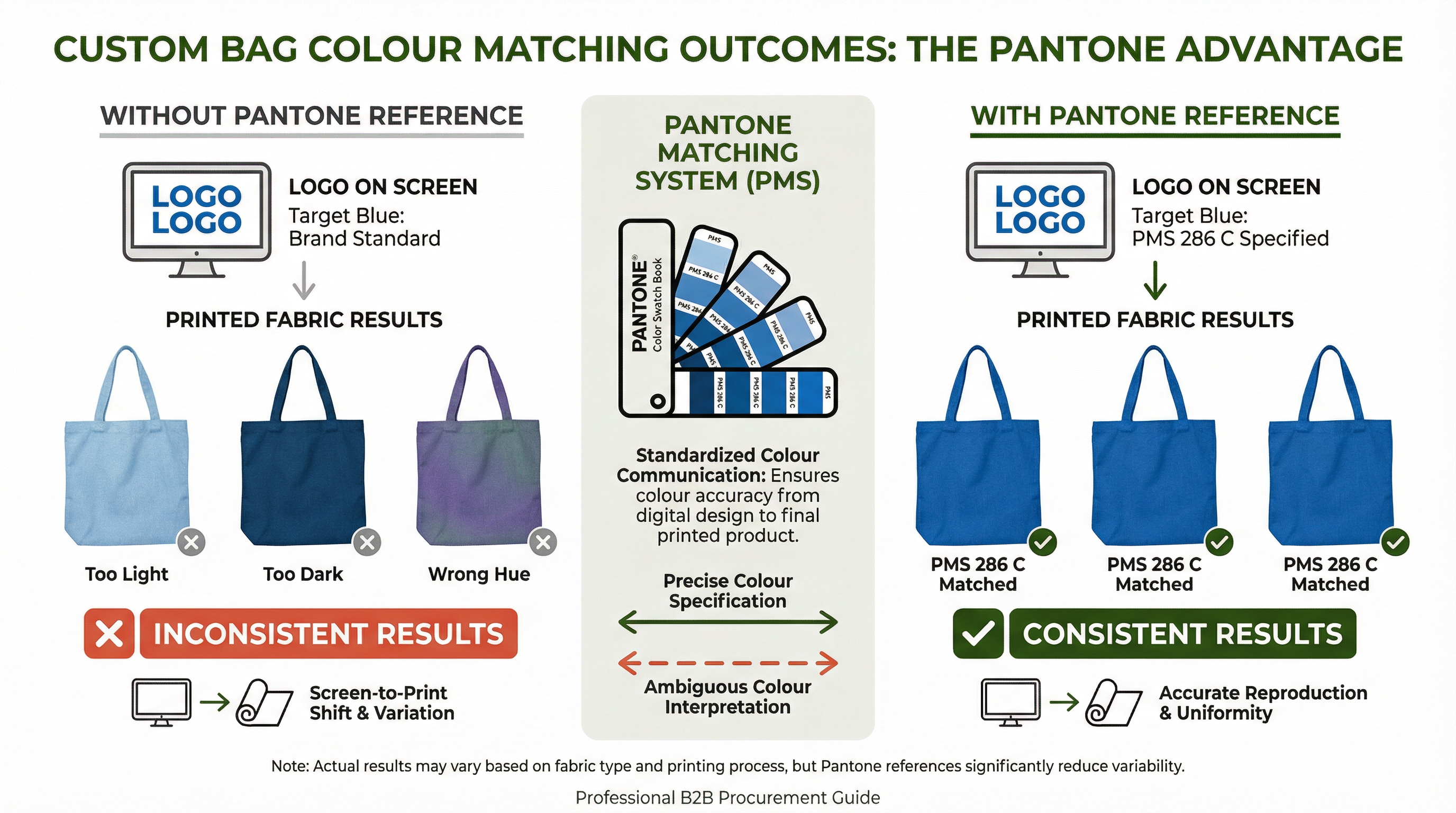
From a procurement perspective, this pattern reveals a fundamental communication gap that verbal descriptions cannot bridge. When someone says "navy blue," they are referencing a mental image formed by their specific experiences with colours they have personally categorised as navy. The factory receiving that instruction is working from an entirely different set of reference experiences. Both parties believe they understand the requirement. Both are working toward different targets. The gap between those targets only becomes measurable when physical bags exist for comparison.
The technical reality is that human colour perception is remarkably inconsistent. The same colour appears different under different lighting conditions, against different backgrounds, and to different individuals based on their unique visual processing. What appears as a rich, professional navy on a computer screen in a well-lit Auckland office may render quite differently on a factory floor in Guangzhou under fluorescent lighting. Without an objective reference point, there is no way to align these different perceptions toward a single, verifiable target.
This is precisely the problem that the Pantone Matching System was designed to solve. A Pantone reference—such as PMS 286 C for a specific blue—provides an objective, physically verifiable colour standard that removes interpretation from the equation. The factory does not need to guess what "corporate blue" means to the client. They mix ink to match PMS 286 C, verify the match against a physical Pantone swatch, and produce bags that will match that same swatch when they arrive at the client's location. The subjective conversation about colour becomes an objective specification.
What makes this particularly relevant for custom bag projects is the nature of fabric printing. Unlike paper printing, where colour management systems are highly refined, fabric printing introduces additional variables: the base colour of the fabric, the texture of the weave, the absorption characteristics of different materials. A colour that matches perfectly on smooth white paper may shift noticeably when printed on natural cotton canvas or textured jute. Pantone references account for these variables by providing a target that the factory can match regardless of substrate, rather than attempting to reproduce a digital file that was never designed for fabric reproduction.
The practical challenge is that many organisations do not have their brand colours defined in Pantone references. Brand guidelines often specify colours in RGB (for screens) or CMYK (for paper printing), neither of which translates directly to fabric printing. When procurement requests "the brand colour" from marketing, they may receive a hex code or RGB value that cannot be directly matched in fabric printing. The factory then faces a choice: attempt to convert the digital value to a printable equivalent (introducing interpretation and potential error) or request clarification that delays the project.
In practice, this is often where customization decisions begin to go wrong. The procurement team, wanting to maintain project momentum, accepts the factory's "best match" interpretation rather than pausing to establish proper Pantone references. The sample arrives, the colour looks approximately correct under office lighting, and approval is granted. Bulk production proceeds. When the finished bags arrive and are placed next to existing branded materials, the colour difference becomes apparent—not dramatically wrong, but noticeably inconsistent. The bags cannot be rejected as defective because they match the approved sample. They simply do not match the brand standard that was never properly communicated.
The cost of this pattern extends beyond the immediate project. Custom bags with slightly-off brand colours create visual inconsistency across marketing materials. They photograph differently than other branded items. They undermine the professional impression that justified the investment in custom merchandise. The savings from skipping proper colour specification are illusory—they simply defer the cost to brand dilution and eventual replacement orders.
For procurement professionals managing custom bag projects, colour specification deserves the same rigour as material specifications or quantity requirements. Before engaging suppliers, the question should be asked: do we have Pantone references for our brand colours, and if not, who needs to establish them? This conversation with marketing or brand management should happen before artwork is submitted, not after samples reveal colour discrepancies. The ordering workflow should include colour verification as an explicit checkpoint, with Pantone references documented in writing rather than assumed from verbal descriptions.
The factories that consistently deliver colour-accurate custom bags are not using superior printing technology. They are working with clients who provide unambiguous colour specifications from the outset. The difference between a custom bag that reinforces brand identity and one that subtly undermines it often traces back to a single early decision: whether colour was communicated through subjective description or objective Pantone reference. That decision, made in the first week of a project, determines outcomes that will be visible for years as the bags circulate through events, offices, and daily use.