Procurement Strategy
Why the Per-Unit Savings from Higher MOQ May Not Actually Save Money on Custom Jute Bags
The calculation that justifies ordering 1,000 custom jute bags instead of 500 often ignores the carrying costs, obsolescence risk, and capital opportunity cost that can erase the apparent per-unit savings entirely.
Published · By Emily Zhang
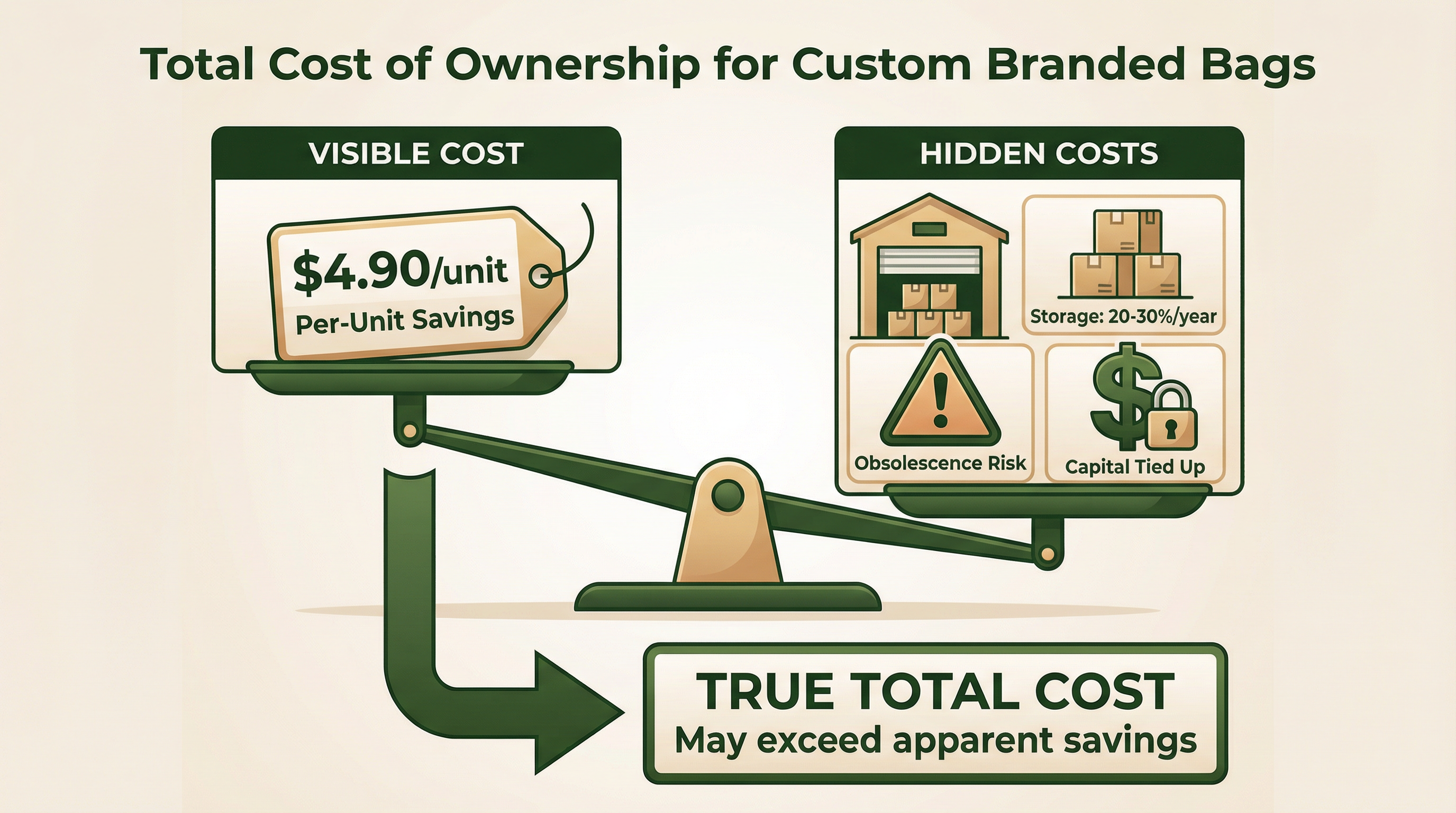
The arithmetic that procurement teams use to justify ordering at higher quantity thresholds typically focuses on a single variable: the per-unit price. A supplier quotes $5.80 per bag at 500 units and $4.90 per bag at 1,000 units. The calculation appears straightforward—ordering double the quantity saves $0.90 per unit, or $900 across the larger order. This is the number that appears in budget justifications, approval requests, and vendor comparison spreadsheets. What rarely appears in these documents is the total cost of ownership, which includes storage, obsolescence risk, and the opportunity cost of capital tied up in inventory that may sit in a warehouse for months.
The gap between per-unit price and total cost becomes particularly significant for custom branded products. A generic tote bag that fails to sell can be liquidated through discount channels, donated for tax benefit, or held indefinitely until a buyer emerges. A custom jute bag printed with a specific company logo, event date, or campaign message has no secondary market. If the inventory exceeds actual consumption, the surplus represents a complete write-off rather than a discounted sale.
Carrying costs for promotional merchandise typically range from 20 to 30 percent of the product's value annually. This figure includes warehouse storage fees, insurance, handling, and the cost of capital that could otherwise be deployed elsewhere in the business. For a $4.90 bag held in storage for twelve months, carrying costs add approximately $1.00 to $1.50 to the effective unit cost. The $0.90 per-unit savings from ordering at the higher MOQ threshold disappears entirely if the additional inventory sits in storage for more than eight to ten months.
The calculation becomes more problematic when obsolescence risk enters the equation. Custom branded bags are vulnerable to a range of events that can render inventory worthless overnight. A corporate rebrand that changes the logo, a merger that eliminates the company name, a campaign that concludes before the inventory is consumed, or simply a design refresh that makes the previous version look dated—any of these scenarios transforms stored inventory from an asset into a liability. Unlike raw materials or generic products, custom branded merchandise cannot be repurposed or resold. The write-off is total.
In practice, this is often where procurement decisions around order quantities start to be misjudged. The approval process focuses on the visible savings—the difference between the per-unit price at 500 versus 1,000 units—while treating the carrying costs and obsolescence risk as theoretical concerns that may or may not materialise. The problem is that these costs are not theoretical; they are predictable and quantifiable, even if the specific timing is uncertain.
Consider a scenario that plays out regularly in corporate procurement. A marketing team requests 500 custom jute bags for an upcoming trade show. The procurement team obtains quotes and discovers that ordering 1,000 units reduces the per-unit cost by 15 percent. The budget approval request highlights the $450 savings from ordering at the higher quantity. What the request does not highlight is that the marketing team has no confirmed use for the additional 500 bags. The assumption is that future events will absorb the surplus, but no specific events are scheduled and no budget allocation exists for distributing them.
Six months later, the company announces a brand refresh. The new visual identity includes an updated logo and colour palette. The 500 surplus bags, still sitting in storage, now feature the old branding. They cannot be used at future events without creating brand inconsistency. The options are limited: donate them and claim a tax deduction at a fraction of their cost, dispose of them, or continue paying storage fees while hoping someone finds a use for outdated branded merchandise. The $450 savings from the higher MOQ has been replaced by a $2,450 loss—the cost of the surplus inventory plus six months of storage fees.
This pattern repeats across organisations of all sizes, yet the lesson rarely translates into changed procurement practices. The per-unit price remains the primary decision variable because it is concrete, comparable, and easy to justify in approval workflows. The carrying costs and obsolescence risk are harder to quantify and easier to dismiss as unlikely scenarios that probably will not happen this time.
The connection to understanding how suppliers structure their minimum order requirements for custom bags provides important context here. Suppliers set MOQ thresholds based on their production economics—setup costs, material minimums, and efficiency considerations. These thresholds are not arbitrary, but they are also not designed with the buyer's total cost of ownership in mind. A supplier benefits from larger orders regardless of whether the buyer can actually consume the inventory within a reasonable timeframe.
The procurement teams who avoid this trap tend to apply a different calculation framework. Rather than comparing per-unit prices at different quantity thresholds, they calculate the total cost of ownership at each option. This calculation includes the purchase price, estimated carrying costs based on realistic consumption timelines, and a risk-adjusted factor for obsolescence. For custom branded products with limited shelf life or high rebrand risk, this factor can be substantial.
Some organisations address this by establishing inventory holding policies that cap the maximum months of supply for promotional merchandise. A policy that limits custom branded inventory to six months of projected consumption forces procurement teams to justify any order that exceeds this threshold. The justification must address not just the per-unit savings but also the specific plan for consuming the additional inventory within the policy timeframe.
The opportunity cost of capital adds another dimension to this calculation. Money spent on surplus inventory is money that cannot be deployed elsewhere in the business. For organisations with constrained budgets or high-return investment opportunities, the capital tied up in warehouse inventory has a real cost that extends beyond storage fees. A $2,450 inventory surplus represents capital that could have generated returns elsewhere—whether through marketing activities, equipment upgrades, or simply earning interest in a business account.
The fundamental issue is that procurement approval processes are optimised for comparing visible costs rather than total costs. The per-unit price is visible; the carrying costs and obsolescence risk are not. Changing this dynamic requires either modifying the approval process to include total cost calculations, or building sufficient institutional memory that decision-makers recognise the pattern and apply appropriate scepticism to per-unit savings claims.
For custom branded merchandise specifically, the safest approach is often to order closer to confirmed consumption requirements and accept the higher per-unit cost as insurance against obsolescence risk. The $0.90 per-unit premium for ordering 500 bags instead of 1,000 is a known, fixed cost. The potential write-off from surplus inventory is an unknown cost that could easily exceed the premium many times over. Risk-adjusted decision-making favours the certain cost over the uncertain but potentially larger loss.
This does not mean that higher MOQ thresholds are never appropriate. When consumption is predictable, brand stability is high, and storage costs are minimal, ordering at higher quantities can deliver genuine savings. The key is ensuring that the decision is based on realistic consumption projections rather than optimistic assumptions, and that the total cost calculation includes all relevant factors rather than just the per-unit price that appears on the supplier quote.