Guides
Why Print Method Selection Locks in Your Custom Eco Bag Timeline Before You Realise It
Discover how choosing screen printing vs digital printing for custom eco bags creates hidden timeline constraints. Expert analysis of setup time, colour complexity, and production scheduling.
Published · By David Ross
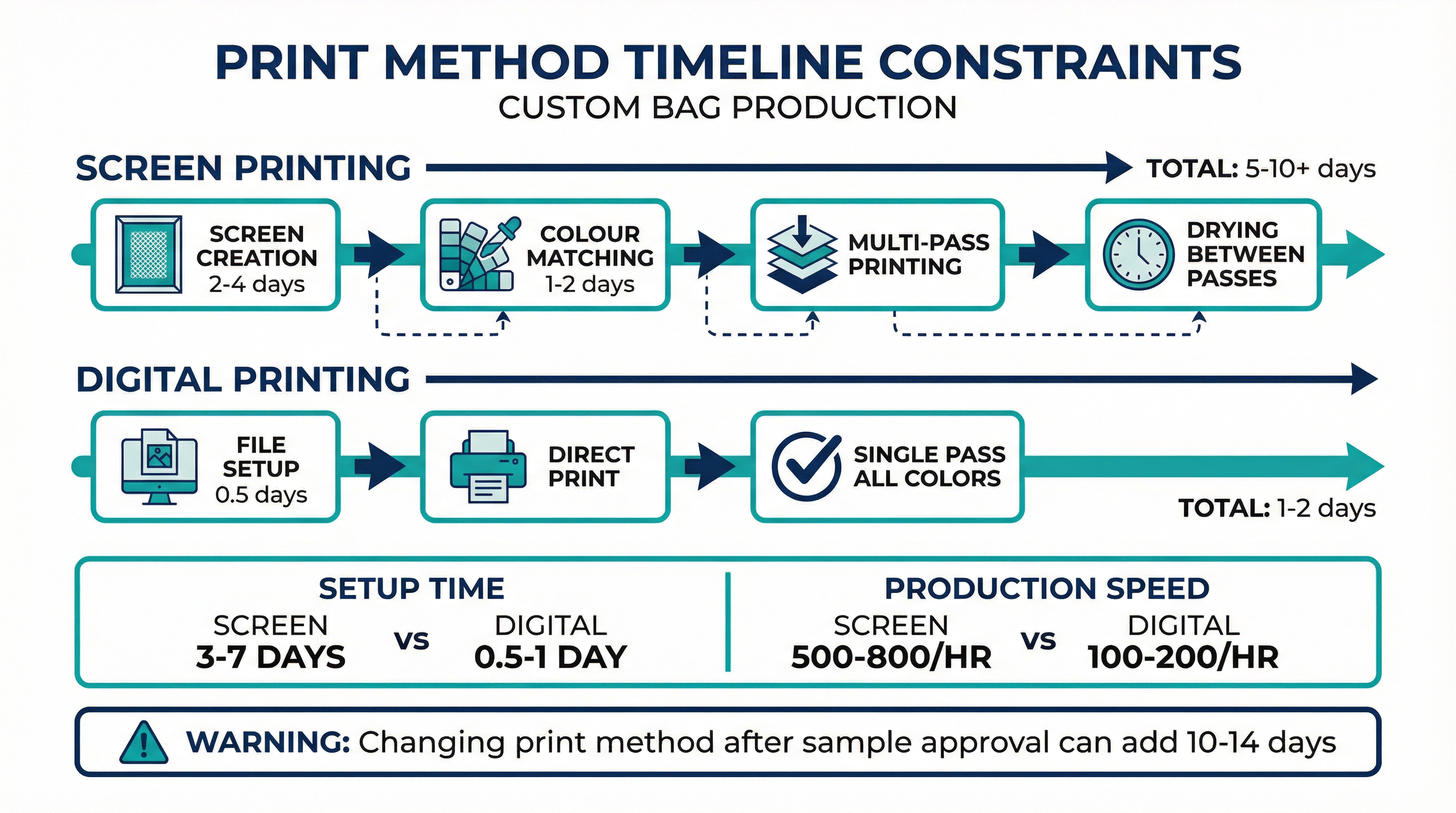
There is a particular moment in the custom bag procurement process where timeline decisions get made without anyone recognising them as timeline decisions. It happens during the design phase, when someone selects a print method based on visual outcome or budget—without understanding that this choice has just locked in a production schedule that cannot be compressed later.
The practical reality is that print method selection is not simply a finishing decision. It is a production architecture decision. Screen printing, digital transfer, heat transfer vinyl, embroidery—each method carries its own setup requirements, production sequencing, and drying or curing intervals. When buyers treat this as a late-stage aesthetic choice, they often discover the timeline implications only after the production window has already narrowed.
Consider the mechanics of screen printing for custom eco bags. Before any ink touches fabric, screens must be created—one for each colour in the design. A three-colour logo requires three separate screens, each involving coating, exposure, and drying. This preparation phase typically consumes 2-4 days before production can begin. For a single-colour design on a standard cotton tote, this is manageable. For a five-colour gradient design with Pantone-matched corporate colours, the setup phase alone can extend to 5-7 days.
What compounds this is the sequential nature of multi-colour screen printing. Each colour must be printed and dried before the next colour is applied. A four-colour design does not simply take four times longer than a single-colour design—it requires four separate production passes with drying intervals between each. In humid conditions or with heavy ink deposits, these intervals extend further. The production team cannot accelerate this physics.
Digital printing presents a different timeline profile. There are no screens to create, no colour separations to prepare. The design file transfers directly to the printing equipment, and full-colour output happens in a single pass. For complex artwork with gradients, photographic elements, or variable data, digital printing can reduce setup time from days to hours. This makes it attractive for rush orders or prototype quantities.
However, digital printing carries its own constraints that are less visible in initial timeline discussions. The per-unit production speed is often slower than screen printing for large quantities. A screen printing line running a single-colour design can produce 500-800 bags per hour once setup is complete. Digital printing, depending on equipment and design complexity, may produce 100-200 bags per hour. For an order of 5,000 units, this difference translates to significant production time variation.
The decision point that creates the most timeline disruption is changing print methods after sample approval. This happens more frequently than procurement teams expect. A buyer approves a digitally printed sample, then requests screen printing for the production run to reduce per-unit cost. Or a screen-printed sample reveals colour matching issues, prompting a switch to digital for better accuracy. Each method change effectively restarts the pre-production phase—new setup, new test prints, new approval cycles.
In practice, this is often where production timeline estimates start to diverge from reality. The original quote assumed one print method throughout. The change request arrives after materials have been ordered, sometimes after production scheduling has been confirmed. The factory must reallocate equipment, potentially reschedule other orders, and repeat quality verification steps. What appears on paper as a simple substitution can add 10-14 days to the delivery schedule.
Specialty finishes introduce additional timeline layers that are rarely discussed during initial quoting. Metallic inks require extended curing times—the particles need proper setting to achieve the desired reflective quality. Raised or textured prints involve additional passes and specialised equipment. Glow-in-the-dark or thermochromic inks have specific temperature and humidity requirements during application. Each specialty element adds process steps that cannot be parallelised with other production activities.
For New Zealand buyers sourcing custom eco bags, understanding these print method timeline dynamics becomes particularly relevant when coordinating with offshore manufacturers. The production time quoted by a Chinese or Vietnamese factory assumes a specific print method. If that method changes after the quote is accepted, the timeline adjustment may not be communicated clearly—or may be communicated too late to affect shipping arrangements. Buyers who have studied the complete picture of how long custom bag production actually takes are better positioned to ask the right questions before print method decisions become irreversible.
The practical guidance emerging from this pattern is straightforward but frequently overlooked. Print method selection should happen during the specification phase, not the design refinement phase. The timeline implications should be explicitly discussed before artwork development begins. And any mid-process method changes should be evaluated not just for cost impact, but for the full cascade of timeline consequences they create.