Insights
Why the Print Position on Your Custom Corporate Gift Bag Determines Whether Recipients Classify It as a Gift or a Promotional Item
The position of a logo on a corporate gift bag is not a design detail but a classification signal that tells recipients whether they are receiving a gift or branded promotional merchandise.
Published · By KiwiBag Works Team
There is a production decision that occurs on every custom corporate gift bag order, and it is almost never specified by the procurement team. The decision is where, exactly, the logo or brand mark will be positioned on the bag’s surface. In the absence of a specific instruction, the factory defaults to centre-front placement at eye level—the position that maximises brand visibility when the bag is carried. This default makes sense for retail carrier bags and trade show giveaways, where the bag’s primary function is mobile advertising. It does not make sense for corporate gift bags, where the bag’s primary function is to frame a gesture of appreciation or relationship investment. The position of the print on a custom bag is not a design detail. It is a classification signal. It tells the recipient, within the first second of visual contact, whether they are receiving a gift or a branded promotional item, and that classification determines how the entire gesture is interpreted.
The misjudgment stems from how procurement briefs are structured. A typical brief for custom corporate gift bags specifies the bag dimensions, material, colour, print method, and artwork file. The artwork file contains the logo at the correct resolution and colour profile, but it rarely includes a positional specification—a defined placement zone with exact coordinates relative to the bag’s edges. The factory’s pre-press team receives the artwork and places it according to their standard template, which positions the logo at the horizontal and vertical centre of the bag’s front panel. This placement is technically correct—it is centred, balanced, and produces the most symmetrical visual result. It is also the placement that most strongly activates the recipient’s “promotional item” pattern recognition, because centre-front logo placement is the universal visual language of branded merchandise. Every conference tote bag, every retail shopping bag, every promotional giveaway the recipient has ever received used centre-front placement. By defaulting to the same position, the corporate gift bag enters the same mental category regardless of its material quality, construction, or the value of its contents.
The factory floor perspective on this is instructive because it reveals why the default persists. When a production order arrives without positional specifications, the screen printing or heat transfer team sets up the print using their standard jig—a positioning guide that centres the artwork on the panel. Changing the position requires creating a new jig or adjusting the existing one, which adds approximately fifteen to twenty minutes of setup time per production run. For a factory processing dozens of orders daily, the incentive to use the standard jig unless specifically instructed otherwise is significant. The production manager is not making a design decision. They are making an efficiency decision, and the efficiency decision happens to produce a design outcome that undermines the bag’s gifting purpose. This is not negligence—it is the natural result of a specification gap that the procurement team did not know existed.
The mechanism through which print position affects recipient perception operates at a level that is difficult to override with other design elements. Consumer psychology research on packaging and product presentation consistently demonstrates that visual weight distribution—where the eye is drawn first and how it moves across the surface—determines the object’s perceived category before conscious evaluation begins. A logo positioned at the centre of a bag’s front panel creates a symmetrical, brand-dominant visual hierarchy. The eye lands on the logo first, identifies the brand, and categorises the object as branded merchandise. A logo positioned at the lower-right corner of the same bag creates an asymmetrical hierarchy where the eye first registers the bag’s material, colour, and form, then discovers the brand mark as a secondary element. The same bag, the same logo, the same print quality—but the perceptual sequence is reversed, and that reversal changes the classification from “branded item” to “quality item with brand attribution.”
In practice, this is often where corporate gift bag decisions start to diverge from their intended purpose. A procurement team invests in premium 12-ounce organic cotton canvas, specifies a muted colour palette appropriate for executive gifting, selects a subtle debossed print method—and then submits artwork without positional instructions, resulting in a centre-front logo that visually overpowers every other design decision. The material says “premium gift.” The colour says “considered gesture.” The print position says “promotional bag.” The recipient’s brain resolves this contradiction by defaulting to the most familiar pattern, which is the promotional classification. All the investment in material and colour is subordinated to a print position that was never deliberately chosen.
The distinction between print positions maps onto specific corporate gifting contexts in ways that procurement teams can use as a decision framework. For client appreciation gifts distributed during relationship-building occasions—annual reviews, contract renewals, milestone celebrations—a lower-corner placement or a tone-on-tone debossed logo on the bag’s front panel communicates restraint and confidence. The brand is present but not assertive, which signals that the company values the relationship more than the branding opportunity. For employee recognition gifts distributed during internal events—onboarding, team celebrations, service anniversaries—a centre-front placement with moderate logo sizing is appropriate because the internal audience expects and appreciates visible brand identity as a marker of belonging. For partner or supplier gifts distributed during commercial negotiations or joint ventures, an interior placement—logo printed on the inside flap or the bag’s base—communicates that the gift is genuinely about the relationship, not about brand exposure. Each of these placements serves a different relational purpose, and each produces a different recipient response.
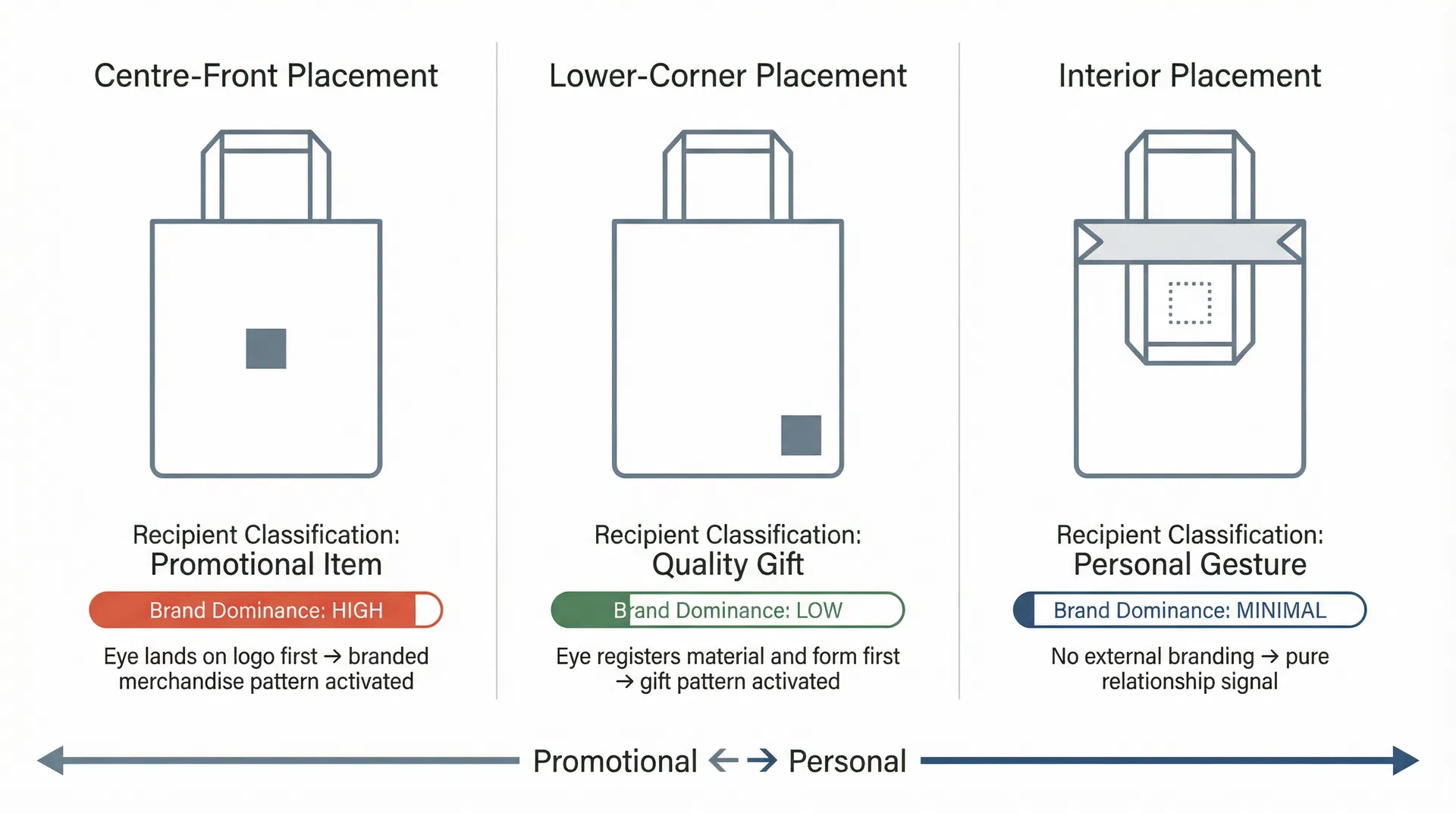
The New Zealand business context adds a cultural dimension to print placement that procurement teams operating from international brand guidelines often miss. New Zealand business culture is characterised by a preference for understatement and authenticity over overt self-promotion. A corporate gift bag with a large, centre-front logo may be perceived differently in Auckland than in London or Singapore—not because the logo is objectionable, but because the cultural expectation for corporate gifts in New Zealand leans toward genuine generosity rather than branded visibility. A Kiwi business executive receiving a gift bag that looks like a promotional item may interpret it as the company prioritising its own brand exposure over the recipient’s experience, which is precisely the opposite of the intended message. The print placement that works for a global brand activation campaign is not the print placement that works for a relationship-building gift in the New Zealand market, and the difference is not about logo size—it is about logo position.
The production cost of changing print position is negligible in the context of a corporate gift bag order, which is part of why the specification gap is so persistent—there is no cost barrier to getting it right, only an awareness barrier. Moving a logo from centre-front to lower-right on a screen-printed cotton tote adds no material cost and approximately NZD 0.05 to NZD 0.10 per unit in additional setup time, amortised across a typical order of 200 to 500 units. Switching from a surface print to a tone-on-tone deboss adds NZD 0.30 to NZD 0.60 per unit depending on the logo complexity and the fabric weight. These are not premium upgrades. They are specification refinements that cost less than the tissue paper most companies use to wrap the gifts inside the bag. The tissue paper is specified because procurement teams understand its presentation function. The print position is not specified because procurement teams do not recognise it as a presentation variable.
The interaction between print position and print method creates compounding effects that further separate gift-appropriate bags from promotional ones. A screen-printed logo in a contrasting colour at centre-front is the highest-visibility combination—and the most promotional. A debossed logo in a tone-on-tone colour at the lower corner is the lowest-visibility combination—and the most gift-appropriate. Between these extremes, there are calibrated combinations that serve different purposes: a small screen-printed logo at the lower-right works for mid-tier corporate gifts where brand presence is desired but not dominant. A foil-stamped logo at the centre-bottom—below the bag’s visual midpoint—creates a premium impression that balances brand visibility with gift positioning. The factory can execute any of these combinations with equal ease, but only if the procurement specification includes both the print method and the positional coordinates. A specification that says “screen print, Pantone 432 C” without a position reference will always produce centre-front placement, because that is the factory’s default interpretation of an unspecified position.
The afterlife of the bag—its use beyond the gifting occasion—is where print position has its most sustained impact on brand perception. A corporate gift bag with a subtle corner logo becomes a daily-use tote that the recipient carries to meetings, markets, and social occasions. The brand mark is visible but not dominant, creating the impression that the recipient chose to carry a quality bag that happens to be from a particular company. A bag with a centre-front logo becomes a walking advertisement that the recipient may feel self-conscious carrying in non-professional contexts. The first bag earns ongoing brand impressions through voluntary daily use. The second bag earns a single impression at the gifting event and then migrates to the back of a cupboard. The difference in long-term brand value between these two outcomes is substantial, and it traces back entirely to a print position that was never specified in the procurement brief.
For teams assessing which corporate gift formats align with specific business relationship objectives, the print position specification deserves to be treated as a strategic decision rather than a production default. The position is not about where the logo looks best on the bag. It is about what classification signal the logo’s position sends to the recipient, and whether that signal aligns with the relationship purpose the gift is intended to serve. A procurement brief that includes a positional specification—“logo positioned at lower-right, 30mm from bottom edge and 25mm from right edge”—takes thirty seconds longer to write than one that includes only the artwork file. That thirty seconds determines whether the factory produces a gift bag or a promotional bag, and the recipient will know the difference before they ever look at the logo itself.
The pattern that consistently produces the strongest results in corporate gifting is not the absence of branding but its deliberate subordination to the gift’s relational purpose. The logo remains present—it must, because the gift is from a specific company with a specific identity—but its position on the bag communicates whether the company’s priority is brand exposure or recipient experience. When the logo sits at the centre, the company’s priority is legible. When the logo sits at the periphery, the recipient’s experience is centred. Both are valid choices, but they serve different purposes, and the procurement team that makes this choice deliberately rather than by factory default is the one whose corporate gift bags actually function as gifts.