Quality Control
Why Quality Control Inspection Adds Days You Cannot Recover for Custom Wine Bags
QC inspection scheduling creates hidden timeline dependencies for custom wine bags. Expert analysis of the inspection-rework cycle that procurement teams frequently miscalculate.
Published · By David Ross
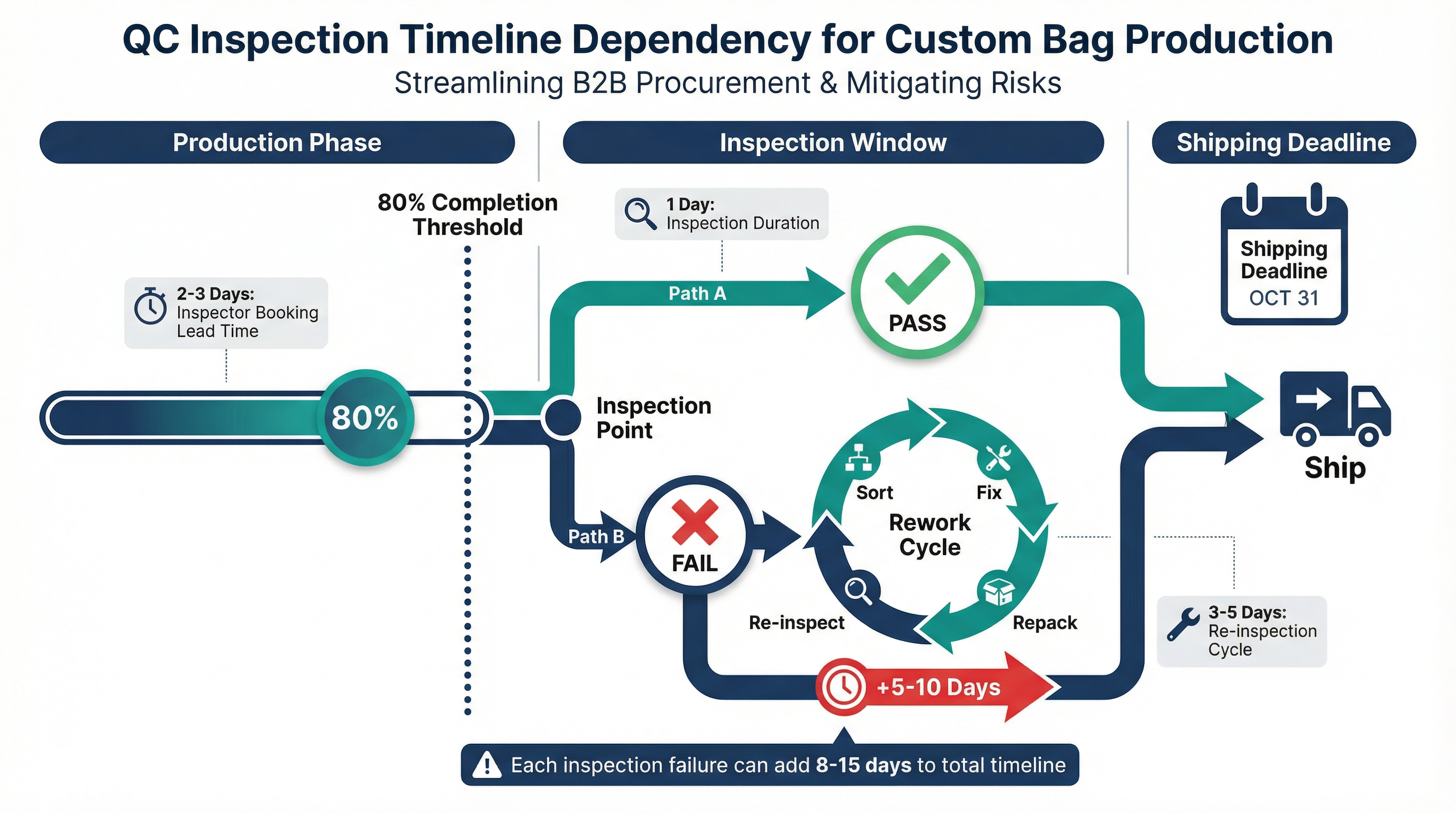
There is a persistent miscalculation in custom wine bag procurement that surfaces most painfully when orders are destined for corporate events with immovable dates. The error occurs when procurement teams treat quality control inspection as a simple checkbox at the end of production rather than recognising it as a timeline variable with its own scheduling constraints, failure scenarios, and recovery windows.
The arithmetic seems straightforward on paper. Production takes four weeks, inspection takes one day, shipping takes two weeks. Total timeline: six weeks plus one day. This calculation fails because it treats inspection as a passive observation rather than an active process with prerequisites, booking requirements, and consequential outcomes that can reset portions of the timeline entirely.
In practice, this is often where production timeline decisions start to be misjudged. The first constraint that catches teams off guard is the completion threshold requirement. Pre-shipment inspection cannot be conducted on partially completed orders. Industry standard requires eighty percent or more of the order to be finished, packed, and ready for examination before inspectors can meaningfully assess the shipment. For a custom wine bag order of one thousand units, this means at least eight hundred bags must be completely sewn, printed, quality-checked by the factory, and packed into cartons before third-party inspection can even be scheduled.
This threshold creates a scheduling dependency that procurement calendars rarely capture. If production encounters any delay that pushes completion below the threshold on the planned inspection date, the inspection must be rescheduled. Rescheduling is not instantaneous. Third-party inspection companies typically require two to three business days advance notice for booking, and inspector availability varies significantly by region and season. During peak production periods before major holidays, securing an inspector for a specific date may require a week or more of lead time.
The second miscalculation involves what happens when inspection reveals problems. Quality control inspection is not a formality designed to generate paperwork. For custom wine bags intended for corporate gifting, inspectors examine print registration, colour consistency across the batch, stitching integrity, handle attachment strength, and packaging presentation. Any of these elements can fail to meet specifications, and failure triggers a cascade that most timelines do not accommodate.
When inspection identifies defects exceeding acceptable quality limits, the factory must sort, rework, or replace affected units. Rework for custom wine bags might involve reprinting logos that show colour variance, restitching handles that fail pull tests, or replacing units with visible fabric flaws. This process typically requires five to ten additional production days depending on defect severity and factory capacity. After rework completion, re-inspection must be scheduled and conducted. The re-inspection cycle adds another three to five days minimum, assuming the second inspection passes.
The compounding effect becomes severe when orders have hard deadlines. A corporate client ordering custom wine bags for an annual conference cannot shift the event date to accommodate production delays. If the initial inspection fails and rework pushes the order past the sea freight cutoff, the only remaining option is air freight at five to ten times the shipping cost. Some procurement teams discover this reality only after the inspection report arrives, leaving insufficient time for any recovery strategy.
There is a particular pattern with custom wine bags that amplifies inspection risk. Wine bags for corporate gifting typically feature precise branding requirements—Pantone colour matching, centred logo placement, consistent print density across all units. These specifications create more inspection checkpoints than generic promotional bags, and each checkpoint represents a potential failure point. A batch of plain cotton totes might pass inspection with minor colour variation that would fail a corporate wine bag order where brand consistency is paramount.
The timeline buffer that experienced procurement teams build for inspection is not arbitrary padding. It reflects the statistical reality that first-pass inspection failure rates for custom printed products range from fifteen to twenty-five percent depending on factory quality systems and order complexity. Building a one-week buffer after planned production completion provides space for one rework-reinspection cycle without triggering emergency shipping measures.
Buyers who have studied the complete picture of how long custom bag production actually takes understand that quality control inspection represents a decision point, not merely a verification step. The inspection report determines whether the order proceeds to shipping as planned, enters a rework cycle, or in worst cases, requires partial or complete remanufacturing. Each outcome carries different timeline implications that cannot be compressed once the inspection result is known.
The most consequential error is treating inspection scheduling as something that happens automatically once production finishes. In reality, inspection requires coordination between buyer, factory, and inspection provider. The factory must confirm readiness, the inspection company must have available inspectors in the region, and the buyer must have authorised the inspection scope and sampling plan. Any breakdown in this coordination chain delays the inspection date, and delayed inspection compresses every subsequent timeline element.
For custom wine bag orders with event deadlines, the practical approach is to work backward from the required delivery date and build inspection timing into the critical path rather than treating it as an afterthought. This means confirming inspector availability before finalising the production schedule, establishing clear communication protocols for production status updates, and having contingency shipping options priced and ready before the inspection date arrives. The alternative is discovering at the worst possible moment that quality control inspection is not a one-day formality but a multi-day process with failure modes that can consume weeks of carefully planned timeline.