Insights
Why Changing Order Quantity After Sample Approval Creates Hidden Costs That Erase Expected Savings
The decision to increase order quantity after sample approval appears financially logical—larger orders mean lower unit costs. Yet this late-stage change triggers a cascade of production adjustments that often eliminate the anticipated savings entirely.
Published · By KiwiBag Works Team
There is a particular type of decision that procurement teams make with the best intentions, yet it consistently produces outcomes that contradict the expected benefits. This decision occurs when, after sample approval, someone realises that ordering more units would reduce the per-unit cost. The logic seems unassailable: if 500 bags cost $8 each and 2,000 bags cost $5.50 each, increasing the order saves $2.50 per unit. The purchase order is amended, the larger quantity is confirmed, and everyone anticipates a better outcome. What actually happens is considerably more complex.
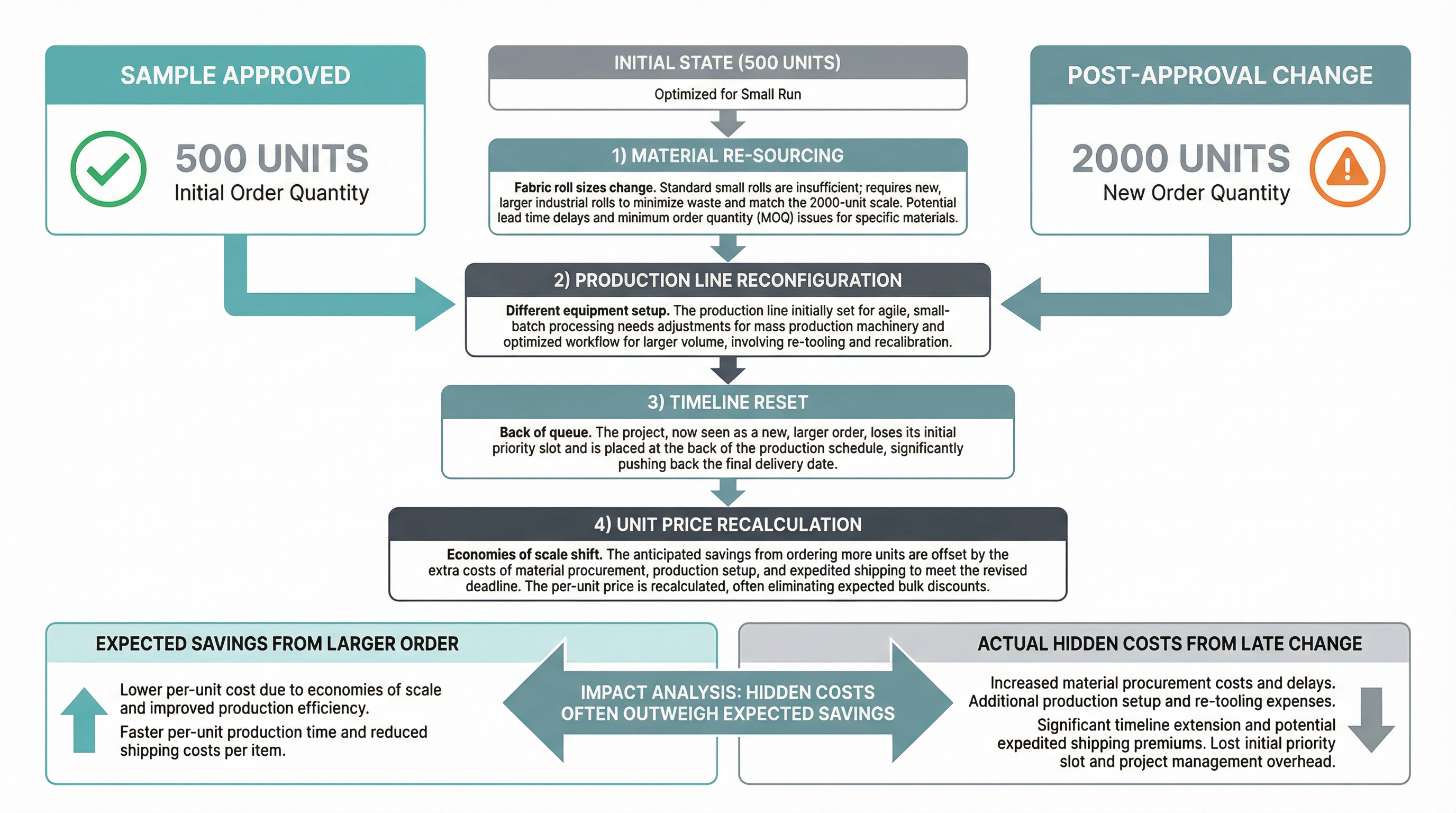
From the production floor perspective, a quantity change after sample approval is not simply a matter of running the machines longer. The entire production setup was configured for the original quantity, and that configuration affects everything from material procurement to production line scheduling. When the quantity changes significantly—particularly when it increases by multiples rather than marginal adjustments—the factory must essentially restart the planning process while the project remains nominally in progress.
The first impact occurs in material sourcing. Fabric suppliers sell materials in standard roll sizes, and the original order quantity determined which roll configuration was most efficient. A 500-unit order of custom cotton tote bags might use three standard rolls with minimal waste. A 2,000-unit order requires different roll sizes entirely—larger industrial rolls that may not be immediately available from the same supplier. The factory now faces a choice: source from a different supplier (introducing potential material variation), wait for the correct roll sizes to become available (adding lead time), or proceed with inefficient smaller rolls (increasing material cost and waste). None of these options preserves the original pricing assumptions.
Production line configuration presents the second challenge. Custom bag manufacturing involves multiple workstations—cutting, printing, sewing, finishing, quality control—each calibrated for specific throughput volumes. A small-batch setup prioritises flexibility and quality control at lower speeds. A large-batch setup prioritises efficiency through different equipment configurations, larger cutting dies, and adjusted workflow sequences. When quantity increases after the line has been configured for small-batch production, the factory must reconfigure—a process that takes time and may require equipment that is currently allocated to other orders.
The timeline impact is where the hidden costs become most apparent. The original sample was approved based on a production slot that accommodated the original quantity. That slot was sized appropriately: a 500-unit order might occupy a production line for two days, fitting neatly between other committed orders. A 2,000-unit order requires eight days on the same line—time that was already allocated to other customers. The factory cannot simply extend the original slot; it must find new capacity, which typically means the project moves to the back of the queue while scheduling is rearranged. The "same delivery date" that procurement assumed would apply to the larger order becomes impossible without expedited processing, which carries its own premium.
In practice, this is where the ordering workflow begins to break down. The procurement team, having committed to an internal deadline based on the original timeline, now faces pressure to maintain that deadline despite the quantity change. The factory, wanting to preserve the customer relationship, may offer expedited processing—but expedited processing means overtime labour, priority material sourcing, and disruption to other orders. These costs appear as line items that were not present in the original quotation: rush fees, material surcharges, air freight instead of sea freight. The per-unit savings from the larger quantity are systematically consumed by the costs of accommodating the late change.
There is also a quality dimension that is rarely discussed. Sample approval establishes a quality benchmark based on the production conditions that existed when the sample was made. Small-batch production typically receives more individual attention per unit—more frequent quality checks, more careful handling, more time for the printing to cure properly. Large-batch production, by necessity, relies more heavily on process consistency and statistical quality control. The sample that was approved may have represented small-batch quality, while the delivered bulk order reflects large-batch production realities. The bags are not defective, but they may exhibit more variation than the sample suggested.
The financial analysis that justified the quantity increase rarely accounts for these factors. The comparison between $8 per unit and $5.50 per unit assumes that all other variables remain constant—same materials, same timeline, same production conditions. When the quantity change triggers material re-sourcing, production reconfiguration, timeline extension, and expedited shipping to recover lost time, the actual per-unit cost may exceed the original small-batch pricing. The expected savings become actual losses, and the procurement team is left explaining why a decision that appeared financially sound produced a worse outcome.
For procurement professionals managing custom bag projects, the quantity decision deserves finalisation before sample production, not after. If there is any possibility that the order quantity might increase, that larger quantity should be specified from the outset—even if it means paying for a sample that represents larger-batch production conditions. The sample approval should confirm not just the product quality but the production parameters: this is what 2,000 units will look like, produced under 2,000-unit conditions, delivered on a 2,000-unit timeline. Changes after that approval point are not impossible, but they should be understood as project restarts rather than simple amendments, with pricing and timeline implications reassessed from the beginning.
The factories that deliver consistent results are not necessarily more flexible or accommodating. They are working with clients who understand that production planning is not infinitely elastic, and that the efficiencies of larger orders only materialise when those larger orders are planned from the start. The per-unit savings from bulk ordering are real, but they are only accessible to buyers who commit to bulk quantities before the production process begins—not to those who attempt to capture bulk pricing after small-batch production is already underway.