Procurement Strategy
Why the Quoted Price for Custom Cotton Bags May Shift Before Production Begins
The per-unit price on a supplier quote represents a snapshot of production economics at a specific moment, not a guaranteed figure that survives the gap between approval and manufacturing.
Published · By Michael Chen
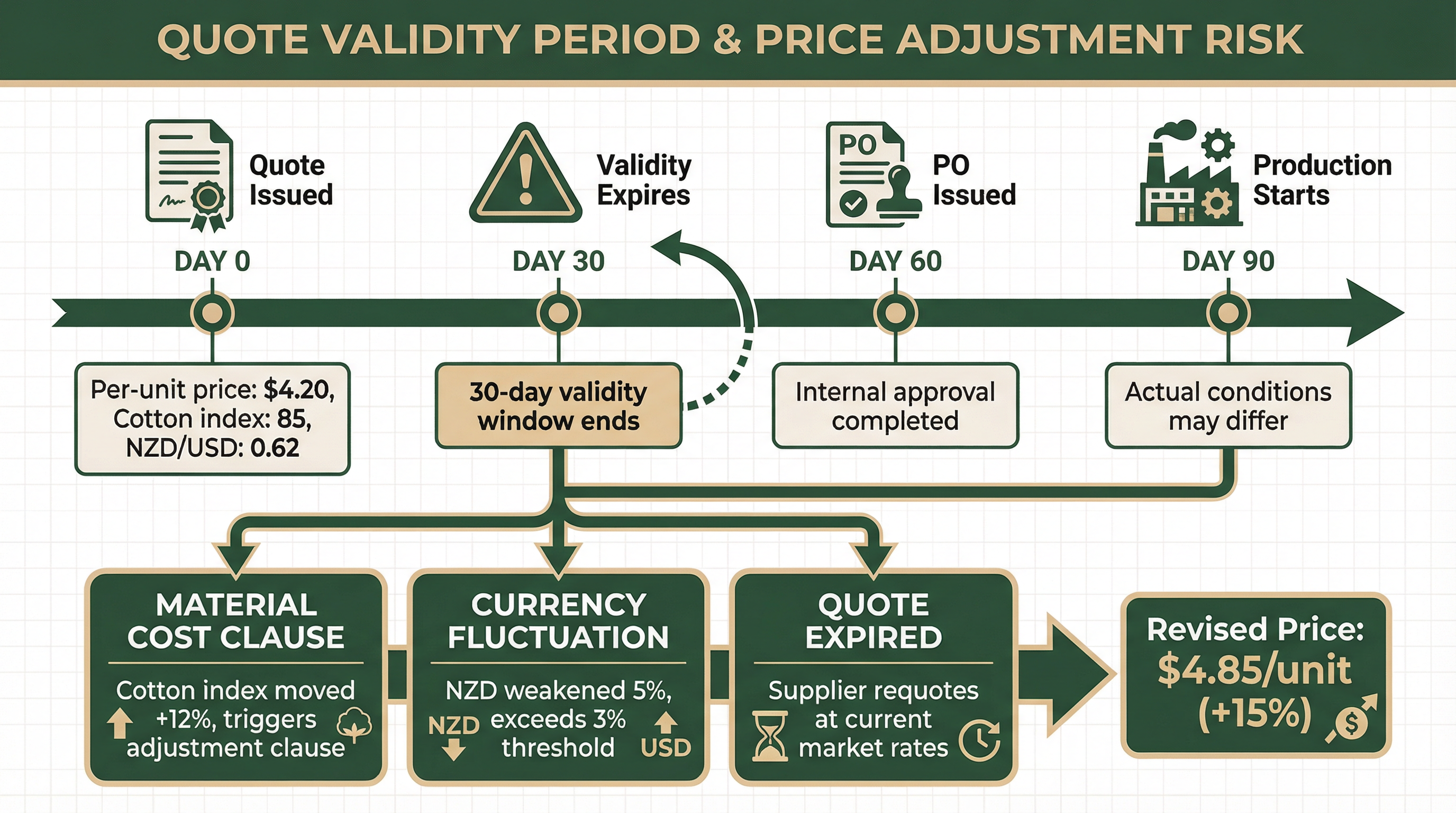
The per-unit price on a quote for custom cotton drawstring bags represents a snapshot of production economics at a specific moment. Procurement teams routinely treat this number as fixed once the quote is signed, building budgets and approval workflows around the assumption that the final invoice will match the approved figure. In practice, this assumption fails more often than most buyers realise, and the failure typically surfaces at the worst possible moment—when the bags are already manufactured and ready for shipment.
The mechanics of why quoted prices shift relate to the conditions embedded in supplier pricing structures. A quote for 500 custom drawstring bags at $4.20 per unit contains implicit assumptions about when production will occur, what the current material costs are, and what exchange rate applies to any imported components. These assumptions are rarely stated explicitly on the quote document itself, but they exist in the supplier's internal calculations and often in the fine print of their standard terms and conditions.
Quote validity periods represent the most straightforward example of this dynamic. Most suppliers include a validity window—typically 30 to 60 days—during which the quoted price remains guaranteed. After this period expires, the supplier reserves the right to requote based on current conditions. Procurement teams frequently overlook this detail, particularly when internal approval processes extend beyond the validity window. A quote approved by finance 45 days after it was issued may no longer reflect the supplier's actual costs, especially if raw material prices have moved during that interval.
Cotton pricing illustrates this particularly well. The fabric used in custom drawstring bags is a commodity whose price fluctuates based on harvest conditions, global demand, and currency movements. A supplier quoting in December might be working from cotton prices that reflected favourable harvest conditions earlier in the year. By February, when the procurement team finally secures internal approval and issues a purchase order, cotton futures may have shifted by 8-12%. The supplier faces a choice: honour the original quote and absorb the margin compression, or invoke the validity clause and issue a revised quotation. Most suppliers choose the latter, which creates budget friction that could have been avoided if the procurement timeline had aligned with the quote validity period.
Material cost adjustment clauses add another layer of complexity. Some suppliers include provisions that allow them to adjust pricing if raw material costs change by more than a specified threshold—often 5-10%—between quote acceptance and production start. These clauses are particularly common in contracts for natural fibre products like cotton, jute, or organic materials, where input costs are inherently volatile. A procurement team that signs a contract without fully understanding these provisions may discover that their "locked" price is actually indexed to material costs that moved against them.
Currency fluctuation provisions operate similarly. For custom bags manufactured offshore and quoted in New Zealand dollars, the supplier has typically converted their production costs from the manufacturing country's currency at a specific exchange rate. If the NZD weakens significantly between quote acceptance and payment, the supplier's actual costs in their home currency increase. Many supplier contracts include clauses that allow price adjustments if exchange rates move beyond a defined band—typically 3-5% from the rate used in the original quotation. Procurement teams focused on the per-unit price often miss these provisions entirely until an adjusted invoice arrives.
The gap between quote acceptance and production start creates the window in which these adjustments occur. When a procurement team takes three months to finalise artwork, secure internal approvals, and issue a purchase order, they've created a 90-day exposure to all the variables that the original quote assumed would remain stable. The supplier quoted based on conditions in January; production begins in April. The price that made sense in January may no longer be economically viable in April, and the supplier's terms typically allow them to address this discrepancy.
What makes this particularly difficult to manage is that suppliers rarely communicate these adjustments proactively. The original quote remains on file, the purchase order references that quote, and the procurement team assumes the transaction is proceeding as planned. The adjustment surfaces when the supplier issues a pro forma invoice that doesn't match the approved budget, or when the final invoice includes line items that weren't part of the original quotation. By this point, the bags are manufactured, the deadline is approaching, and the buyer has limited leverage to negotiate.
The connection to understanding how suppliers structure their pricing for custom promotional bags becomes essential context here. The per-unit price at a given quantity threshold reflects an optimised production scenario—stable material costs, favourable currency rates, and production occurring within a reasonable timeframe from quotation. Each week of delay between quote and production moves the actual transaction further from that optimised scenario, even when the quoted price and quantity remain nominally unchanged.
Production scheduling assumptions compound this issue. A supplier quoting a four-week lead time in their January quote may have been assuming production would slot into an available window in February. When the purchase order finally arrives in April, that production slot no longer exists. The supplier now faces a choice between delaying delivery until capacity becomes available or expediting production at higher cost. If the buyer insists on the original delivery date, the expediting costs often surface as adjustments to the quoted price—framed as rush fees or priority handling charges that weren't part of the original quotation.
The procurement teams who navigate this successfully tend to treat quote validity as a hard constraint rather than a formality. They align their internal approval timelines with supplier validity periods, ensuring that purchase orders are issued while the quote remains guaranteed. They also read the terms and conditions attached to quotations, identifying any clauses that allow for price adjustments based on material costs, currency movements, or production timing. When these clauses exist, they either negotiate them out of the contract or build contingency into their budgets to accommodate potential adjustments.
Some organisations address this by requesting extended validity periods upfront. A supplier who normally offers 30-day validity might agree to 90 days if the buyer commits to a firm order within that window. This extended validity typically comes at a cost—either a slightly higher per-unit price or a non-refundable deposit that compensates the supplier for holding pricing stable during a period of potential market movement. The cost of this extended validity is usually far less than the budget disruption caused by unexpected price adjustments after the fact.
The underlying principle is that a quoted price represents a conditional commitment, not an absolute guarantee. The conditions relate to timing, material costs, currency rates, and production scheduling—all of which can shift between quotation and production. Procurement teams who understand these conditions can manage them proactively. Those who treat the quoted price as fixed often discover the conditionality only when it's too late to adjust their budgets or timelines accordingly.