Procurement Strategy
Why Your Reorder Quote for Custom Jute Bags Might Be Higher Than the Original
The assumption that a repeat order should cost less than the original purchase leads to some of the most contentious supplier conversations in custom bag procurement.
Published · By James Wilson
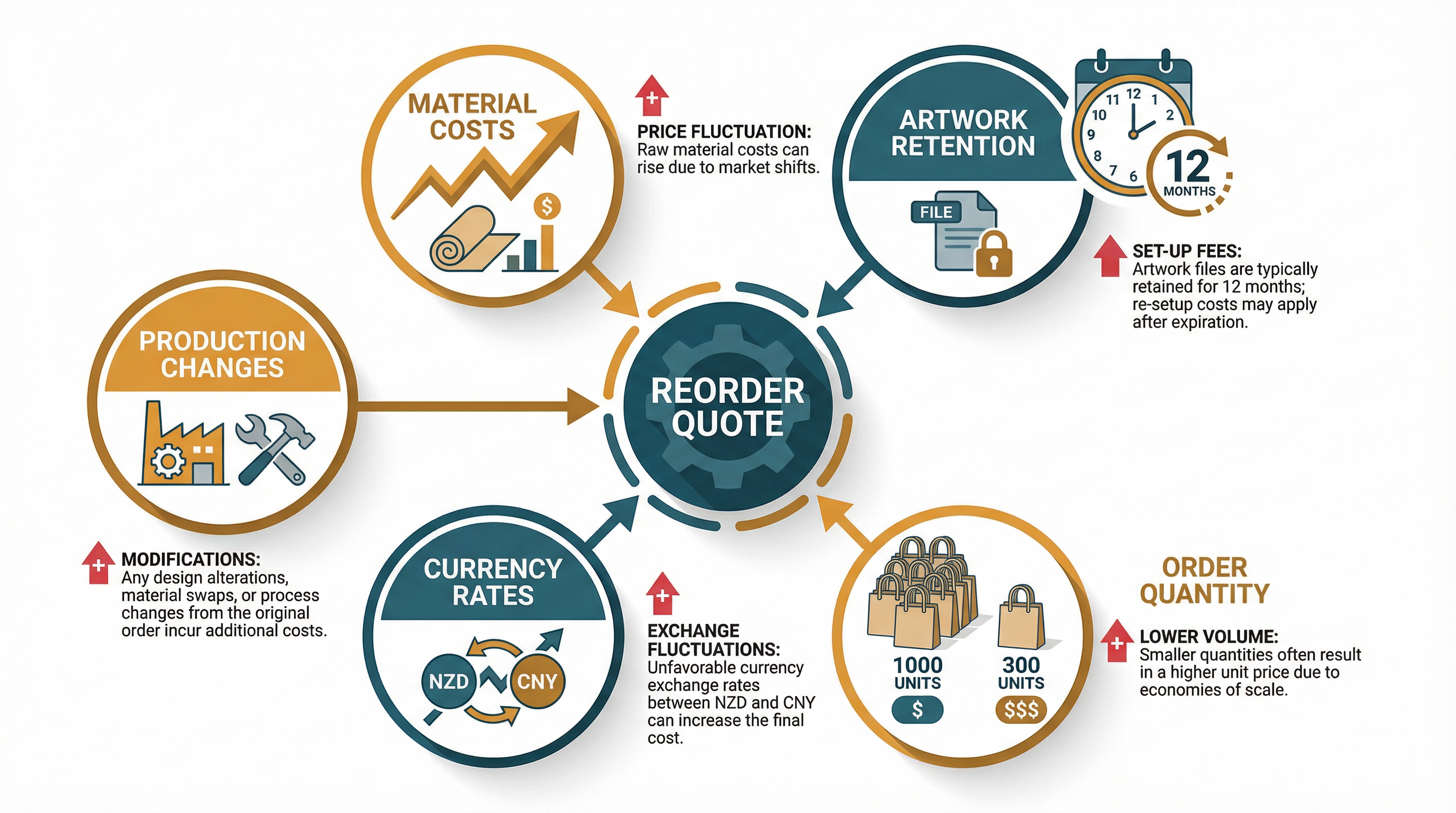
The assumption that a repeat order should cost less than the original purchase is so deeply embedded in procurement thinking that it rarely gets questioned. After all, the supplier already has the artwork, the specifications are documented, and the production process has been proven. Logic suggests the second order should be simpler, faster, and cheaper. In practice, this assumption leads to some of the most contentious supplier conversations in custom bag procurement, because the reality of manufacturing economics often produces the opposite result.
When a factory receives a reorder request, the production team does not simply retrieve the original job file and press "run again." The first step is verifying whether the materials specified in the original order are still available at the same specification. Cotton canvas, jute fabric, and recycled polyester all experience supply fluctuations. A 12oz cotton canvas sourced eighteen months ago may no longer be produced by the same mill, or may now carry a different price point due to raw cotton market movements. The factory must either source an equivalent material—which introduces subtle variation—or quote based on current material costs, which may have increased significantly since the original order.
Artwork file retention creates another layer of complexity that buyers rarely anticipate. Most production facilities maintain customer artwork for a limited period, typically twelve months from the last order. Beyond that window, files may be archived, compressed, or purged entirely. A reorder request arriving fourteen months after the original might trigger a new setup process, complete with artwork re-digitisation, screen recreation, or embroidery file regeneration. The setup fee that was waived on the first order because it was amortised across a larger quantity now appears as a line item on the reorder quote, creating the impression that the supplier has become more expensive when in fact the cost structure has simply become visible.
The relationship between order quantity and pricing operates differently for reorders than for initial purchases, and this is where the connection to understanding minimum order quantities becomes particularly relevant. A first order of 1,000 custom tote bags might have qualified for a volume price break that a reorder of 300 units does not. The per-unit price on the reorder quote reflects the actual cost of producing a smaller batch, not a price increase. Procurement teams who compare the two quotes without adjusting for quantity differences often conclude that the supplier has raised prices, when the supplier has simply quoted accurately for a different order profile.
Currency movements compound this effect for any product sourced internationally. A custom jute bag order placed when the New Zealand dollar traded at a particular rate against the Chinese yuan or Indian rupee will carry a different landed cost when reordered twelve months later under different exchange conditions. The supplier's factory-gate price may not have changed at all, yet the quote in local currency reflects a genuine shift in procurement economics. This is not a supplier problem; it is a market reality that affects every imported product category.
Production line configuration presents a more subtle challenge. Manufacturing facilities continuously optimise their operations, upgrading equipment, changing thread suppliers, adjusting quality control protocols. A reorder request assumes that the production environment remains static, but factories are dynamic systems. The sewing machines that produced the original batch may have been recalibrated, replaced, or reassigned to different product lines. Recreating the exact production conditions of the first order sometimes requires more setup effort than the original run, particularly if the factory has since specialised in different product categories or adjusted its standard specifications.
The practical implication for procurement teams is not to expect reorder pricing to match or undercut original quotes, but to understand the factors that legitimately cause variation. A supplier who explains why a reorder costs more—citing material price changes, artwork re-setup, or quantity-based pricing tiers—is demonstrating transparency, not opportunism. The suppliers who should concern procurement professionals are those who cannot articulate why their pricing has changed, because that opacity often indicates either poor record-keeping or deliberate margin expansion.
For custom jute bag and canvas tote procurement specifically, the most reliable approach to reorder pricing involves maintaining direct communication with the supplier about upcoming needs. A heads-up that a reorder is likely within the next quarter allows the factory to reserve materials at current prices, retain artwork files beyond standard retention periods, and plan production capacity accordingly. This advance notice often costs nothing but delivers meaningful price stability compared to surprise reorder requests that force the supplier to quote based on whatever conditions exist at that moment.
The disconnect between expectation and reality in reorder pricing stems from a fundamental misunderstanding of what "repeat order" means in a manufacturing context. For the buyer, it feels like ordering the same thing again. For the factory, it is a new production job that happens to share specifications with a previous one—subject to all the variables that affect any new order, plus the additional complexity of matching a historical output that may no longer be straightforward to replicate.