Supply Chain
Why Rush Orders for Custom Cooler Bags Cost More Than the Air Freight Premium
Discover the hidden cascade effect of rush orders in custom bag manufacturing. Expert insight on how expedited production disrupts factory scheduling and damages supplier relationships.
Published · By David Ross
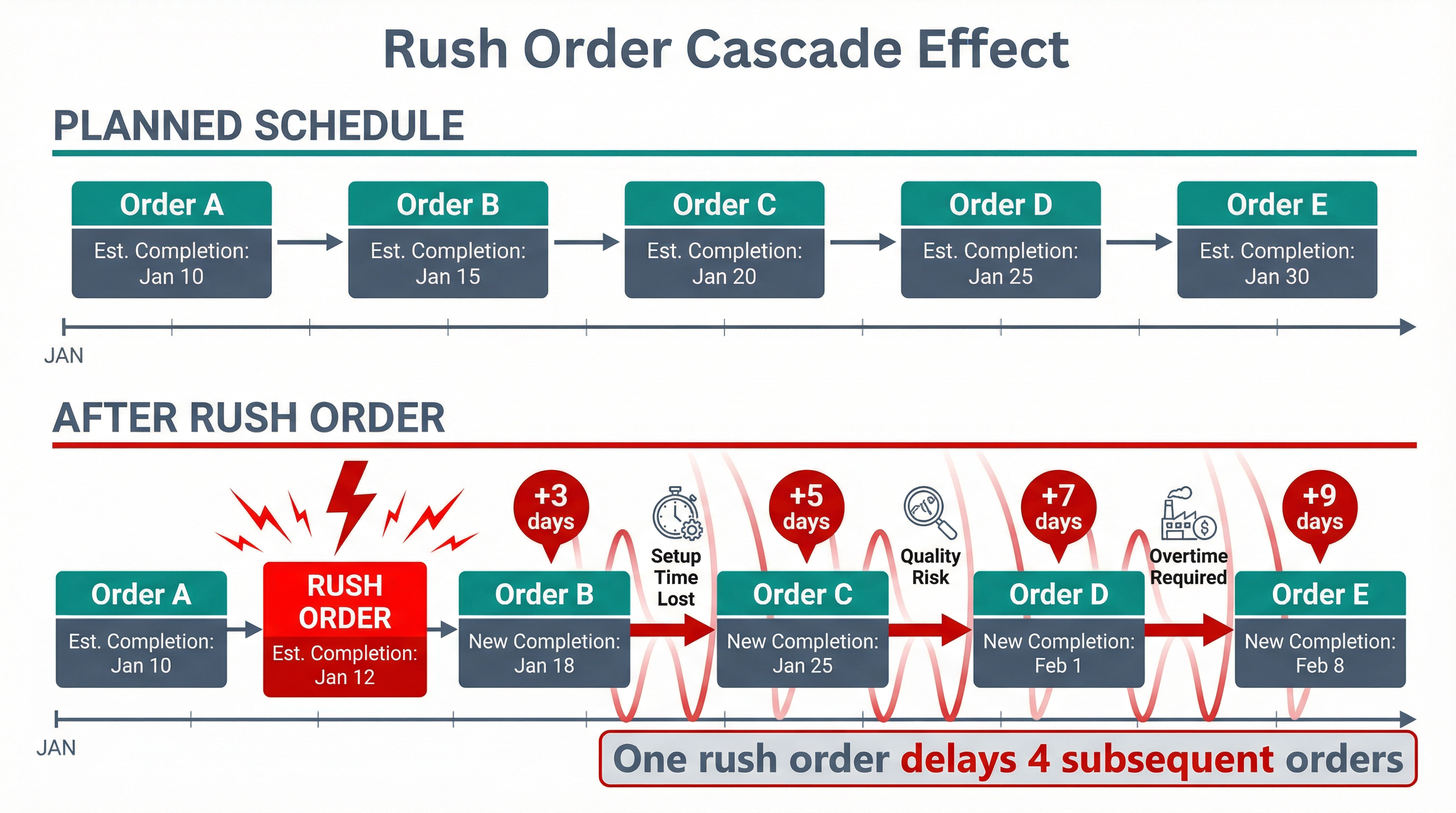
When procurement teams request expedited delivery on custom cooler bags, the conversation typically centres on freight costs. Air shipping from Asia to New Zealand runs roughly ten times the cost of sea freight—a premium that seems substantial but calculable. What rarely enters the discussion is the cascade of consequences that rush orders trigger within the factory's production environment, consequences that often exceed the freight premium in both immediate cost and long-term relationship damage.
The mechanics of factory scheduling operate on principles that most buyers never see. A production facility managing custom bag orders maintains a queue—a carefully sequenced list of jobs arranged to optimise material flow, minimise setup changes, and balance workload across sewing lines. When a rush order arrives, it does not simply slot into an empty space. It forces the factory to interrupt whatever is currently running, complete partial work, store work-in-progress, reconfigure equipment for the rush job, and then later return to the interrupted work. Each of these transitions consumes time that appears nowhere on the buyer's invoice.
In practice, this is often where lead time decisions start to be misjudged. A buyer sees the quoted rush fee—perhaps an additional fifteen to twenty percent on the unit price—and assumes that covers the factory's inconvenience. What that fee rarely accounts for is the productivity loss from breaking a production run mid-stream. A sewing line running continuously on one bag style might achieve ninety-five percent efficiency. The same line, interrupted and restarted multiple times, might drop to seventy percent. The factory absorbs this loss initially, but it eventually surfaces in future pricing, reduced priority for your orders, or reluctance to accept your business during peak seasons.
The quality implications deserve particular attention. Rushed production correlates directly with elevated defect rates. When operators work overtime to meet compressed deadlines, fatigue increases error frequency. When quality control inspectors face pressure to clear goods quickly, marginal defects pass that would normally trigger rejection. A cooler bag with slightly misaligned stitching or an imperfectly sealed insulation layer might ship on time, but it represents a quality compromise that undermines the brand value the bag was meant to convey.
What compounds this situation is the impact on other orders in the queue. When your rush order jumps ahead, every order behind it shifts backward. If those delayed orders belong to other buyers, the factory faces difficult conversations and potential penalties. If those delayed orders are your own future orders, you have effectively borrowed time from yourself—solving today's urgency by creating tomorrow's crisis. Procurement teams who habitually request rush orders often find themselves trapped in a cycle where each expedited shipment creates the conditions that necessitate the next one.
The relationship dimension matters more than most buyers recognise. Factories track which customers consistently request expedited treatment and which customers plan adequately. Over time, the chronic rush-order customer becomes a less desirable account—profitable in the short term but operationally disruptive. When capacity tightens during peak season, these customers find their orders deprioritised or their quotes inflated to compensate for anticipated disruption. The factory may never explicitly state this, but the pattern becomes evident in lead time quotes that seem longer than competitors receive, or in sample turnaround that mysteriously slows.
Understanding the full production timeline for custom bags reveals why adequate planning eliminates most rush order scenarios. The stages that consume time—artwork approval, sample iteration, material sourcing—are largely within the buyer's control. A procurement team that finalises specifications early, responds to sample requests promptly, and maintains realistic internal deadlines rarely needs to expedite. The rush order is almost always a symptom of upstream planning failures, not an unavoidable business requirement.
The financial calculation changes dramatically when these hidden costs enter the equation. A rush order that appears to cost an extra two thousand dollars in air freight and expediting fees might actually cost five thousand dollars when accounting for quality rework, relationship depreciation, and the future orders that will now require their own expediting to recover lost time. The visible premium is the smallest component of the true cost.
For organisations that find themselves requesting rush orders repeatedly, the pattern itself signals a process problem worth addressing. The solution is not better negotiation on expediting fees—it is earlier engagement with suppliers, more realistic internal timelines, and buffer time built into project schedules. The most cost-effective rush order is the one that never becomes necessary.