Supply Chain
Why Sample Approval Delays Compound Your Custom Tote Bag Timeline More Than Expected
Discover how each sample revision cycle multiplies production delays for custom bags. Expert insight on the hidden timeline costs of approval loops.
Published · By Michael Chen
There is a particular pattern we observe repeatedly when reviewing procurement timelines that have gone sideways. The initial production schedule looked reasonable. The supplier quoted eight weeks. The event was twelve weeks out. Four weeks of buffer seemed more than adequate. Yet somehow, the bags arrived two days before the conference, with no time for quality inspection and certainly no contingency for the three units that had printing defects.
When we trace back through the project timeline, the culprit is almost never a single catastrophic failure. It is rarely a shipping delay or a factory fire. In the majority of cases, the timeline erosion happened incrementally, during what most procurement teams consider a routine phase: sample approval.
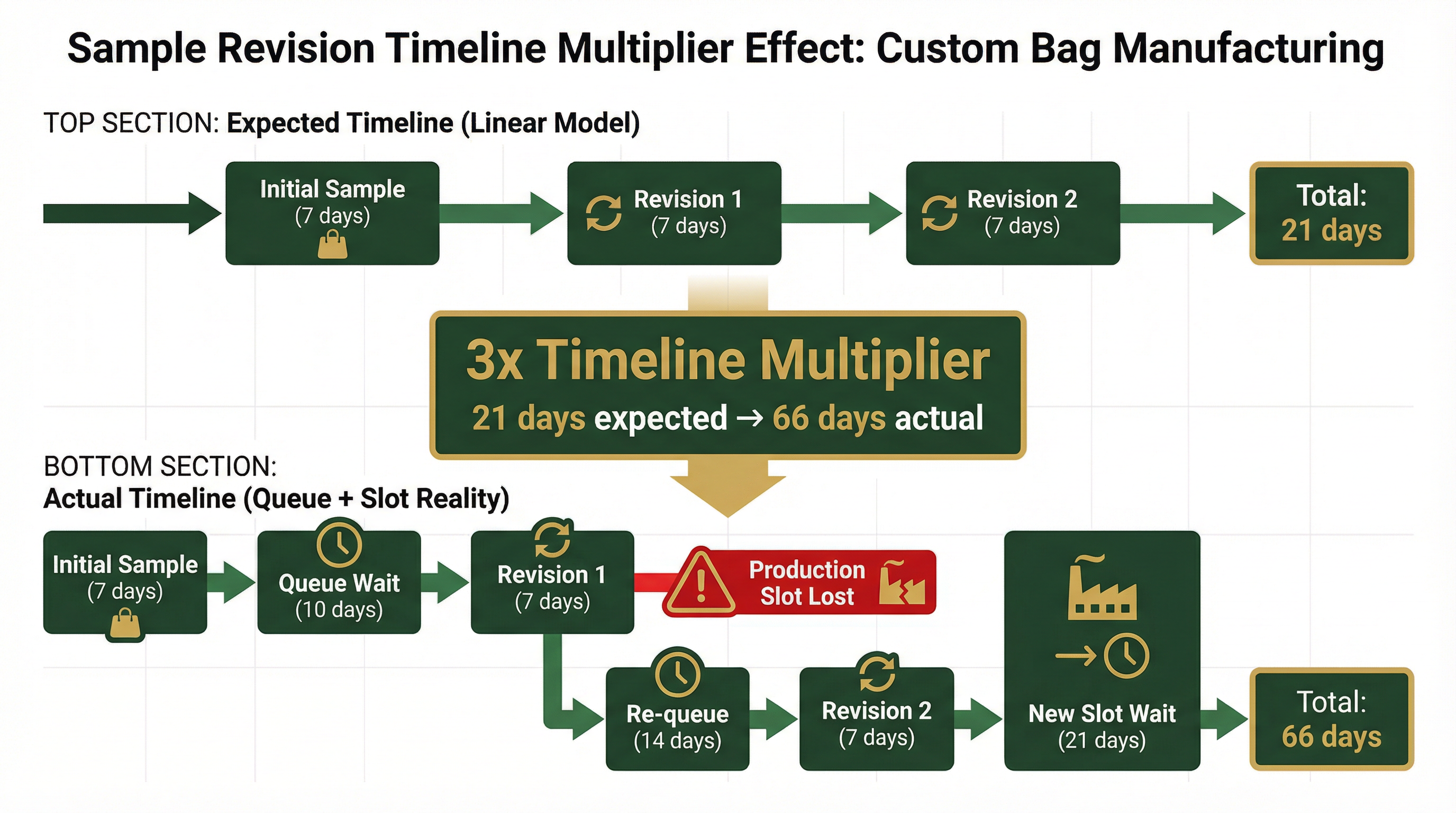
The fundamental misunderstanding centres on how sample revision cycles interact with production scheduling. Most buyers conceptualise the process as linear: submit artwork, receive sample, request changes, receive revised sample, approve, begin production. Each step follows the previous one in a neat sequence. The timeline impact of a revision, in this mental model, is simply the time required to produce the revised sample—perhaps five to seven days.
This linear model dramatically underestimates the actual impact. In practice, sample production and mass production operate on different resource pools within a factory. The sampling department typically handles multiple clients simultaneously, working through a queue. When you request a revision, your project does not simply pause for seven days and then resume. Your revised sample request enters the back of the sampling queue. Depending on factory workload, this queue position alone can add one to three weeks beyond the actual revision work.
More significantly, your production slot is not held indefinitely. Factories allocate production capacity in advance, often four to six weeks out. When you initially placed your order, the supplier likely reserved a tentative slot based on your expected approval date. If that approval date slips, your slot may be reassigned to another client whose samples were approved on schedule. You then enter a secondary queue for the next available production window.
The compounding effect becomes severe when multiple revision cycles occur. A first revision might push your approval date back by two weeks. A second revision, however, does not simply add another two weeks. By this point, your original production slot is almost certainly gone. The factory's peak season may have begun. Material costs may have shifted. The supplier may need to re-quote the entire order.
We have seen projects where three sample revisions—each individually minor—resulted in a total timeline extension of eleven weeks. The revisions themselves required perhaps fifteen days of actual work. The remaining time was consumed by queue repositioning, production slot reallocation, and in one case, material re-procurement because the original fabric batch had been sold to another buyer during the extended approval period.
For procurement teams working with custom cotton tote bags or branded canvas bags, this dynamic is particularly acute. Natural fibre materials are often dyed in specific batches. If your approval process extends beyond the material hold period—typically thirty to forty-five days—the factory may need to source a new dye lot. This introduces potential colour variance between your approved sample and the final production run, which may trigger yet another approval cycle.
The practical implication is that sample approval should not be treated as a low-stakes administrative step. It is a critical path item with significant downstream consequences. When evaluating production timelines for custom bags, the sample phase deserves the same rigorous scheduling attention as the manufacturing phase itself.
Several structural approaches can mitigate this risk. First, consolidate feedback. Rather than providing incremental comments across multiple revision cycles, gather all stakeholders for a single comprehensive review of the initial sample. A detailed first-round feedback document, even if it contains twenty items, is far less damaging to the timeline than three rounds of five items each.
Second, establish approval authority clearly before the sample arrives. We frequently encounter situations where a sample is approved by the procurement team, only to be rejected by the marketing director who was not consulted. This internal approval loop can consume weeks while the factory waits.
Third, understand the difference between critical defects and acceptable variances. A logo positioned three millimetres off-centre may be technically incorrect, but requesting a revision for this variance will cost you weeks of timeline. Determine in advance which specifications are genuinely non-negotiable and which fall within acceptable tolerance.
The sample approval phase is where many custom bag projects quietly fail. Not through dramatic supplier failures, but through the accumulation of small delays that compound into missed deadlines. Recognising this dynamic is the first step toward building timelines that account for the reality of how factories actually schedule work.