Insights
Why Sample Approval for Custom Promotional Bags Should Never Be a Single-Person Decision
The sample approval stage appears straightforward—examine the physical sample, confirm it matches expectations, authorise production. Yet this single checkpoint creates more post-production disputes than any other stage in the customization process.
Published · By KiwiBag Works Team
There is a recurring pattern in custom promotional bag projects that creates significant downstream problems, and it centres on a seemingly simple question: who approves the sample? The answer, in most organisations, is whoever happens to be managing the procurement process. This default approach, while administratively convenient, systematically excludes perspectives that only become relevant after bulk production is complete and the bags are being distributed.
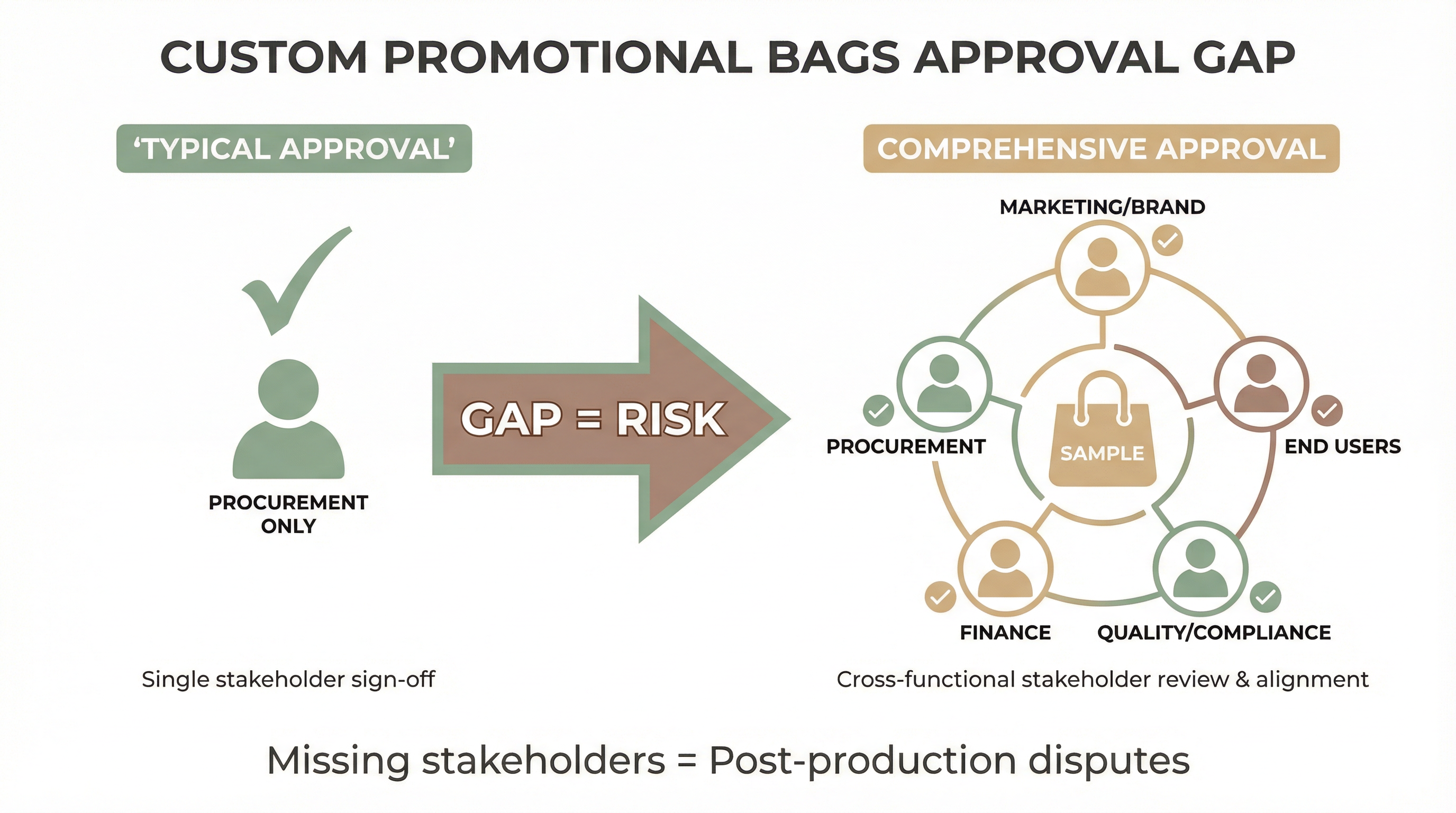
The sample approval stage sits at a critical juncture in the customization workflow. Everything before it—material selection, design refinement, supplier negotiation—remains theoretical until a physical sample exists. Everything after it—bulk production, shipping, distribution—proceeds on the assumption that the approved sample accurately represents what all stakeholders need. When that assumption proves incorrect, the consequences are substantial: rejected inventory, reputational damage from substandard branded merchandise, and the difficult conversations that follow when marketing discovers that procurement approved something that does not meet brand standards.
The fundamental issue is that different stakeholders evaluate samples against different criteria, and these criteria are often invisible to each other. A procurement manager assessing a custom cotton tote bag sample will naturally focus on construction quality, material weight, stitching integrity, and whether the delivered sample matches the agreed specifications. These are legitimate and important considerations. However, they represent only one dimension of what determines whether the finished bags will successfully serve their intended purpose.
Marketing and brand teams evaluate samples through an entirely different lens. Their concerns centre on colour accuracy against brand guidelines, logo placement relative to visual balance, how the bag photographs for social media content, and whether the overall aesthetic aligns with brand positioning. A bag that passes every procurement quality checkpoint may still fail catastrophically from a brand perspective if the green is slightly too yellow, the logo sits 10mm lower than optimal, or the material texture reads as cheap in photographs despite meeting technical specifications.
End users—the people who will actually carry these bags—bring yet another perspective that is almost never represented in sample approval. They notice things like strap comfort during extended carrying, whether the bag sits properly on a shoulder, how the material feels against clothing, and whether the size actually accommodates what they need to carry. A conference attendee who finds the bag uncomfortable after thirty minutes will not use it again, regardless of how well it met procurement specifications or brand guidelines.
The quality and compliance perspective adds another layer that procurement may not fully appreciate. For New Zealand businesses, this includes considerations around material certifications, care labelling requirements, and whether any claims made about the product (organic, recycled, sustainably sourced) can be substantiated. A sample might look perfect but lack the documentation needed to support marketing claims, creating legal exposure that only becomes apparent when someone asks for certification proof.
What makes this pattern particularly problematic is the timing pressure that typically surrounds sample approval. The sample arrives, there is a deadline approaching, and the procurement manager is asked to confirm approval quickly so production can begin. Coordinating input from multiple stakeholders takes time—time that feels unavailable when the project timeline is already tight. The path of least resistance is to approve based on the criteria immediately visible to the person holding the sample.
The cost of this shortcut becomes apparent only after bulk production is complete. At that point, when marketing objects to the colour rendering or end users report that the bags are uncomfortable, there are no good options. Rejecting the shipment creates supplier relationship damage and financial loss. Accepting and distributing substandard bags creates brand damage. Attempting to negotiate partial refunds or corrections consumes time and rarely produces satisfactory outcomes. The sample approval that took one person fifteen minutes to complete has created a problem that will take multiple people multiple weeks to resolve.
The practical solution requires restructuring sample approval as a formal checkpoint rather than an administrative formality. Before the sample even arrives, the stakeholder list should be defined: who needs to see this sample, what criteria will each stakeholder evaluate, and what constitutes approval from each perspective? When the sample arrives, it should circulate through this defined review process, with each stakeholder documenting their assessment. Only when all required approvals are obtained should production authorisation proceed.
This approach does require more time at the sample stage. A process that previously took two days might now take a week. However, this additional time investment is trivial compared to the cost of post-production disputes. More importantly, it surfaces problems when they can still be corrected—before thousands of units have been manufactured, shipped, and paid for.
For procurement professionals managing custom bag projects, the sample approval question deserves explicit attention during project planning. The question is not simply "who will approve the sample" but "whose perspectives need to be represented in sample approval, and how will we ensure those perspectives are captured?" The answer will vary by organisation and project, but the question itself should never be skipped. The fifteen minutes saved by single-person approval can easily translate into fifteen thousand dollars of post-production problems.