Procurement Strategy
Why Sample Fees Reveal More About Total Cost Than the Quote Does for Custom Canvas Bags
The sample fee line item on a supplier quote tends to receive less scrutiny than it deserves, creating a blind spot that consistently leads to suboptimal purchasing decisions.
Published · By Michael Chen
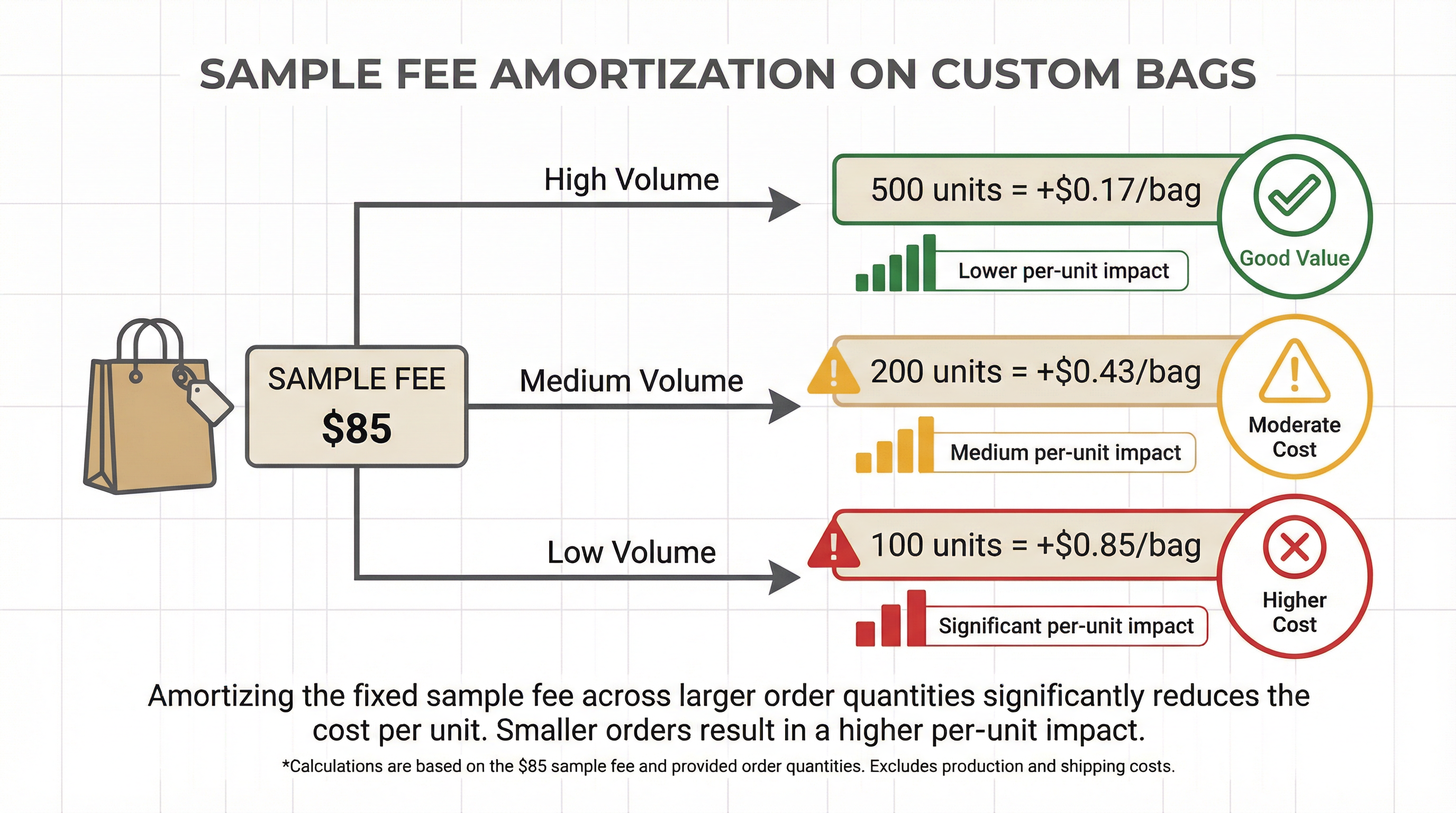
The sample fee line item on a supplier quote tends to receive less scrutiny than it deserves. Procurement teams routinely treat it as a minor administrative cost—something to be paid, forgotten, and mentally separated from the bulk order evaluation. This compartmentalisation creates a blind spot that consistently leads to suboptimal purchasing decisions for custom canvas bags and other branded merchandise.
When evaluating suppliers for a custom tote bag project, the instinct is to compare unit prices at the quoted MOQ. A supplier offering $4.20 per bag at 500 units looks more attractive than one quoting $4.50 at the same quantity. But this comparison ignores the sample phase entirely, and the sample phase is where significant cost variance actually occurs. The supplier with the lower unit price may charge $85 per sample with a two-week turnaround, while the higher-priced supplier includes two sample rounds in their standard process at $45 each with faster iteration. Over a typical three-round approval cycle, the "cheaper" supplier has already added $255 to the project cost before production begins.
The mathematics become more revealing when sample costs are amortised across the actual order quantity. That $255 in sample fees distributed across 500 bags adds $0.51 to the effective unit cost, narrowing the apparent price gap considerably. For smaller orders—say, 200 units for a pilot programme—the same sample investment adds $1.28 per bag, potentially reversing which supplier actually offers better value. Procurement professionals who understand how minimum order quantities interact with these fixed costs make fundamentally different supplier selections than those who evaluate samples and bulk orders as separate decisions.
The hidden cost multiplier emerges most clearly when organisations engage multiple suppliers during the evaluation phase. Standard practice for significant purchases involves requesting samples from three to five potential vendors. Each sample request carries its own fee, its own shipping cost, and its own internal evaluation time. A procurement team comparing five suppliers for a custom jute bag project might spend $400-600 in sample fees alone before selecting a single vendor. This investment is rarely recovered, and it rarely appears in any post-project cost analysis. The winning supplier's quote looks clean; the four losing suppliers' sample fees simply vanish into overhead.
Iteration costs compound this effect in ways that catch even experienced buyers off guard. The first sample rarely achieves approval. Colour matching requires adjustment. Logo placement needs refinement. Handle length doesn't feel right in hand. Each revision cycle carries cost—sometimes explicit in the form of additional sample fees, sometimes hidden in extended timelines and expedited shipping to recover lost days. A project budgeted for one sample round that actually requires three has effectively tripled its pre-production investment, yet this overrun almost never triggers the same scrutiny as a production cost increase of equivalent magnitude.
The "free sample" offer deserves particular attention from a cost analysis perspective. When a supplier waives sample fees entirely, the economics of their operation haven't changed—the cost of producing that sample still exists somewhere. In some cases, free samples indicate a supplier confident enough in their conversion rate to absorb the cost as customer acquisition expense. More often, however, free samples signal that sample costs have been built into the unit price, the setup fee, or the shipping charges. The buyer who selects a supplier based partly on free samples may be paying for those samples across every unit in the bulk order, long after the sample phase has concluded.
The practical implication for procurement teams is not to avoid sample fees, but to evaluate them as integral components of total project cost. A supplier with transparent, itemised sample pricing often represents better value than one with opaque "all-inclusive" quotes, because transparency enables accurate comparison. The sample fee itself also serves as a signal: suppliers who invest in detailed sample production, who provide comprehensive specification sheets with each sample, and who price their samples to reflect actual cost rather than as loss leaders tend to maintain similar discipline throughout the production relationship.
For custom canvas bag procurement specifically, sample evaluation should include not just the physical product but the documentation that accompanies it. Does the sample arrive with a detailed specification sheet noting fabric weight, thread count, and dye lot information? Is the printing method clearly identified with colour codes that can be referenced in the production order? These details cost the supplier time and money to provide, and their presence or absence in the sample phase predicts the level of quality control that will characterise the bulk order. A $45 sample with comprehensive documentation often outperforms a $25 sample that arrives with nothing but a packing slip.
The relationship between sample investment and order success extends beyond individual transactions. Suppliers who maintain rigorous sample processes—charging appropriately, documenting thoroughly, and iterating professionally—build institutional knowledge about each client's preferences and standards. This accumulated understanding reduces error rates in subsequent orders, shortens approval cycles, and ultimately delivers lower total cost of ownership even when the per-unit price appears higher on paper. The sample fee, viewed correctly, is not an obstacle to be minimised but an investment in production accuracy that pays dividends across the supplier relationship.