Quality Assurance
Why Splitting Orders Creates Hidden Quality Variance in Custom Tote Bags
The instinct to divide a larger order into smaller batches often backfires in ways that procurement teams discover only after delivery.
Published · By Sarah Mitchell
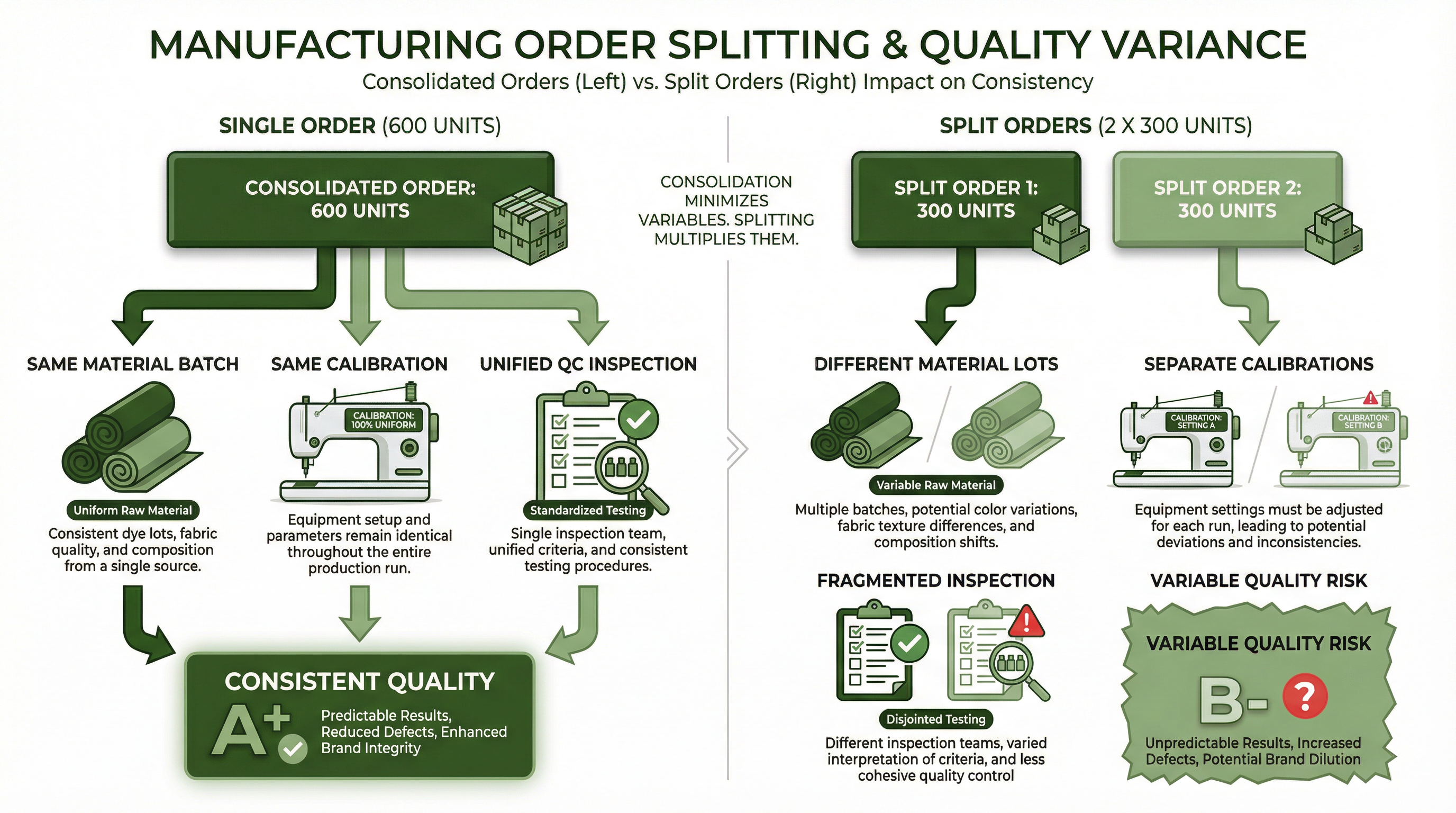
The instinct to divide a larger order into smaller batches often backfires in ways that procurement teams discover only after delivery. When a buyer decides to split what could have been a single 600-unit order for custom tote bags into two separate 300-unit runs, the reasoning usually sounds sensible: reduce upfront commitment, test market response, or spread cash flow across quarters. What rarely enters the calculation is how this decision fundamentally changes the quality profile of the goods received.
Material consistency is the first casualty of split orders. Cotton canvas, organic fabrics, and recycled materials all arrive at factories in batches—dye lots for coloured goods, fabric rolls for construction. A single production run draws from a unified material source, meaning every bag in that order shares the same base characteristics. When an order is split across two production windows, even by a few weeks, the second batch may pull from an entirely different material lot. The specification remains identical on paper, but the hand feel, the precise shade, the weight per square metre can shift in ways that become obvious only when bags from both batches sit side by side.
Production calibration compounds this variance. Sewing machines, printing equipment, and heat presses are tuned at the start of each run. Operators adjust tension, temperature, and timing based on the specific materials loaded that day. These settings get locked in for the duration of a production run, creating internal consistency within that batch. A second run, even using the same equipment, begins with a fresh calibration cycle. The operator may be different. The ambient humidity in the factory may have changed. The result is two batches that meet specification individually but diverge from each other in subtle ways that quality control processes are not designed to catch.
The mathematics of inspection sampling work against smaller orders in ways that surprise most buyers. Standard quality control follows Acceptable Quality Level protocols, where a statistical sample from each batch determines pass or fail. The sample size does not scale linearly with order size. A 600-unit order might require inspection of 80 units to achieve a given confidence level. Two 300-unit orders require separate inspections, but the combined sample coverage relative to total units actually decreases. More importantly, defects that would have been caught in a larger unified sample may slip through when the population is divided. The inspection process assumes a single production context; split orders violate that assumption.
Certification scope presents another complication that procurement teams rarely anticipate. When a factory certifies a production run—whether for organic content, recycled material claims, or safety compliance—that certification typically applies to a specific batch produced under documented conditions. Splitting an order means requesting certification twice, which some suppliers accommodate and others do not. Even when both batches receive certification, the documentation trail becomes fragmented. For buyers who need to demonstrate compliance to their own customers or regulatory bodies, this fragmentation creates administrative burden and potential audit vulnerabilities.
The phenomenon that quality professionals sometimes call "same spec, different result" emerges most clearly in split-order scenarios. Two batches of custom canvas bags can both pass inspection, both meet the written specification, and both carry valid certification—yet look and feel noticeably different when a recipient receives one from each batch. This is not a failure of manufacturing; it is a predictable outcome of how production variability works at scale. Understanding how order quantities shape these outcomes is essential knowledge for anyone managing custom bag procurement, and the relationship between batch size and consistency is more direct than most buyers realise.
The practical implication is not that split orders are always wrong, but that they carry quality costs that rarely appear in the quoted price. When consistency across units matters—for retail merchandise, corporate gifts intended for senior recipients, or any application where bags from different shipments will be seen together—consolidating volume into a single production run produces more reliable results than the sum of its parts would suggest.