Insights
Why the Surface Finish of Your Custom Corporate Gift Bag Is the Last Production Step but the First Recipient Experience
Surface finish specification sits at the bottom of every production order and is the first line item cut during cost review, yet it is the first physical sensation the recipient registers when they take the bag.
Published · By KiwiBag Works Team
There is a line item on every custom corporate gift bag production order that sits at the bottom of the specification sheet, and it is the one most likely to be removed during cost review. That line item is the surface finish—the lamination, coating, or texture treatment applied to the bag’s exterior after printing is complete. In production sequencing, surface treatment is the final step before packing: the bag is cut, sewn, printed, and then finished. Because it occupies the last position in the manufacturing sequence, it is perceived by procurement teams as an additive layer—something applied on top of a bag that already exists in its complete form. This perception is technically accurate from a production standpoint but fundamentally wrong from a recipient standpoint, because the surface finish is the first physical sensation the recipient experiences when they take the bag. Before they read the logo, before they assess the colour, before they evaluate the material weight, their fingertips register whether the bag’s surface is smooth, textured, matte, glossy, or velvety. That tactile first impression establishes a quality expectation that every subsequent observation either confirms or contradicts, and it happens in the fraction of a second before conscious visual processing begins.
The reason surface finish is so consistently underspecified in corporate gift bag orders is structural rather than negligent. Procurement briefs for custom bags are built around visible attributes: material type, bag dimensions, colour, logo design, print method, handle style. These are the elements that appear in the visual mockup that circulates for approval, and they are the elements that stakeholders evaluate when signing off on the design. Surface finish does not appear in a visual mockup because it is a tactile property—it cannot be seen in a flat rendering or a digital proof. The procurement team approves a bag they have seen but not touched, and the surface finish decision either defaults to whatever the factory considers standard for the material, or it is explicitly discussed only when the factory sends a physical sample. If the sample arrives with a matte lamination that the procurement team finds acceptable, the specification is confirmed. If the sample arrives unlaminated because the factory’s standard for cotton canvas is no surface treatment, the procurement team may not realise that a finish was even an option. The absence of surface treatment is invisible in the approval process because the approval process is visual, and the surface finish is haptic.
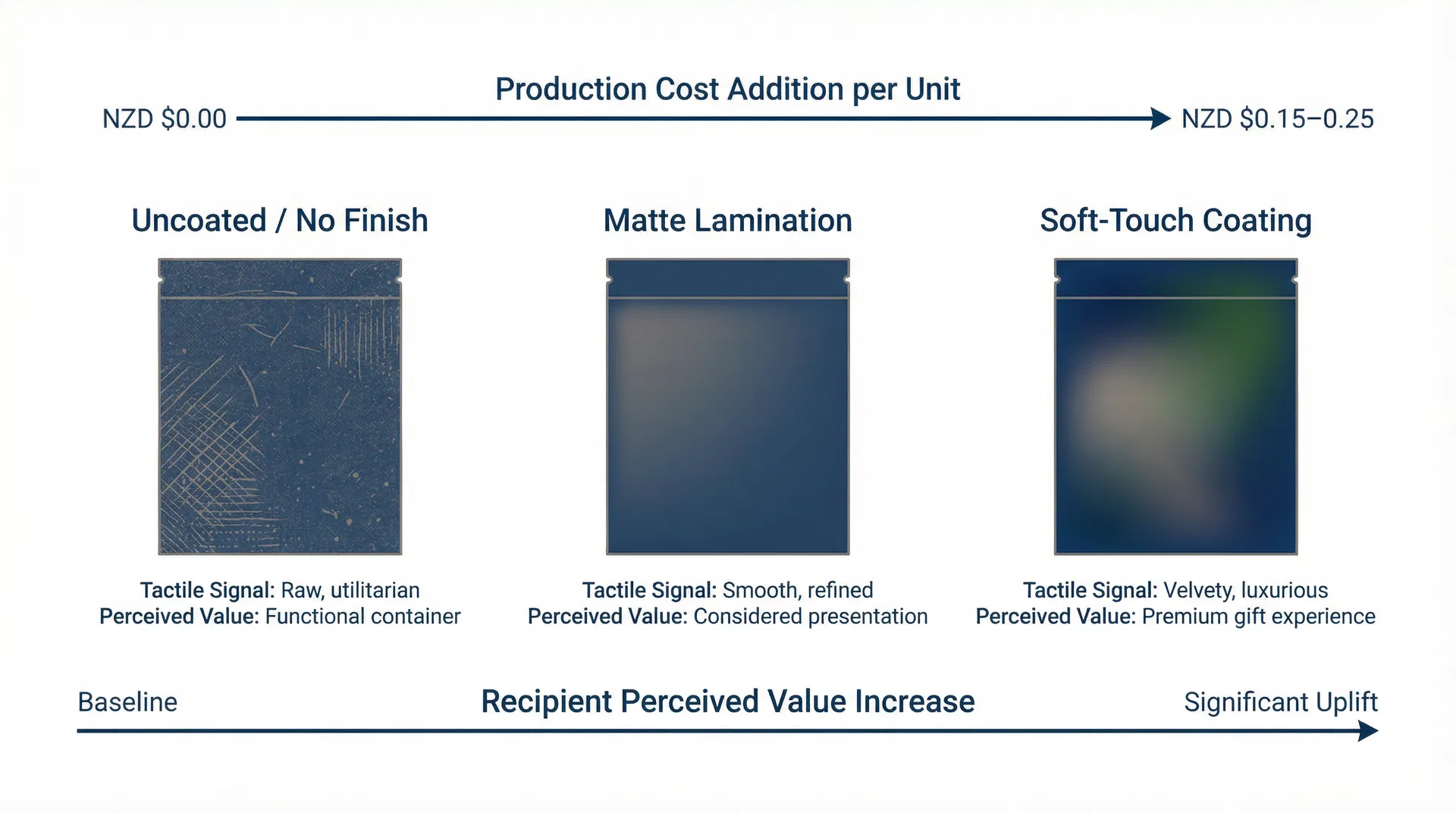
From the production floor, the dynamics of surface finish specification follow a pattern that repeats across nearly every corporate gift bag order where budgets are reviewed mid-process. The initial specification includes a surface treatment—typically matte lamination for paper-based bags or a soft-touch coating for coated materials. The production estimate is prepared with this treatment included. At some point between quotation and production confirmation, the total order cost is reviewed against the approved budget, and the surface finish line item is identified as the most removable cost element. The logic is straightforward: removing the lamination does not change the bag’s appearance in photographs, does not alter the logo’s visibility, does not affect the bag’s structural dimensions, and does not require redesigning any other element. It simply removes a step from the production process and reduces the per-unit cost by what appears to be a modest amount—typically NZD 0.08 to NZD 0.25 per unit depending on the bag size and the treatment type. On a 500-unit order, that saving is NZD 40 to NZD 125. The saving is real, but what it purchases is a bag that feels different in the hand from the bag that was approved in the sample stage, and that tactile difference is what the recipient encounters first.
The specific surface treatments available for custom corporate gift bags each create a distinct tactile signature, and understanding what each treatment communicates is essential to understanding why the specification matters. An uncoated cotton canvas bag has a natural, slightly rough texture that communicates authenticity and environmental consciousness—appropriate for brands positioning around sustainability and craft. A matte-laminated paper gift bag has a smooth, non-reflective surface that absorbs light and feels substantial in the hand, communicating understated sophistication. A gloss-laminated bag reflects light and feels slick, communicating energy and retail polish—which is precisely why it reads as retail packaging rather than gift packaging in a corporate context. A soft-touch lamination creates a velvety, almost suede-like surface that triggers a tactile pleasure response and communicates premium positioning. Research from the graphic communications field has demonstrated that consumers prefer soft-touch coatings over uncoated surfaces and are willing to accept a price premium for products presented in soft-touch packaging, specifically because the tactile experience elevates the perceived value of the contents. The surface finish is not decorating the bag. It is calibrating the recipient’s value expectation before they open it.
The production timing of surface treatment creates a vulnerability that procurement teams rarely anticipate. Because lamination and coating are post-print processes, they are scheduled after the printing run is complete. If the printing run encounters delays—colour matching issues, ink adhesion problems on a new material batch, or equipment scheduling conflicts—the surface treatment step absorbs the schedule compression. A production timeline that allocated two days for lamination may be compressed to one day, or the lamination may be skipped entirely if the shipping deadline cannot be moved. The factory’s calculation is rational: delivering unlaminated bags on time is preferable to delivering laminated bags late, because the client’s event date is fixed and the surface finish is the element least likely to trigger a rejection at incoming inspection. This calculation is correct from a logistics perspective but produces bags that feel noticeably different from the approved sample, and the difference is one that recipients register even if the procurement team does not. A bag that was approved with matte lamination and delivered without it will feel thinner, less substantial, and more prone to surface marking from handling during distribution. The visual appearance may be nearly identical, but the haptic experience is fundamentally altered.
Embossing represents a surface treatment category that operates differently from lamination because it modifies the bag’s physical structure rather than applying a coating layer. A debossed logo—pressed into the bag’s surface to create an indentation—creates a tactile brand mark that the recipient can feel with their fingertips. This is significant in the context of corporate gifting because it transforms the logo from a visual element into a multi-sensory element: the recipient sees the logo and feels it simultaneously, which creates a stronger memory encoding than either sensation alone. Blind embossing—debossing without ink, so the logo is visible only as a shadow created by the indentation—is particularly effective on corporate gift bags because it communicates restraint and craftsmanship. The logo is present but not assertive, discoverable rather than displayed, which aligns with the gift-giving dynamic where brand presence should be felt rather than announced. The production cost of embossing includes a one-time tooling charge for the embossing die (typically NZD 150 to NZD 400 depending on the logo’s complexity and the die size) plus a per-unit embossing charge of NZD 0.15 to NZD 0.40. The tooling charge is amortised across the order quantity, making embossing more cost-effective on larger orders, but even on a 200-unit order the per-unit total (tooling plus embossing) is typically under NZD 2.50—a cost that is modest relative to the bag’s total unit cost but that creates a tactile brand experience no other specification element can replicate.
The interaction between surface finish and the other specification elements that shape corporate gift bag perception reveals why finish cannot be evaluated in isolation. A bag’s fabric weight—the subject of earlier analysis in this series—communicates substance and investment through the recipient’s sense of heft. But the surface finish determines how that weight is interpreted. A heavy cotton canvas bag with no surface treatment feels robust and utilitarian—appropriate for a reusable shopping tote. The same heavy cotton canvas bag with a light matte coating feels structured and intentional—appropriate for a corporate gift. The weight is identical, but the surface finish reframes the weight from functional to presentational. Similarly, the colour palette’s emotional register is modulated by the surface finish: a deep navy bag with a matte finish reads as formal and premium, while the same deep navy with a gloss finish reads as corporate and retail. The finish does not change the colour, but it changes the colour’s emotional temperature, and that temperature shift determines whether the bag registers as a gift vessel or a branded carrier.
In the New Zealand market specifically, the surface finish decision intersects with the growing expectation that corporate gifts should demonstrate environmental responsibility. Lamination—particularly plastic-based lamination such as BOPP (biaxially oriented polypropylene)—adds a non-recyclable layer to an otherwise recyclable or compostable bag. A paper gift bag that would be fully recyclable without lamination becomes a mixed-material item with lamination, which complicates its end-of-life processing in New Zealand’s municipal recycling systems. Procurement teams that specify lamination for tactile quality may inadvertently undermine the sustainability narrative that the bag’s material was chosen to support. The resolution is not to eliminate surface treatment but to specify treatments that are compatible with the bag’s end-of-life pathway. Water-based matte coatings provide a smooth, refined surface feel without adding a plastic film layer, maintaining the bag’s recyclability while elevating its tactile quality. Aqueous soft-touch coatings achieve a similar velvety feel to BOPP soft-touch lamination but are water-based and do not interfere with paper recycling processes. These alternatives cost marginally more than standard lamination—typically NZD 0.03 to NZD 0.08 per unit additional—but they resolve the contradiction between specifying a sustainable material and applying a non-sustainable finish.
The pattern that emerges when reviewing corporate gift bag programmes where surface finish was specified versus where it was omitted or cut during cost review is consistent: bags with intentional surface treatment are described by recipients using qualitative language—“it felt premium,” “the bag itself was beautiful,” “you could tell it was quality”—while bags without surface treatment are described in functional terms—“it was a nice bag,” “good size,” “sturdy.” The qualitative descriptions indicate that the recipient processed the bag as an object with aesthetic value, which is the processing mode that leads to retention and reuse. The functional descriptions indicate that the recipient processed the bag as a container, which is the processing mode that leads to disposal after the contents are removed. The surface finish did not change the bag’s function, its durability, or its capacity. It changed the perceptual category the recipient assigned to it, and that category assignment—aesthetic object versus functional container—is what determines the bag’s lifespan and, by extension, the duration of the brand impression it generates.
For procurement teams evaluating which corporate gift formats best serve their specific business relationship objectives, the surface finish specification deserves to be understood as the bridge between the bag’s production identity and its recipient identity. In production, the surface finish is the last step—an additive layer applied to a completed bag. In reception, the surface finish is the first step—the initial sensory data point that the recipient’s nervous system processes before conscious evaluation begins. This inversion means that the element treated as least essential in the production sequence is most influential in the reception sequence, and the procurement team that recognises this inversion will protect the surface finish specification when budgets are reviewed rather than sacrificing it. The cost of a matte coating or a soft-touch lamination is measured in cents per unit. The cost of its absence is measured in the difference between a recipient who remembers the bag as a gift and one who remembers it as packaging—and that difference determines whether the corporate gifting programme achieved its relational objective or merely its logistical one.