Procurement Strategy
Why Volume Commitments Don't Always Secure the Flexibility Buyers Expect for Custom Promotional Bags
Annual volume commitments for custom promotional bags often lock in buyer obligations while leaving supplier delivery flexibility ambiguous—a structural gap that surfaces only when schedules need to change.
Published · By Sarah Mitchell
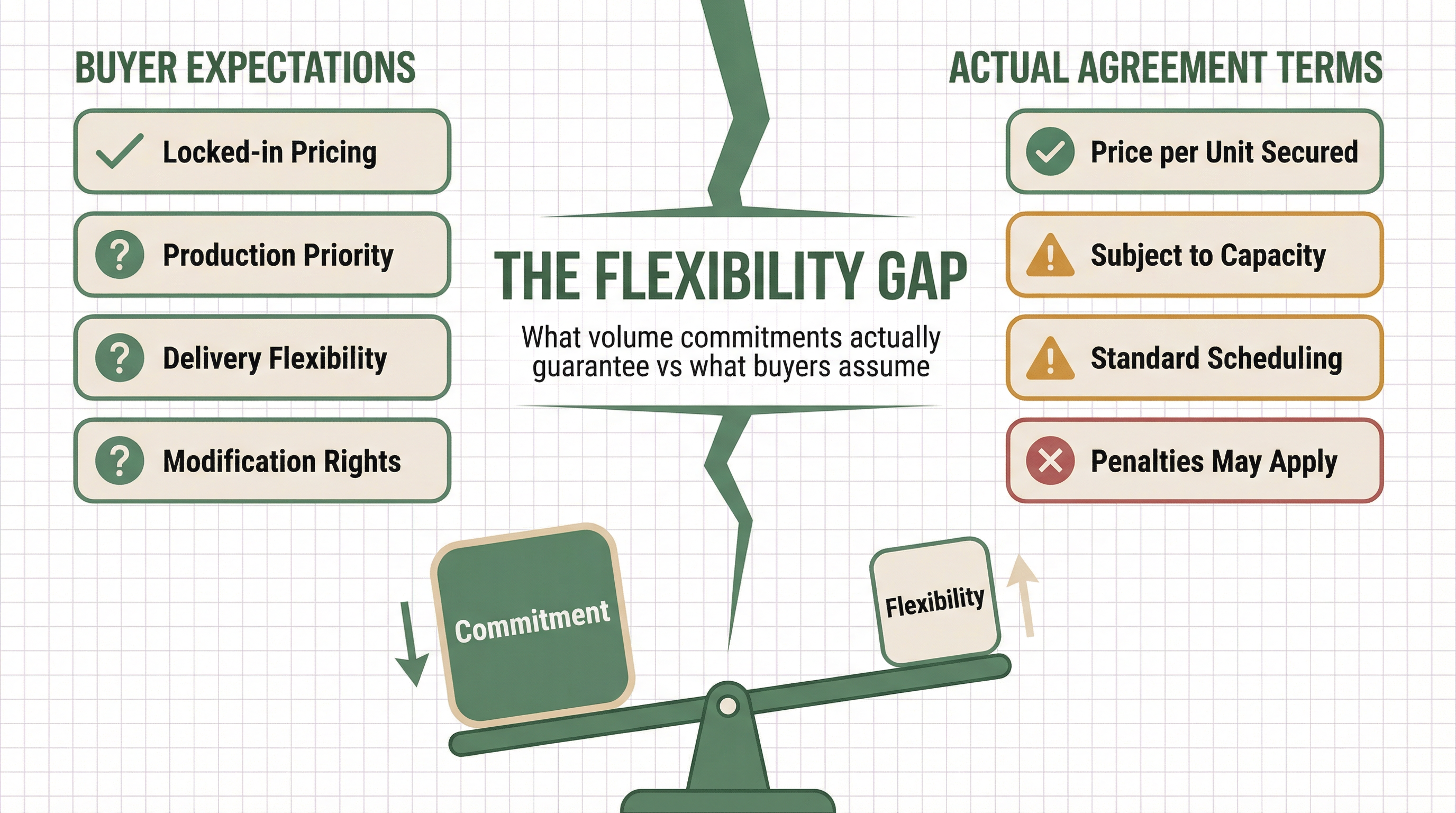
The conversation typically begins with a procurement team seeking to secure favourable pricing for the coming year's promotional bag requirements. The supplier offers a tiered structure: commit to 5,000 units annually and the per-unit price drops by 12 percent compared to ad-hoc ordering. The procurement team signs the agreement, expecting that this commitment will not only lock in pricing but also guarantee production priority and delivery flexibility throughout the year. What often happens in practice is that the commitment locks in the buyer's obligation to purchase while leaving the supplier's delivery obligations surprisingly ambiguous.
This structural asymmetry in volume commitment agreements represents one of the more persistent blind spots in promotional merchandise procurement. The buyer commits to a total annual quantity, believing this secures a partnership-level relationship with corresponding benefits. The supplier accepts the commitment, knowing that production scheduling, material availability, and capacity allocation will still be managed according to their operational priorities rather than the buyer's delivery preferences.
The gap between expectation and reality typically surfaces when the buyer needs to adjust delivery timing. A marketing campaign shifts by six weeks, requiring the second batch of custom canvas totes to arrive earlier than originally planned. The procurement team contacts the supplier expecting accommodation—after all, they committed to 5,000 units for the year. The supplier responds that the revised delivery date falls during a peak production period and cannot be accommodated without expedite fees. The volume commitment, it turns out, secured pricing but not scheduling priority.
In practice, this is often where decisions around annual volume arrangements start to be misjudged. The procurement approval process focuses on the per-unit savings from the volume commitment while treating delivery flexibility as an assumed benefit that comes with the relationship. The problem is that delivery flexibility is rarely specified in volume commitment agreements, and suppliers have legitimate operational reasons for maintaining scheduling discretion regardless of annual commitments.
Understanding how suppliers actually manage production capacity illuminates why volume commitments don't automatically translate to delivery flexibility. A factory running custom promotional bag production operates with finite capacity that must be allocated across multiple customers with competing deadlines. An annual volume commitment from one customer represents a revenue forecast, not a capacity reservation. The supplier will honour the commitment by producing the agreed quantity over the year, but the specific timing of each production run remains subject to overall capacity management.
The distinction between revenue commitment and capacity reservation is critical. A buyer who commits to 5,000 units annually has secured pricing and guaranteed that the supplier will accept their orders up to that quantity. What they have not secured is the right to dictate when those orders will be produced relative to other customers' orders. A customer placing a larger single order with a tight deadline may receive production priority over a volume-committed customer whose delivery date is more flexible—even if the volume-committed customer has been a partner for years.
This dynamic becomes particularly problematic for custom branded products where production cannot begin until artwork is approved and materials are confirmed. A volume commitment for custom promotional bags typically covers the total quantity and per-unit price, but each actual order within that commitment still requires the standard production workflow: artwork approval, material confirmation, production scheduling, and quality inspection. The volume commitment does not bypass these steps or guarantee faster processing through them.
The flexibility illusion extends to modification and cancellation terms. Procurement teams often assume that a volume commitment provides flexibility to adjust quantities or specifications as business needs evolve. In practice, most volume commitment agreements include clauses that limit modifications or impose penalties for changes. A buyer who committed to 5,000 units but discovers midway through the year that they only need 3,500 may face cancellation fees, minimum purchase obligations, or forfeiture of the volume pricing tier for the units already delivered.
The connection to understanding how suppliers structure their minimum order requirements for custom bags provides important context here. MOQ structures reflect the supplier's production economics—setup costs, material minimums, and efficiency thresholds. Volume commitments operate on top of these structures rather than replacing them. A buyer with a 5,000-unit annual commitment still faces the same MOQ requirements for each individual order within that commitment. The volume commitment secures pricing; it does not eliminate the operational constraints that drive MOQ policies.
Some procurement teams attempt to address this by negotiating blanket orders with scheduled releases. The buyer commits to the annual volume and specifies a delivery schedule upfront: 1,000 units in March, 1,500 in June, 1,500 in September, and 1,000 in November. This approach provides more clarity than an open volume commitment, but it introduces its own rigidity. If business needs change and the September delivery needs to move to August, the buyer may find that the supplier has already allocated August capacity to other orders based on the original schedule.
The fundamental issue is that flexibility and commitment exist in tension. A supplier who guarantees delivery flexibility must maintain reserve capacity, which has a cost. A supplier who offers aggressive volume pricing is typically optimising for production efficiency, which requires predictable scheduling. Buyers cannot simultaneously secure the lowest possible pricing and maximum delivery flexibility—these objectives pull in opposite directions.
Experienced procurement teams address this by explicitly negotiating flexibility terms rather than assuming they come with the volume commitment. This might include specifying a window for delivery date adjustments without penalty, defining the process for order modifications, or establishing priority status for production scheduling. These terms have value, and suppliers may price them accordingly. A volume commitment with guaranteed 48-hour delivery date flexibility might carry a 3-5 percent premium over a commitment with standard scheduling terms.
The risk assessment for volume commitments should include scenario planning for what happens when flexibility is needed. If the marketing calendar shifts, can delivery dates be adjusted? If a campaign is cancelled, what are the financial implications? If a rebrand occurs midway through the commitment period, can specifications be modified? These questions rarely have satisfactory answers in standard volume commitment agreements, and the answers that do exist often favour the supplier's operational interests over the buyer's flexibility needs.
For custom promotional bags specifically, the flexibility constraints are amplified by the customisation itself. A volume commitment for generic stock bags might allow for delivery timing adjustments because the supplier can produce to inventory and ship from stock. A volume commitment for custom branded bags requires production-to-order, which means every delivery is subject to production scheduling constraints. The customisation that makes the bags valuable for branding purposes is the same characteristic that limits delivery flexibility.
The practical implication is that volume commitments should be evaluated primarily on their pricing benefits, with flexibility treated as a separate negotiation item rather than an assumed benefit. If delivery flexibility is critical to your operations, negotiate it explicitly and expect to pay for it. If pricing is the primary objective and delivery timing is predictable, a standard volume commitment may deliver the expected value. The misjudgment occurs when procurement teams expect both benefits from an agreement that only guarantees one.