Logistics
Why the Container Booking Window Determines Your Custom Cooler Bag Delivery Date More Than Production Speed
Container booking timelines operate on fixed schedules that production cannot influence. Factory PM perspective on the booking decision point that procurement teams frequently misjudge.
Published · By Marcus Chen
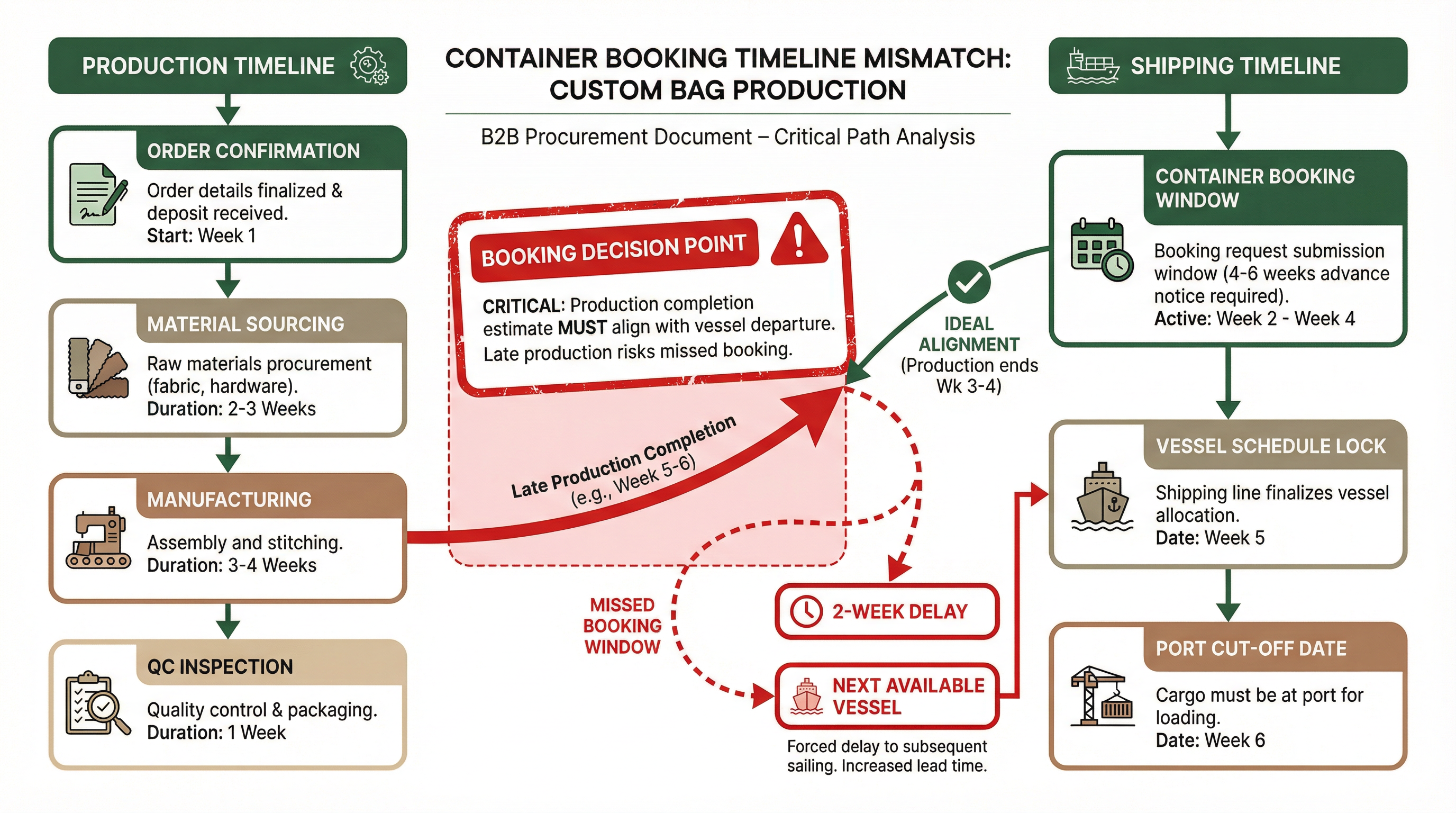
There is a timing dependency in custom cooler bag procurement that catches experienced buyers as often as first-time purchasers. The dependency exists because container booking operates on a fundamentally different calendar than production scheduling, and the two systems intersect at a decision point that most procurement timelines fail to identify.
The production side of the equation is familiar to anyone who has ordered custom merchandise. Material sourcing takes two to three weeks, manufacturing takes three to four weeks, quality inspection takes one week. These phases are sequential but somewhat flexible—a factory can sometimes compress manufacturing by adding shifts, or expedite material sourcing by paying premium prices. Production timelines respond, within limits, to urgency and budget.
The shipping side operates differently. Container booking windows are fixed periods during which cargo space on specific vessels becomes available for reservation. These windows typically open four to six weeks before vessel departure and close when capacity fills or when the port cut-off date approaches. Unlike production, shipping schedules cannot be compressed by paying more or working harder. A vessel departing Auckland on March 15th will depart on March 15th regardless of whether your cooler bags finished production on March 10th or March 20th.
In practice, this is often where production timeline decisions start to be misjudged. The booking decision point occurs when a procurement team must commit to a specific vessel departure based on estimated production completion. This decision typically must be made three to four weeks before the vessel sails, at a point when production is often still in progress and completion dates remain uncertain. Booking too early risks paying for container space that sits empty waiting for delayed production. Booking too late risks missing the vessel entirely and waiting two weeks or more for the next available departure.
The consequences of missing a booking window are more severe than many procurement teams anticipate. Vessel schedules from Asian manufacturing hubs to New Zealand operate on weekly or biweekly frequencies depending on the route. Missing the target vessel does not mean a one-day delay—it means waiting for the next scheduled departure, which may be seven to fourteen days later. For custom cooler bags ordered for a specific promotional campaign or seasonal event, this delay can transform a successful project into a missed deadline.
The port cut-off date adds another constraint that production schedules rarely account for. Cargo must arrive at the departure port and clear export documentation before this deadline, typically two to three days before vessel departure. This means production must complete, pass inspection, transport to port, and clear export formalities within a window that is shorter than the vessel departure date suggests. A cooler bag order that finishes production on the vessel departure date has already missed the shipment.
Container availability introduces a variable that fluctuates independently of both production and vessel schedules. During peak shipping seasons—typically September through November for pre-holiday inventory and January through March for post-holiday restocking—container space becomes scarce. Booking windows that normally remain open for weeks may fill within days. Premium rates for guaranteed space can increase shipping costs by 30 to 50 percent. For custom cooler bag orders with fixed delivery requirements, this scarcity can force difficult choices between delayed delivery and significantly higher logistics costs.
The practical implication is that production completion date and delivery date are connected by a shipping schedule that neither buyer nor factory controls. A factory that completes your cooler bag order two days after the booking window closes has not delivered two days late—they have delivered fourteen days late, because the next available vessel departs in two weeks. This discontinuity between production time and shipping time is where timeline calculations most frequently fail.
Experienced procurement teams address this dependency by working backward from vessel schedules rather than forward from order placement. The process begins with identifying the required delivery date in New Zealand, subtracting transit time and customs clearance, identifying the latest acceptable vessel departure, then subtracting the port cut-off buffer to establish the true production deadline. Only after this shipping-anchored deadline is established does production planning begin.
Buyers who have studied the complete picture of how long custom bag production actually takes understand that the booking decision point represents a commitment that production must then meet. The alternative approach—completing production first and then finding shipping—works only when delivery dates are flexible. For custom cooler bags with event deadlines or seasonal windows, the shipping schedule must anchor the entire project timeline.
The coordination challenge extends to communication between factory and freight forwarder. Production status updates must flow to the logistics team with sufficient lead time to adjust bookings if completion dates shift. A factory that reports production delays after the booking window closes has eliminated options that would have existed with earlier communication. The procurement team's role includes establishing these communication protocols before production begins, not discovering their absence when deadlines approach.
There is a particular pattern with insulated products like cooler bags that amplifies booking timing sensitivity. These items occupy more container volume per unit than flat-packed tote bags or foldable shoppers. A container that holds 8,000 cotton totes might hold only 3,000 cooler bags of similar value. This volume constraint means cooler bag orders are more sensitive to container availability and more likely to face space limitations during peak shipping periods. The booking window for bulky insulated products effectively closes earlier than for compact items competing for the same vessel space.
The financial dimension of booking timing extends beyond shipping rates. Missed delivery dates for promotional cooler bags can trigger penalty clauses, cancelled campaigns, or lost sales opportunities. The cost of air freight to recover from a missed vessel—typically five to ten times sea freight rates for the same cargo—often exceeds the original shipping budget entirely. These costs are avoidable, but only when the booking decision point is identified and managed as a critical milestone rather than an administrative detail handled after production completes.
For New Zealand buyers sourcing custom cooler bags from overseas manufacturers, the practical approach involves treating vessel departure dates as immovable constraints and building production schedules that deliver finished goods to port with buffer time before cut-off. This reversal of typical planning logic—shipping first, production second—reflects the operational reality that production timelines have some flexibility while shipping schedules have none. The buyers who consistently meet delivery dates are those who understood this dependency before placing their orders, not those who discovered it when their cooler bags sat in a warehouse waiting for the next available vessel.