Logistics
Why LCL Consolidation Creates Hidden Waiting Periods for Custom Canvas Bags That Quotes Never Mention
LCL shipping quotes show transit time but omit the consolidation waiting period at both origin and destination. Procurement perspective on the timeline gap that makes LCL deliveries consistently later than expected.
Published · By David Thornton
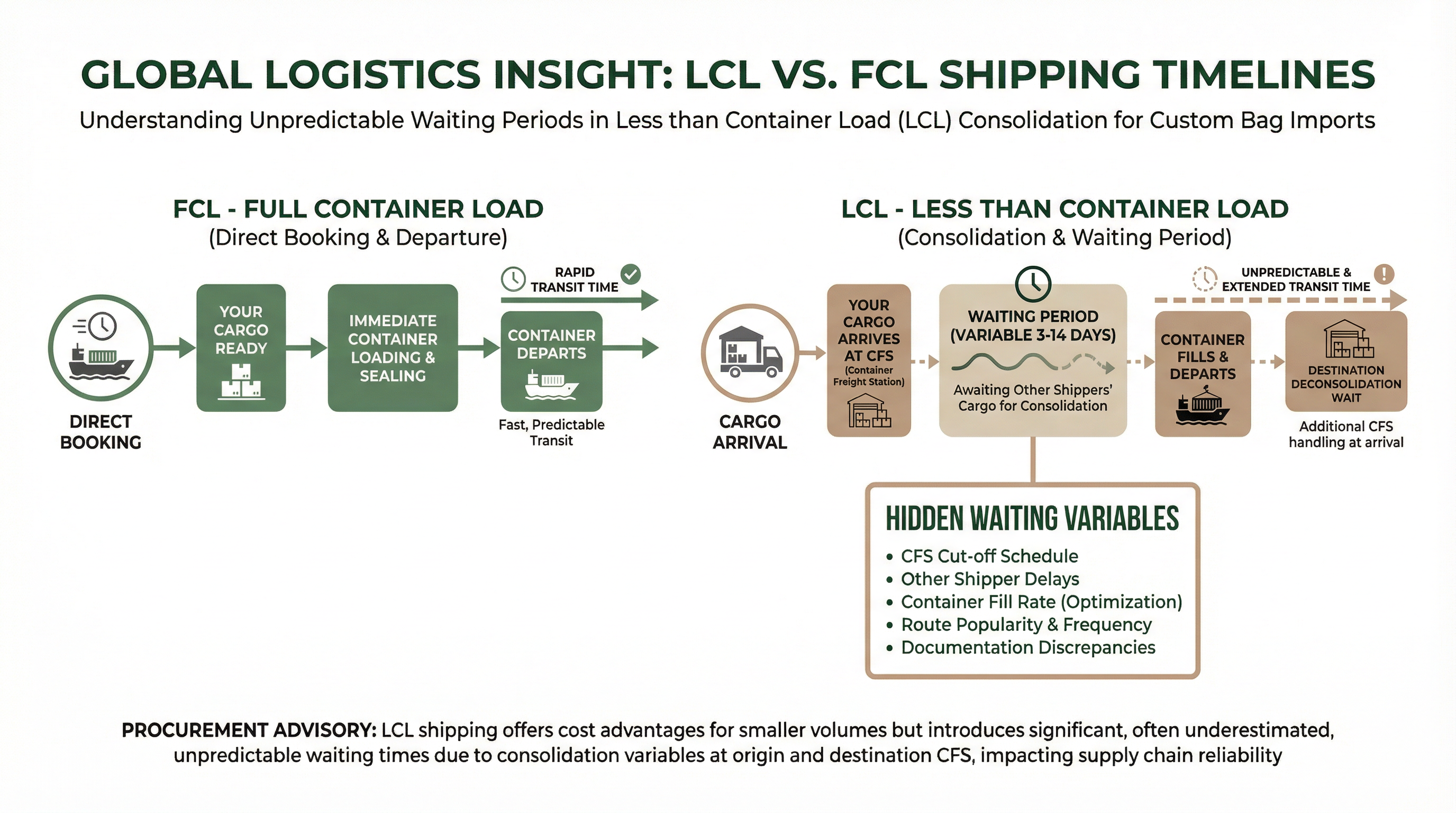
There is a specific pattern in custom canvas bag procurement that I encounter repeatedly when reviewing shipping timelines with clients. The pattern involves LCL shipments—Less than Container Load—and the consistent gap between quoted transit times and actual delivery dates. This gap exists because LCL quotes communicate ocean transit duration while omitting the consolidation and deconsolidation periods that bookend the voyage, and these omitted periods routinely add one to three weeks to the total timeline.
The mechanics of LCL shipping create waiting periods that FCL shipments do not experience. When a custom canvas bag order does not fill an entire container—and most orders below 3,000 to 5,000 units fall into this category—the cargo must be consolidated with shipments from other buyers to fill a container before departure. This consolidation happens at a Container Freight Station, where your finished bags wait alongside cargo from other shippers until the consolidator accumulates enough volume to justify sealing and dispatching a container.
In practice, this is often where production timeline decisions start to be misjudged. The waiting period at the origin CFS depends entirely on factors outside your control or your supplier's control. How quickly are other shippers delivering their cargo to the same consolidation point? Is the route popular enough to fill containers weekly, or does the consolidator wait for biweekly or monthly sailings? Did another shipper's documentation problems delay the container's departure after your cargo was already loaded? These variables determine whether your canvas bags wait three days or three weeks at the origin CFS, and none of them appear in the shipping quote.
The CFS cut-off schedule introduces another timing constraint that procurement teams rarely factor into their planning. Consolidators operate on fixed schedules—cargo must arrive at the CFS by a specific date to make a particular sailing. Missing the cut-off by one day does not mean a one-day delay; it means waiting for the next consolidation cycle, which might be seven or fourteen days later depending on route frequency. A supplier who delivers your canvas bags to the CFS on Thursday when the cut-off was Wednesday has not caused a one-day delay—they have caused a week-long delay that compounds through the rest of the timeline.
The destination side mirrors these delays. When the container arrives at the New Zealand port, it must be transported to a deconsolidation CFS where your cargo is separated from the other shipments sharing the container. This deconsolidation process involves scheduling, physical handling, and documentation verification for each consignment. The timeline depends on CFS capacity, staffing levels, and the complexity of the other shipments in the same container. A container carrying straightforward cargo might be deconsolidated in two days; a container with multiple consignments requiring inspection or documentation review might take a week.
The route popularity factor deserves particular attention because it creates counterintuitive timing dynamics. High-volume routes—Shanghai to Auckland, for example—typically offer more frequent consolidation cycles, which reduces waiting time at origin. But these same routes experience higher congestion at destination CFS facilities, which can extend deconsolidation time. Lower-volume routes might have longer origin waiting periods but faster destination processing. The net effect on total transit time is difficult to predict and varies seasonally as shipping volumes fluctuate.
Buyers who have examined the complete picture of how long custom bag production actually takes understand that shipping mode selection affects more than freight cost—it fundamentally changes the predictability of the delivery timeline. FCL shipments, while more expensive for smaller orders, offer timeline certainty that LCL cannot match. The container departs when you book it to depart, arrives according to the vessel schedule, and clears customs as a single consignment. LCL shipments introduce waiting periods at both ends that transform a quoted three-week transit into a five-week or six-week actual delivery.
The cost calculation that drives LCL selection often ignores these timeline implications. A procurement team comparing a $2,500 LCL quote against a $4,500 FCL quote sees a $2,000 saving. What they may not see is that the LCL option adds two weeks of uncertainty to the delivery date, which may require earlier production starts, larger safety stock, or contingency planning for missed deadlines. The true cost of LCL includes these operational adjustments, not just the freight invoice.
The documentation complexity of LCL shipments amplifies delay risk. Each consignment in a consolidated container requires its own customs documentation, and a problem with any single consignment can delay the entire container's clearance. Your canvas bag documentation might be perfect, but if another shipper in the same container has a tariff classification dispute or a missing certificate of origin, the container sits in customs hold while the issue is resolved. This shared-risk characteristic of LCL shipping is rarely discussed during the booking process but becomes painfully apparent when delivery dates slip.
For custom canvas bag orders with firm delivery requirements, the practical approach involves adding consolidation buffers to quoted transit times rather than treating the quote as the complete timeline. A conservative estimate adds one week at origin and one week at destination to any LCL transit quote. For less frequent routes or peak shipping seasons, two weeks at each end provides more realistic planning. These buffers may seem excessive when the shipment moves quickly, but they prevent the scramble that occurs when consolidation delays push delivery past the deadline.
The alternative approach—shipping FCL despite not filling the container—makes economic sense when timeline certainty has measurable value. A promotional campaign with a fixed launch date, an event with non-negotiable setup requirements, or a retail commitment with penalty clauses all represent situations where the FCL premium buys schedule reliability that LCL cannot provide. The calculation is not simply freight cost versus freight cost; it is freight cost plus delay risk versus freight cost plus schedule certainty.
The uncomfortable reality is that LCL shipping quotes communicate incomplete information, and this incompleteness is structural rather than deceptive. Consolidators cannot predict how quickly other shippers will deliver cargo or how smoothly destination deconsolidation will proceed. They quote what they can control—the ocean transit—and leave the consolidation variables unstated. Procurement teams who treat these quotes as complete timelines will consistently experience deliveries that arrive later than planned, and the pattern will repeat until the planning process accounts for the waiting periods that quotes never mention.